

If you want your John Deere tractor running at its best, you’ve got to roll up your sleeves and learn all about John Deere tractor grease points. There might be small differences between models, but the basic rules stay the same. Let’s get into the details.
Lubricating Seat Slide Rails
The seat slide rails aren’t high-stress parts, but they directly affect riding comfort. For maintenance, just tip the seat forward to expose the metal sliding rails, then apply a thin coat of clean engine oil to them. Never use heavy grease—it easily collects dust and can cause the seat to jam instead. After oiling, slide the seat back and forth a few times to spread the oil evenly. This will make seat adjustments smooth and easy, and also prevent rust.
Three-Point Hitch Grease Points
The three-point hitch handles heavy lifting for all your attachments. It’s crucial for proper attachment operation and depth control. You’ll find one grease fitting (zerk) on the pivot point of each lift arm. Apply a few pumps of general-purpose grease here—this keeps the arms raising and lowering smoothly without binding, and eases strain on the hydraulic system. If your hitch has a top link or side links with pivot joints, check those for grease fittings too and lubricate them as needed.
Loader Grease Points
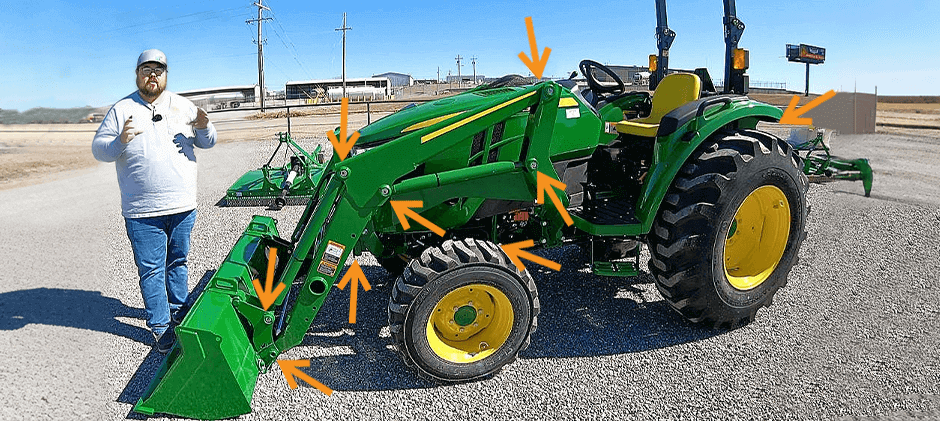
If your tractor is fitted with a front-end loader, it has the most grease points. The loader is frequently used as a moving attachment. Regular lubrication prevents wear of pins and bushings. Locations vary slightly by model, but the key grease points are often on both left and right sides as follows:
- Mounting frame: Where the loader connects to the tractor’s main frame, usually with two grease fittings on each side.
- Loader knuckle: Located in the middle of the loader arm, acting as its elbow with frequent movement, and usually fitted with two grease fittings.
- Cylinder ends: Every pin at both ends of the hydraulic cylinders (for lifting arms or curling the bucket) is equipped with a grease fitting and needs regular greasing.
- Quick attach coupler: The mechanism at the front of the loader. The levers and pins for changing attachments also need lubrication, otherwise they tend to seize up.
In total, there are over a dozen grease points just on the loader. These are critical areas that must be lubricated frequently, especially when the loader is under heavy load.
Front Axle Grease Points
The front axle bears heavy loads and controls steering. Its pivot points are under constant stress. Proper lubrication here is vital for responsive steering and longer component life.
Wheel Spindles and Bushings
Each front wheel pivots on a steering spindle. There is a grease fitting on the top of each spindle, and sometimes the bottom too. Greasing these points pushes grease into the bushings, making wheel turns smooth and easy. Some models, especially 4WD ones, may have an extra fitting for the wheel hub. Lubricating these parts stops the spindles from seizing up—a repair that’s both tough and costly.
Front Axle Pivot
The whole front axle pivots at the center, letting it move up and down over bumpy ground. This central pivot pin supports the tractor’s entire front end. There’s a single grease fitting here, usually in the middle of the axle on the front or rear side. Be sure to pump grease into this fitting until it seeps out of the pivot joint. This makes sure the entire bushing is coated and protected, preventing wear that causes a wobbly front end.
Lubricate Hydraulic Steering Cylinder
For tractors with power steering, hydraulic cylinders deliver the steering force. Each end of these cylinders has ball joints or pin-type pivots, which move as the wheels turn. There’s a grease fitting on each joint. Regular lubrication keeps the steering smooth and responsive.
Lubricate Steering Spindles (2WD Only)
On 2WD tractors, the rear wheels are usually the steering wheels. Like the front axle on other tractors, these rear steering spindles have pivot points that need lubrication. There’s a grease fitting on each spindle assembly. Keeping them greased is key for easy, precise steering, especially when moving in tight spaces.
Lubricate Rear Axle Pivot Pin
This is one of the most important grease points on a tractor, and also one that’s often overlooked. On many models, the rear axle pivots slightly to absorb frame stress. The grease fitting for this pivot pin is usually on the bottom of the rear axle housing, tucked between the frame rails. Out of sight, it’s easy to forget about. Skipping lubrication here can cause severe wear to the pin and axle housing, leading to a major repair. Pump grease into this fitting until it seeps out from both the front and rear of the axle casting.
These high-wear pivot points are serviced, but even with perfect maintenance, the bushings and pins will wear out eventually. If you notice excessive play in a joint, or a fitting that won’t take grease anymore, it’s a clear sign replacement is needed. Sourcing high-quality aftermarket John Deere parts is a smart way to control repair costs—they’re often just as durable as OEM parts, but cost a lot less.
Lubricate Rear Tie Rod
Tie rods connect the steering spindles and make sure the wheels turn together. Each end of the tie rods has a ball joint, which needs lubrication to stand up to constant vibration and movement. There’s a grease fitting on each tie rod end. Skipping the lubrication will cause loose steering and early failure of the tie rod ends.
Lubricate Hydrostatic Linkage
If your tractor has a hydrostatic transmission, the speed and direction control pedals connect to the transmission through a set of linkages. There’s usually a key pivot point on these linkages with a grease fitting. It may be under a small service hatch on the operator’s platform. Keeping this point greased ensures smooth, precise control of the tractor’s movement.
Lubricate Engine Drive Shaft
The drive shaft sends power from the engine to the transmission and axles. It uses universal joints (U-joints) to adjust for angle changes. Inside these U-joints are tiny needle bearings that need lubrication. There’s a small grease fitting on each U-joint body. You must pump grease into the fitting until fresh grease seeps out of all four bearing caps. This is the only way to make sure the joint is fully lubricated. A dry U-joint will fail fast, causing strong vibration and even serious damage.
Lubricate Brake Pedal Linkage
The brake pedals also use pivot points that can rust and bind over time. Grease fittings are located on the linkage under the operator’s platform. A quick shot of grease keeps the pedals moving freely and helps them return smoothly to their original position without sticking.
Maintenance Frequency and Usage
The manufacturer’s recommendation, usually found in the operator’s manual, for John Deere tractor grease points is often every 50 hours of operation. This is only a baseline. Your actual lubrication schedule should match how the machine is used and the conditions it works in.
- Heavy use: For constant, heavy loader work, grease the loader and front axle points every 10–20 hours.
- Wet or muddy conditions: When working in wet, muddy, or snowy conditions, grease the machine after each use to push out water and contaminants from the joints.
- Dusty conditions: Fine dust acts like sandpaper inside pivot points. More frequent greasing helps flush out this abrasive material.
Conclusion
Knowing all John Deere tractor grease points and methods is crucial not only for their immediate performance but also for extending their lifespan. With this guide, you can easily maintain your tractor in excellent condition and keep it ready for fieldwork at any time. For reliable maintenance and repairs, get your John Deere parts from FridayParts—quality parts that help keep your equipment running strong.
