

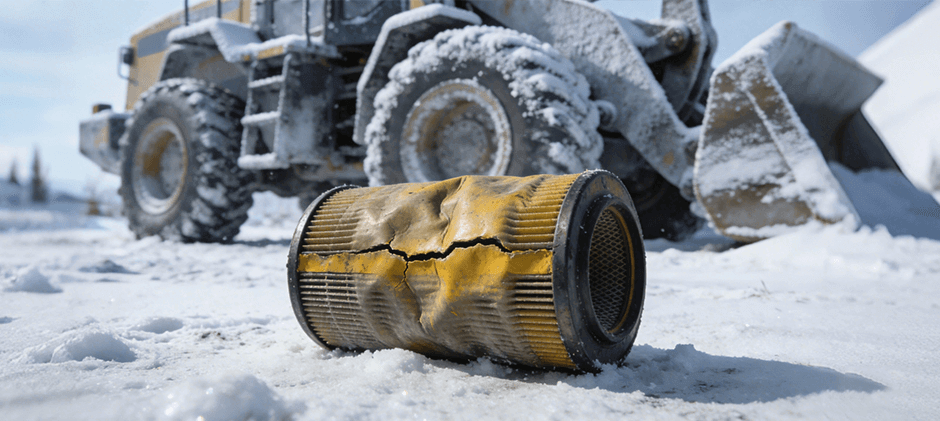
Ever found a burst or swollen oil filter and blamed a manufacturing defect? Most heavy equipment owners do. However, it is not the fault of the oil filter itself. It is the first few seconds of a cold start. This article walks through why your oil filter fails during cold starts and how to prevent it.
What Is A Cold Start
A cold start is commonly associated with winter. But it doesn’t happen just in cold weather. It also happens any time you start an engine at low oil temperature after long shutdowns. This process can lead to high starting pressure, poor oil circulation and premature engine wear. But its most dramatic victim can be the oil filter.
5 Truths Why Cold Start Destroys Your Oil Filter
No. 1 Rising Oil Viscosity Is to Blame
Increased oil viscosity is the root of the oil filter failure. As the temperature drops, oil quickly gets colder and thicker. In this state, oil can’t flow freely and strongly resists movement. It is hard for the cold oil to go through the tiny pores in your filter.
No. 2 Oil Pump Makes Matters Worse
If your oil pump is a positive-displacement gear pump, it is even worse. The gear pump is designed to move a fixed volume of oil with every single rotation, regardless of the resistance. When the thick oil blocks the filter, the pump won’t stop working. It simply builds pressure inside the filter until some parts yield. That’s not a gradual increase. It is a pressure spike from a normal 40-60 PSI to over 300 PSI. Your oil filter is then to take that massive hit.
No.3 Bypass Valve Also Plays A Part
There’s a bypass valve inside an oil filter. It is a safety component that opens when oil pressure is extremely high. A cold start can test your bypass valve. If the valve opens and lets oil bypass the filter during the cold start, your engine will get lubricated and won’t starve for oil. Yet, if the valve fails due to debris, the immense pressure from the oil pump has nowhere to go. Then, the filter canister fails and you get a swollen or burst oil filter.
No. 4 Dashboard Gauge Can Be Misleading
You may rely on the oil pressure reading on the dashboard, yet it can sometimes fail you. In modern engines, the sensor is located on the main oil gallery and measures the pressure of the oil passing through it. If the bypass valve opens, unfiltered oil reaches the sensor and registers normal pressure. Your gauge will read normal, leaving you unaware that abrasive oil is damaging your engine. If the bypass valve sticks, pressure builds greatly. Due to little oil flow, your sensor reports low pressure only. You won’t notice the internal high pressure. In either case, your dashboard gauge fails to show you the real pressure and gives you no warning of the danger.
No. 5 Every Cold Start Adds Damage
An oil filter rarely fails just one cold start. It fails every few seconds of a cold start.
The repeated pressure spike weakens the housing and seals of your oil filter. This is why an oil filter has been working perfectly fine for its entire service life but can suddenly fail without warning.
How to Prevent Cold Start Oil Filter Failure
To protect your oil filter engine, consider the following practices.
Use the Right Engine Oil
High oil viscosity is one of the major causes of a faulty oil filter. In cold weather, oil gets thicker and resists flowing. Choosing the right oil can help prevent gelling and maintain consistent performance. You can use winter-grade oil or synthetic oil that flows more easily in cold months. It can ensure your engine receives proper lubrication from the starting moment. Change oil if it is contaminated with water, debris or sludge, in case it should freeze or become viscous, thus blocking the oil filter.
Preheat Your Engine
When you don’t use your heavy-duty equipment, park it in a garage to maintain a higher temperature and minimize the impacts of cold starting. In very cold places like Northern Michigan, using an engine block heater can help keep the oil and engine warmer, reducing the strains on the lubrication system and the wear on critical parts.
Drive Gently After a Cold Start
Instead of idling for long periods, start driving slowly and avoid hard acceleration for the first few minutes. This helps warm up the engine gradually and reduces strain on mechanical parts.
Select Quality Oil Filters
While the extremely high pressure during a cold start is responsible for the burst oil filter, choosing high-quality oil filters is the last line of defense. Always look for oil filters with strong canisters, reliable bypass valves, durable seals and anti-drain back valves.
Invest in Good Batteries
If you live in a colder climate, have your battery tested before every cold morning to ensure it holds a proper charge. If your battery is weak, replace it with a high-capacity one. It ensures sufficient power for ignition in low temperatures. Regular battery maintenance is also essential to prevent cold-start-related issues.
Wrapping up
Oil filter failure is not usually the cause of manufacturing defects. It could result from extreme pressure spikes caused by thickened oil during a cold start. Using the proper oil, preheating your engine, and choosing reliable components are the keys to preventing costly damage. FridayParts offers an extensive selection of heavy-equipment parts, like oil filters, block heaters, oil pumps & relief valve and seals & gaskets. Explore our full range of solutions and fortify your engine against the challenges of every cold start.
