

A U.S. gallon of diesel fuel weighs about 6.9 to 7.1 lb (around 3.1 to 3.2 kg). This number can change a little. For off-road machinery owners, knowing why it changes helps you plan fuel use, avoid cold-weather problems, and keep your machine running smoothly.
Why Does the Weight of Diesel Fuel Matter?
Diesel weight is really about diesel density. Denser diesel usually means more energy in each gallon. That can mean:
- Your excavator/dozer/tractor runs a bit longer on the same amount of fuel,
- You may see slightly better fuel economy,
- Your cost per hour can be easier to manage.
It also helps with planning. Fuel is sold by volume (gallons/liters), not by weight. When diesel is less dense (often when it’s hot or blended for winter), you may get a little less energy per gallon.
What Are the 4 Key Factors That Change Diesel’s Weight?
Diesel weight changes mainly because density changes. These four factors are the most important.
1. How Does Temperature Affect Fuel Weight?
Temperature is the biggest day-to-day factor. Diesel acts like most liquids:
- Cold diesel = tighter and denser = heavier per gallon
- Warm diesel = expands and is less dense = lighter per gallon
Clear Statement: You usually get more energy per gallon when the diesel is cold than when it is warm. In some cases, the density difference between a cold winter morning and a hot summer afternoon can be noticeable.
Practical tip: Fueling during the cooler part of the day (like early morning) can help you get slightly more energy in every gallon.
2. What Are the Different Diesel Fuel Types?
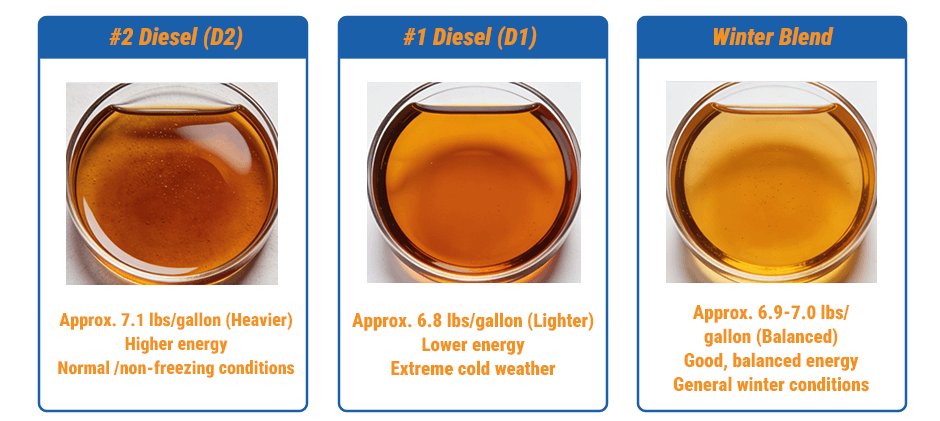
Diesel “type” matters, especially in winter.
- #2 Diesel (D2): The most common diesel. It is usually denser and has more energy per gallon. Good for normal conditions.
- #1 Diesel (D1): Often used in very cold weather. It is usually lighter and has less energy per gallon, but it helps reduce gelling.
- Winter Blend: A mix of #1 and #2. It is a balance: better cold performance than straight #2, but more energy than straight #1.
For off-road equipment, using the right seasonal fuel helps you avoid hard starts, fuel gelling, and downtime.
3. What Is API Gravity?
API Gravity is a standard way the fuel industry describes density.
- Higher API gravity = fuel is lighter (less dense)
- Lower API gravity = fuel is heavier (more dense)
You usually won’t see API gravity on the pump. But it helps explain why two batches of #2 diesel can still weigh slightly different amounts per gallon.
4. How Do Additives Impact Fuel Weight?
Diesel often includes additives (or gets additives added) to help with things like:
- anti-gel protection,
- cleaner injectors,
- better lubrication,
- easier starting.
Additives usually change fuel weight by only a tiny amount. Their bigger value is helping protect modern fuel systems (especially on newer emissions machines) and improving cold-weather reliability.
How Can You Ensure Your Machine Runs Efficiently?
Diesel density is only one piece of the story. Your machine also needs to burn fuel efficiently. Even good fuel can be wasted if the fuel system is not in good shape.
Common problems that waste fuel and reduce power:
- clogged fuel filters,
- worn injectors (poor spray pattern),
- weak fuel pumps (low pressure),
- dirty or contaminated fuel.
Regular checks and on-time maintenance help your machine:
- start easier,
- run smoother,
- use less fuel per hour,
- avoid jobsite downtime.
Summary
A gallon of diesel usually weighs 6.9–7.1 lb, and it changes mainly with temperature, fuel type, API gravity, and additives. To get the best real-world efficiency, keep your fuel system healthy—clean fuel and good parts matter. If you need dependable replacements, FridayParts carries key fuel-system categories like fuel filters, fuel injectors, and fuel pumps/lift pumps to help keep your off-road equipment running strong.
