

You’re usually searching for how to check hydraulic fluid on a New Holland tractor for one of three reasons: your hydraulics feel weak, you see a leak, or you’re doing routine service. This guide shows the safest way to check the hydraulic oil level, read the dipstick or sight glass correctly, and top off with the right fluid—so you don’t guess and don’t overfill.
When Should You Check Hydraulic Fluid Level?
- Check the hydraulic fluid level before work, not after problems get worse. Most owners do a quick check daily or weekly, depending on hours and job site conditions.
- Check it right away if anything feels different. Slow loader lift, jerky cylinders, or new whining noises are often the first signs.
- Check it after you change filters or fluid. The level can drop after the system fills hoses and cylinders again.
3 Common Symptoms of Low or Bad Hydraulic Fluid
- Low fluid often shows up as slow or weak hydraulics. The loader may lift slower, the 3‑point may hesitate, or functions may feel “lazy.”
- A whining or “howling” pump sound can mean the pump is sucking air. That can happen when the oil level is too low or the oil is foamy.
- Leaks are a common real-world reason the level is low. Look for wet hoses, loose fittings, cylinder rod seals, and oil around the rear housing.
How to Check the Hydraulic Fluid: The 6-Step Method
Step 1: What Is The Safest Way To Park Before Checking?
Park on level ground and secure the tractor. Flat ground is the difference between a correct reading and a false “low” reading.
Set the parking brake and chock wheels if needed. This matters even more if you’ll be near the tires or under the machine.
“Level ground first.” It’s the most common advice from experienced owners because it prevents wrong readings.
Step 2: What Should You Do With The Loader And 3‑Point Hitch?
Lower all hydraulic attachments fully to the ground. Put the loader down with the bucket flat, and drop the 3‑point hitch all the way.
Retract cylinders as much as you can. Oil trapped in extended cylinders can make the reservoir look low, and topping off in that moment can lead to overflow later.
Clear statement: If the loader is up, your oil-level check is not reliable.
Step 3: Should The Engine Be On Or Off?
Check with the engine off unless your operator’s manual says otherwise. Most “level checks” are done key-off after letting oil settle.
Check cold or warm consistently. Many owners prefer checking cold (first thing in the morning) because it’s repeatable.
Step 4: Where Is The Hydraulic Dipstick Or Sight Glass?
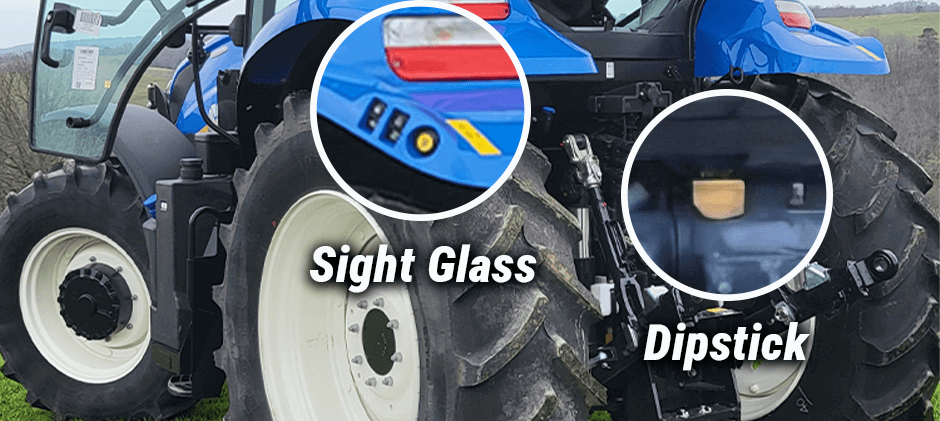
Find the correct checkpoint for your exact model. New Holland locations vary by series (Workmaster, PowerStar, T4/T5, etc.).
Look for one of these common setups:
- Dipstick + fill cap near the rear housing/transmission case
- Sight glass on the side of the rear housing
- Dipstick/fill plug combo (a plug that is both a level check and fill point on some models)
Step 5: How Do You Read A Dipstick The Right Way?
Wipe, insert, then read—don’t “read it dirty.” This simple habit prevents false readings.
- Clean dirt around the dipstick/fill area first.
- Pull the dipstick and wipe it clean.
- Insert the dipstick. (IMPORTANT: Check your manual to see if you should screw the cap all the way in or just rest it on the threads. Screwing it in when you shouldn’t will give a false “high” reading.)
- Pull it again and read the level between MIN and MAX.
Keep the level in the safe range, not necessarily at the very top. Overfilling can cause aeration/foaming and mess.
Step 6: How Do You Read A Sight Glass?
Clean the glass and read the oil line between marks. Dirty housing and dusty jobsites make sight glasses hard to see.
Use a flashlight to illuminate the glass. Do NOT try to rock the tractor to see the fluid move, as this is a safety/crush hazard.
What Fluid Should You Add?
Use the exact hydraulic/transmission fluid type your New Holland manual calls for. On many tractors, this is a Universal Tractor Fluid (UTF) that meets CNH/New Holland specs.
Do not mix unknown fluids if you can avoid it. Mixing different types can cause poor performance, brake chatter (on wet brakes), foaming, or seal issues.
Clear statement: If you’re not sure what’s in the tractor now, don’t gamble—confirm the spec before topping off.
When Should You Change Hydraulic Fluid?
Bad fluid can be “full” and still cause problems. Level is only one part of the story.
Common signs the hydraulic oil needs attention:
- Milky oil (often water contamination)
- Burnt smell or very dark oil (heat and breakdown)
- Visible grit/sludge (dirt contamination)
- Foamy oil (air in system, wrong fluid, overfill, suction leak)
Hours matter, but working conditions matter too. Mud, water, and extreme heat can shorten fluid life, so many owners check more often in tough seasons.
5 Tips To Avoid Low Hydraulic Fluid Problems
- Clean before you open anything. Dirt dropped into a fill tube can damage pumps and valves.
- Look for leaks where hoses rub. Chafing is common on off-road equipment because of vibration and tight routing.
- Recheck after you cycle functions. After topping off, start the tractor and slowly cycle loader/3‑point to purge air, then shut off the engine and wait a few minutes for the oil to settle before you recheck the level.
- Don’t overfill “just to be safe.” Too much oil can foam and cause just as many headaches as too little.
- Keep notes. A simple log of hours, how much you added, and when you changed filters helps spot slow leaks early.
When Should You Stop And Call a Pro?
- Call for help if the level drops again quickly. A fast drop usually means an active leak that needs repair now.
- Stop running if the oil is milky or full of metal. Continuing can turn a small issue into a pump or valve failure.
- Get help if you have a loud pump whine even with the correct level. That can point to a suction restriction, a clogged filter, or an air leak.
Summary
Checking hydraulic fluid on a New Holland tractor is simple when you do it on level ground with attachments lowered and the correct fluid spec. Read the dipstick or sight glass the right way, top off slowly, and never ignore contamination signs like milky or burnt-smelling oil.
If you’re fixing a leak, replacing a cap/seal, changing filters, or refreshing worn hydraulic components, FridayParts offers help. You can find what fits your model here: New Holland tractor parts.
