

When J1939 fault codes appear, downtime can be a real headache. The codes are often complicated, and if the issue isn’t fixed quickly, the lost time and money can be frustrating. But don’t worry — FridayParts has put together a simple guide to the most common fault codes to help you find and fix problems fast, so your machine can get back to peak performance in no time.
What Is a J1939 Fault Code?
J1939 is the standard system used in heavy‑duty machines to report problems to the operator. It’s like the language your machine uses to tell you something’s wrong.
Cars use a system called OBD‑II, but large equipment from Caterpillar, John Deere, Cummins, Volvo, and others uses SAE J1939 instead.
When something fails, the Engine Control Unit (ECU) sends a message through the CAN bus network. You’ll see the fault displayed as a number or message on your screen.
Think of J1939 as your machine’s nervous system — it shows you exactly where it hurts, so you can fix it fast.
How to Read SPN and FMI Numbers
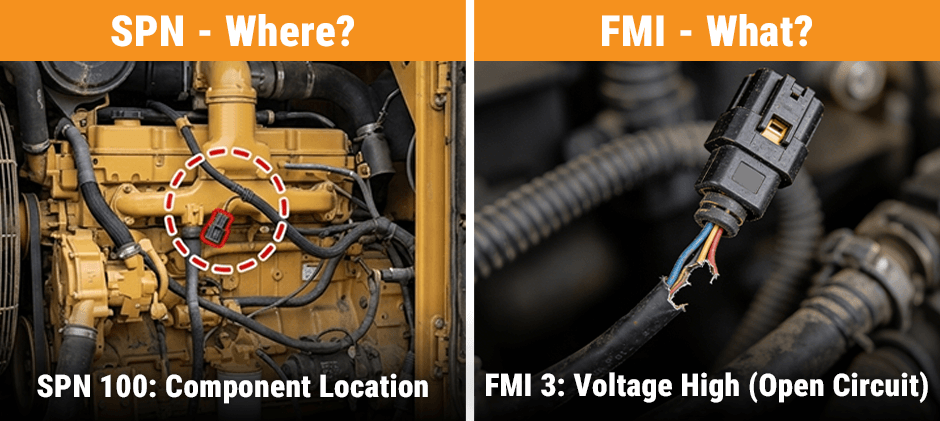
Each J1939 fault code has two parts:
- SPN (Suspect Parameter Number): Tells you which part has a problem. Example: Oil Pressure Sensor, Turbocharger.
- FMI (Failure Mode Identifier): Tells you what kind of problem it is. Example: Voltage too high, Signal missing, Data out of range.
Example:
SPN 100 FMI 3 means the Engine Oil Pressure Sensor has a Voltage Above Normal.
This usually means a loose wire or a bad sensor.
Top 9 Common J1939 Fault Codes (And How to Fix Them)
Here are the most common codes off‑road owners see, grouped by system, with simple checks and repair tips.
1. Emissions & Aftertreatment System Codes (DEF / SCR / DPF)
Modern Tier 4 engines use many sensors to meet emission standards. These sensors often trigger “check engine” lights.
Outlet NOx Sensor – SPN 3226
- What it means: The sensor reading exhaust gases is giving false data or has failed internally.
- Symptoms: Engine derate (low power), warning lights.
- Fix: Check the wiring first. If the connector is tight, replace the NOx sensor. These sensors have a limited lifespan and often fail due to heat.
SCR Catalyst Conversion Efficiency – SPN 4364
- What it means: The ECU thinks the exhaust cleaning system isn’t working effectively.
- Symptoms: “Stop Engine” light, severe power loss.
- Fix: Check the DEF injector (doser) for white crystallization buildup. If the injector is clean, the Outlet NOx Sensor is likely sending inaccurate data (“drifting”) and needs replacement.
DEF Quality / Concentration SPN – 3364
- What it means: The DEF (Diesel Exhaust Fluid) sensor detects whether the fluid is diluted or not pure urea.
- Symptoms: Machine goes into “Limp Mode.”
- Fix: Drain and refill with fresh, known-good DEF. If the code stays active, the DEF Quality Sensor (often built into the DEF Tank Header / Sending Unit) has failed. You may need to replace the entire header assembly.
2. Critical Engine Sensor Codes
These protect your engine’s health. Ignoring them can lead to major damage.
Engine Oil Pressure – SPN 100
- What it means: Oil pressure is dangerously low, or the sensor circuit failed.
- Symptoms: Stop light on, gauge at zero or maxed out.
- Fix: Check oil level immediately. If the oil level is correct, the Oil Pressure Sensor is likely faulty.
Engine Coolant Temperature – SPN 110
- What it means: The engine is overheating, or the sensor is reporting a false high temperature.
- Symptoms: Overheat warning, fan running at max speed.
- Fix: Verify coolant levels and check for radiator debris. If the engine isn’t physically hot to the touch, replace the Coolant Temperature Sensor.
Intake Manifold Pressure (Boost) – SPN 102
- What it means: The turbo isn’t providing the expected boost pressure.
- Symptoms: Sluggish performance, black smoke, loss of power.
- Fix: Inspect air hoses and the Charge Air Cooler for leaks. If the plumbing is tight, the MAP Sensor (Manifold Absolute Pressure) has likely failed.
Fuel Delivery Pressure – SPN 94
- What it means: The low-pressure fuel system is out of spec.
- Symptoms: Hard starting, stalling, rough idle.
- Fix: Replace the fuel filters first. If that doesn’t help, check the lift pump or the Fuel Pressure Sensor.
3. Electrical & Control Codes
These codes usually point to power supply or wiring issues.
SPN 97 – Water in Fuel Indicator
- What it means: Water has accumulated in the fuel filter separator bowl.
- Symptoms: Amber warning light.
- Fix: Drain the water separator immediately. If the light stays on after draining, the Water‑in‑Fuel (WIF) Sensor is corroded and needs replacement.
SPN 168 – Battery Potential / Power Input
- What it means: The ECU detects that the voltage is too high (alternator issue) or too low (battery/wiring issue).
- Symptoms: Flickering lights, unstable gauges, and hard starts.
- Fix: Check battery terminals for corrosion.
For 12V systems: If the voltage exceeds 15V, the alternator regulator is bad.
For 24V systems: Normal charging is around 28V. If the voltage spikes above 30V, the alternator regulator is likely failing.
When Should You Replace a Part?
If you see these FMI codes, it is almost always an electrical circuit or sensor issue:
- FMI 3 (Voltage Above Normal): Usually means the signal wire is broken or disconnected (Open Circuit). The ECU sees max voltage because the sensor isn’t pulling it down.
- FMI 4 (Voltage Below Normal): Often means a Short to Ground.
Here’s what to do:
- Inspect the wiring: Look for broken wires, rub marks, or corrosion.
- Secure the plug: Make sure every connector clicks in firmly.
- Replace the sensor: If the wiring looks clean and tight, the sensor’s internal circuit has failed. Swapping it is the fastest way to clear the code.
Conclusion
With this guide, you no longer need to dig through endless lists of codes. From Emissions & Exhaust Systems to Electrical & Control Systems, you can quickly find the most common fault codes and fix issues with ease.
And if you need replacement parts for CAT, Cummins, John Deere, Volvo, or other major brands during the process, FridayParts is here to help you every step of the way.
