

Managing yard debris across expansive acreage requires more than standard residential tools; it demands a strategic approach to off-road machinery. We recognize that the struggle with heavy leaf fall, scattered twigs, and thick grass clippings can transform routine site maintenance into a grueling, multi-day operation. Clearing vast terrain efficiently is essential for any professional or property owner, but selecting the correct mechanical solution requires evaluating specific performance metrics. This article provides a technical comparison between a lawn sweeper and a bagger to help you determine which system will optimize your cleanup speed and minimize equipment downtime.
What Is a Lawn Sweeper?
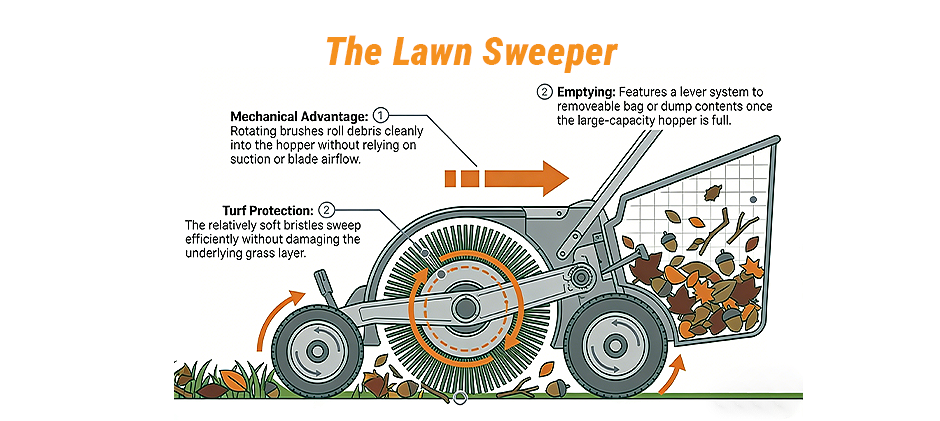
A lawn sweeper is a standalone mechanical implement designed to clear a broad range of debris, including leaves, twigs, grass clippings, and small stones. Unlike standard mowing equipment, it operates as a dedicated machine focused on collecting material rather than reducing turf.
The mechanical operation of a lawn sweeper relies on centrifugal force generated by a series of rotating brushes attached to a central axle. As the unit is propelled across the ground, the axle spins, causing the brushes to lift debris from the turf and propel it into a high-capacity collection hopper. The efficiency of this system is governed by the brush-to-ground contact ratio. If you set the brush height too high, debris stays on the surface; if you set it too low, you create parasitic drag and accelerate wear on the drive gears and bristles.
Lawn sweepers are generally categorized into three main configurations:
- Manual Push Sweepers: These utilize human-powered forward momentum and are suited for confined areas or light debris.
- Tow-Behind Models: Designed to be hitched to utility tractors or riding mowers, these units—often featuring 44-inch to 52-inch widths—are the industry standard for large acreage.
- Powered Versions: These models utilize independent gas or electric motors to drive the brush axle, ensuring high brush speeds regardless of the towing vehicle’s ground speed.
Expert Maintenance Tip: For optimal collection on damp or thick turf, calibrate your brush height so the bristles penetrate the grass canopy by approximately half an inch. This ensures maximum lift without putting undue stress on the axle bearings.
What Is a Lawn Bagger?
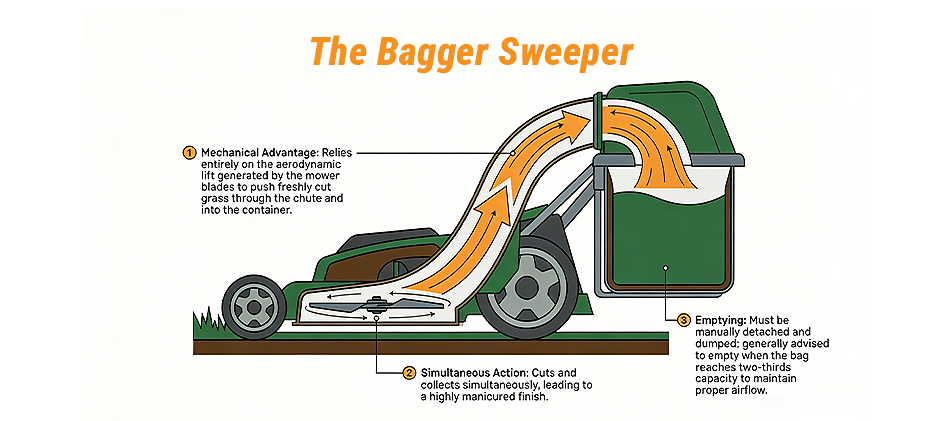
A lawn bagger integrates directly with your mower’s existing discharge system. Rather than operating as an independent machine, it functions as an extension of the mower’s cutting deck, utilizing the aerodynamic lift generated by the blades to transport material.
The bagger connects to the mower’s discharge chute, capturing clippings and light foliage immediately as they are cut. These systems vary in complexity and volume, ranging from basic dual-bag setups to high-capacity triple-bag systems found on zero-turn mowers and commercial tractors. Because the system relies on the mower’s internal airflow, its performance is directly linked to blade speed and deck design. The primary objective of a bagger is to achieve a professional, manicured finish by preventing thatch buildup and ensuring no organic material remains on the grass surface.
Lawn Sweeper vs. Bagger: What are the Pros and Cons?
Choosing between these two systems requires a deep dive into mechanical durability and the specific labor requirements of your terrain.
Lawn Sweeper Pros & Cons
Pros: The primary advantage of the lawn sweeper is its debris versatility. Because it employs mechanical brushes rather than pneumatic suction, it can recover “hard” debris that would damage or clog a bagger’s chute, such as pinecones, acorns, and small gravel. Additionally, a sweeper offers operational independence. You can clear a site without engaging the mower blades, which reduces fuel consumption and blade wear during autumn leaf collection or post-storm cleanup. Many heavy-duty models feature V-shaped bristles designed for enhanced durability and superior material pickup.
Cons: From a logistical perspective, lawn sweepers have a substantial storage footprint. Their wide brush housings and 26 cu. ft. hoppers require dedicated space in a machine shed. Furthermore, they encounter performance issues with saturated debris. Wet leaves can clump together, increasing the torque required to spin the brushes and potentially leading to gear slippage or belt failure.
Lawn Bagger Pros & Cons
Pros: The lawn bagger excels in operational efficiency through “one-pass” convenience. By integrating mowing and collection into a single task, you effectively halve the time spent in the field. This makes it an ideal accessory for high-visibility areas where a clean finish is the priority. Baggers are also exceptionally efficient at capturing fine clippings that brushes might occasionally bypass.
Cons: A primary concern with baggers is the substantial load they place on the prime mover. The weight of a full triple-bag system shifts the mower’s center of gravity rearward, which can compromise steering traction on the front wheels and increase the risk of tipping on steep gradients. Furthermore, the added mass increases the heat and stress on the mower’s drive belts and hydrostatic transmission, necessitating more frequent fluid and component checks.
Expert Takeaway: Always monitor your mower’s engine temperature when operating a full bagger on hills. The increased weight, combined with reduced airflow around the rear of the machine, can lead to thermal stress in the cooling system.
Lawn Sweepers vs. Baggers: Main Differences
Standalone Tool vs. Accessory
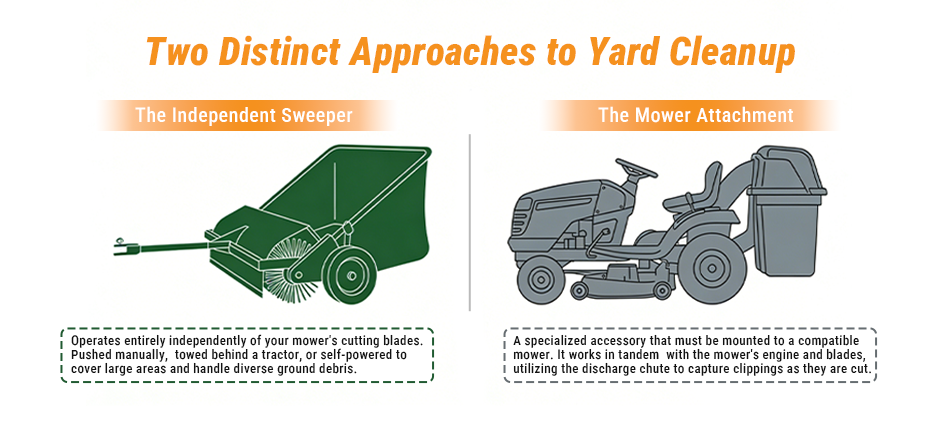
The fundamental difference lies in the machine’s architecture. A lawn sweeper is a dedicated piece of equipment with its own frame, wheels, and drive system. Any vehicle with a hitch can use the bagger. It lacks independent mobility and relies entirely on the mower’s engine and blade physics to function.
Debris Versatility and Collection Mechanics
Lawn sweepers utilize mechanical friction and centrifugal force to sweep material into a hopper. This makes them the superior choice for mixed-debris environments. Conversely, baggers rely on aerodynamic lift. While they are highly effective for grass and dry leaves, heavy objects like stones or thick twigs can puncture the fabric bags or crack the plastic discharge chutes, leading to a loss of vacuum pressure.
Operational Requirements and Ergonomics
While a bagger offers the convenience of “mow-and-go” operation, its smaller capacity leads to frequent stops. Emptying a bagger usually requires the operator to dismount and manually pull the bags from the frame. In contrast, many tow-behind sweepers feature a lever-action or rope-pull dumping mechanism. This allows the operator to empty the 25+ cubic feet of debris from the tractor seat, significantly reducing physical fatigue during long shifts.
Maintenance Realities
- Lawn Sweepers: These machines feature high mechanical complexity. They require a rigorous schedule of lubricating the wheel gears and axle bushings. To ensure structural integrity, operators should perform a comprehensive inspection of all bolts and fasteners every three months, as the vibration from off-road use can cause hardware to back out. Check brushes for wear patterns and replace them when the bristles lose their rigidity.
- Lawn Baggers: These require less mechanical maintenance but are susceptible to material fatigue. Fabric bags will eventually tear due to the abrasive nature of moving debris, and plastic chutes can develop stress fractures. The most critical maintenance task is ensuring the internal surfaces of the chute and bags are free of buildup to maintain the airflow necessary for transport.
How to Choose the Right One?
Selecting the correct implement involves matching the tool’s mechanical strengths to your landscape’s physical demands.
Acreage and Volume
For properties exceeding one or two acres, a high-capacity tow-behind sweeper is often the most productive choice. The ability to collect up to 26 cubic feet of material reduces the frequency of trips to the compost pile. For smaller, highly manicured plots, the bagger is more efficient because it eliminates the need for a second pass across the lawn.
Terrain and Maneuverability
The physical layout of the terrain is a deciding factor. Because sweepers rely on consistent ground contact for the brushes to spin, they perform best on flat or slightly uneven surfaces. If the terrain is excessively bumpy, the brushes may lose contact in depressions. Baggers, rigidly mounted on the mower, hold a fixed position relative to the ground and handle hills and undulations without losing collection efficiency.
Strategic Part Maintenance
Regardless of the tool you deploy, the reliability of your yard cleanup depends on the health of your primary machinery. A heavy tow-behind sweeper places significant torque requirements on the tractor’s transmission, while a full bagger stresses the engine and drive belts.
To maintain the efficiency of a mower used for these tasks, owners should regularly inspect their mower parts for signs of heat damage or wear. A sharp lawn mower blade is essential for the aerodynamic lift required by a bagger. Furthermore, consistent power delivery for both towing and cutting relies on a high-tension lawn mower belt and a reliable lawn mower spark plug. A fouled plug can cause engine hesitation precisely when the machine is under maximum load from a full hopper, leading to potential stalling and transmission strain.
Expert Maintenance Tip: When inspecting your equipment for the season, check the drive belt tensioner. A worn spring can cause the belt to slip under the high-torque demands of towing a weighted sweeper, resulting in glazed belts and loss of power.
Frequently Asked Questions
1. Can a sweeper handle wet leaves?
While heavy-duty sweepers can move damp material, they are not optimized for it. Wet, heavy leaves stick to the bristles, causing clogging and raising drive-gear resistance
2. Are baggers universal?
No. Bagger compatibility is strictly tied to the mower’s deck size and mounting points. Verify your mower’s model first—ensure the discharge chute matches its aerodynamic profile for reliable material transport.
3. Do sweepers damage grass?
When adjusted correctly, sweepers are safe for all turf types. Firm bristles lift stones, yet stay gentle—avoiding soil scarring and protecting grass roots.
Summary
FridayParts supplies premium aftermarket parts at affordable prices, so you keep your machinery in peak condition. With our vast inventory and wide compatibility, you can get mower components for years, powerful and efficient.
