

On Nissan industrial equipment—commonly Nissan forklifts—the master warning light is a general alert that typically means there’s a system warning or fault requiring attention. The real clue is found in the display indicators, code, or warning pattern, depending on the model.
A 3-Step Preparation
- Check for critical warnings (oil pressure, coolant temp, charging).
- Read any on-screen message or note any fault indicator pattern.
- If critical: stop safely. If advisory: proceed carefully and schedule diagnosis.
Stop immediately if there’s:
- Oil pressure warning, overheating, strong burning smell, smoke, or abnormal mechanical noise.
5 Common Causes for the Master Warning Light
- Low voltage/charging system issues (battery, alternator, poor ground)
- Cooling system/airflow restriction (radiator blocked by dust/debris, fan issues)
- Engine sensor/circuit problems (temp/pressure sensors, loose connectors)
- Maintenance-related alerts (filters, service intervals)
- Interlock/safety inputs (seat/safety switches on some configurations)
4 Quick Checks to Identify the Problem
- Inspect battery terminals and ground strap for corrosion/looseness.
- Look for radiator/cooler blockage and restore airflow.
- Verify coolant and engine oil levels.
- Visually inspect wiring near heat/vibration points for rubbing or broken clips.
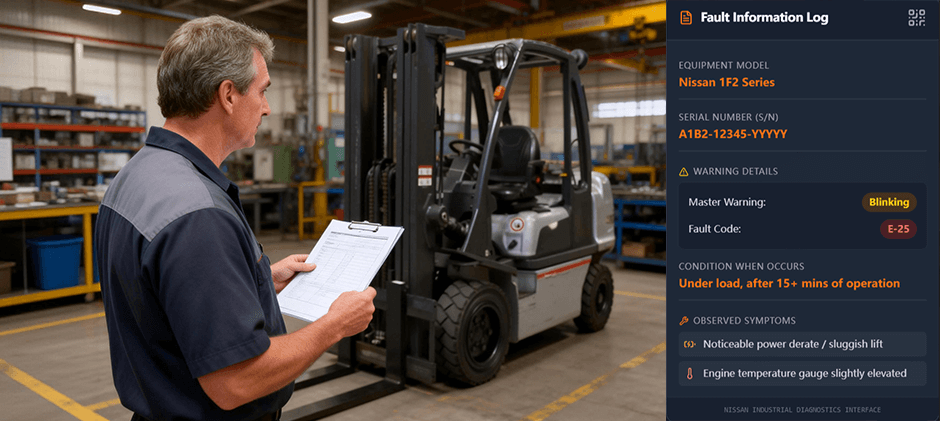
What Information Should You Record?
- Model + serial number
- Master warning behavior (steady/blink)
- Any code/message text
- When it occurs (cold start vs warm, under load, after long idle, etc.)
- Symptoms (derate, stall, overheating, starting difficulty)
What Parts Commonly Fix the Issue?
- Charging: alternator/regulator, battery cables, relays/fuses
- Sensors: coolant temp sensor, pressure sensors, related connectors/pigtails
- Maintenance: air/oil/fuel filters (as applicable)
- Switches: safety/seat switches or interlock switches (model dependent)
Frequently Asked Questions
Q: The master warning light comes on and off—what does that suggest?
A: Often an intermittent electrical connection, borderline voltage/charging, or a sensor signal that occasionally goes out of range.
Q: Should I clear the warning and ignore it if the forklift runs fine?
A: Avoid relying on clearing. If it returns, capture the details and fix the cause to prevent unexpected downtime.
Conclusion
Master warning light Nissan generally means “there’s an active warning—check the display/indicators for specifics.” The best approach is to identify the companion warning, capture any code/message, and verify basics like charging health, airflow/cooling, fluids, and obvious wiring issues. If the warning repeats, it’s a strong sign the underlying fault still exists.
For parts commonly required to solve recurring master warning light problems—alternators, sensors, switches, relays, wiring connectors, and filters—choose FridayParts to source the right components for your Nissan model/serial and reduce repeat failures.
