

In order to keep the engine running smoothly and fuel-efficient, a suitable air-fuel ratio must be maintained. The oxygen sensor monitors the oxygen content in the exhaust in real time and transmits the data to the Engine Control Module (ECM). This way, ECM can adjust fuel injection at any time to keep the air-fuel ratio normal. If there is too much fuel and not enough air, the mixture will become “thick,” and the system will report the P2097 fault code. Learn what this trouble code means, possible causes, and common symptoms.
What Does the P2097 Code Mean?
Fault Diagnosis Code (DTC) P2097 stands for “Post-Catalyst Fuel Trim System Too Rich (Bank 1)”. Simply, your ECM detects that exhaust gases contain too much unburned fuel after passing through a diesel oxidation catalyst (DOC). This indicates that there is a problem with the fuel system or aftertreatment system and that the fuel injection and emissions are not controlled properly.
- Post Catalyst: the area after the DOC (Diesel Oxidation Catalyst) in your exhaust system.
- Fuel Trim System Too Rich: The ECM (engine computer) sees too much unburned fuel in the exhaust at this point. Unlike gas engines, modern diesels normally run lean (with extra air). So a “rich” reading here does not mean the whole engine is running rich. It means extra fuel is getting into the exhaust somewhere.
- Bank 1: just tells you which engine side the problem is on. For inline engines (like straight‑6), there’s only Bank 1. For V‑engines, Bank 1 is the side with cylinder #1.
Don’t ignore this code. It causes poor fuel economy and, more importantly, can damage expensive aftertreatment parts like the DPF (Diesel Particulate Filter) and SCR system.
Which O2 Sensor Is P2097?
The downstream oxygen sensor on Bank 1 triggers the P2097 code.
This sensor is located between the diesel oxidation catalyst (DOC) and the diesel particulate filter (DPF). Its main job is to monitor how well the DOC is working. It measures the oxygen level in the exhaust to check whether the DOC is properly burning off the extra unburned fuel.
When the sensor continues to detect low oxygen levels (which indicates there’s too much unburned fuel in the exhaust), it sends a “rich condition” signal to the ECM (engine computer). If this continues, the ECM will set the P2097 fault code.
One important thing to note: on many newer, more advanced systems, this oxygen sensor may be built into a NOx sensor assembly. So in some cases, a faulty NOx sensor can also be the real cause.
What Causes the P2097 Code?
While a faulty sensor is a possibility, the P2097 code is often a symptom of another underlying issue. It’s crucial to investigate the potential causes before replacing parts. Here are the most common culprits on off-road equipment.
Leaking Aftertreatment Fuel Injector (Doser)
During DPF regeneration, this dedicated injector (commonly known as the “doser” or “7th injector”) into the exhaust stream upstream of the DOC. Diesel fuel burns in the DOC to produce high temperatures, which are used to burn off the soot in the DPF. Once this injector gets stuck or leaks fuel, it will continue to drip fuel into the exhaust. If the downstream oxygen sensor detects too much oil, it will trigger P2097.
Leaking Engine Fuel Injector(s)
If a fuel injector in a cylinder leaks, the extra unburned diesel into the exhaust manifold and directly into the aftertreatment system. When the downstream sensor detects it, cause the P2097 code.
Exhaust Leaks
It may sound strange, but an exhaust leak before the upstream O2 sensor (before the DOC) can actually cause a “rich” fault. When there’s a leak, outside air gets pulled into the exhaust pipe, which makes the upstream sensor think the mixture is lean. The ECM then adds more fuel to correct it, and this over-fueling creates a real rich condition. The downstream sensor detects it and triggers the fault code. Pay close attention to cracked exhaust manifolds, leaking turbo gaskets, and loose flange connections, as these are common leak points.
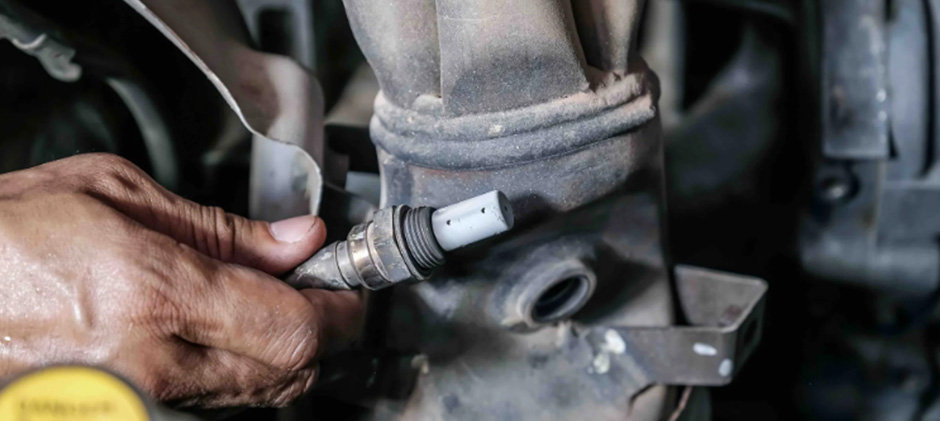
Faulty Oxygen or NOx Sensors
Sensors can fail on their own. A defective downstream oxygen or NOx sensor may send false rich signals. Or the upstream sensor may incorrectly report a lean condition, causing the ECM to add more fuel. This finally makes the downstream sensor trigger P2097.
Damaged or Contaminated Diesel Oxidation Catalyst (DOC)
If the DOC is contaminated by engine oil or coolant, loaded with ash from poor-quality oil, or even physically cracked, it won’t burn hydrocarbons properly. As a result, even a normal amount of unburned fuel from the engine can pass straight through, and the downstream sensor will report a rich condition.
What are the Symptoms of the P2097 Code?
Besides the Check Engine Light (CEL) or Malfunction Indicator Lamp (MIL) turning on, you may notice several performance issues that can affect your daily work.
- Active engine derate/reduced power: This is one of the most common symptoms on heavy equipment. The ECM will intentionally limit engine power to protect the costly aftertreatment system from damage caused by the rich fuel mixture.
- Higher fuel consumption: When fuel leaks into the exhaust instead of producing power, poor fuel efficiency is a direct result.
- Frequent or failed DPF regens: The ECM may have trouble starting or finishing a DPF regeneration because the sensor readings are outside the normal range. You may also get alerts saying the DPF is full.
- Black smoke from the exhaust: This is a clear sign that large amounts of unburned fuel are coming out of the exhaust pipe.
- Strong smell of raw diesel: A noticeable fuel smell around the machine, especially near the exhaust, usually indicates a fuel leak.
- Related trouble codes: P2097 rarely shows up by itself. It is often accompanied by codes related to DPF pressure, injector circuits, or other faulty sensors.
How to Diagnose the P2097 Code?
A step-by-step check helps you avoid wasting time and money on parts you don’t need.
- Scan and save the data: Use a scan tool for heavy equipment (J1939). Write down all codes—active and stored—and the freeze-frame data. This shows what the engine was doing when the fault happened.
- Look at the other codes first: Injector codes (like P0201) or high DPF pressure codes (like P2463) usually point to the real problem.
- Check for exhaust leaks: Inspect the exhaust from the engine to the DOC. Look for black soot marks. With the engine running, listen for hissing sounds.
- Watch live sensor data: Check the upstream and downstream O₂/NOx sensors on the scan tool. The upstream signal should move up and down. The downstream signal should stay fairly steady. If it’s stuck high (rich), there’s a real problem—or a bad sensor.
- Test the fuel doser: Many scan tools can command the doser to spray. Use that function to test it, or remove it and check for leaks or a clogged tip.
How to Fix the P2097 Code?
Once you identify the cause, just repair accordingly: fix exhaust leaks by replacing gaskets, tightening clamps, or repairing pipes; replace faulty aftertreatment injectors, engine injectors, and sensors with high-quality parts; have a contaminated or damaged DOC cleaned or replaced by a professional. After repairs, clear all trouble codes and verify the system works properly.
Conclusion
The P2097 code means there’s too much fuel in the exhaust system. If you don’t fix it in time, it can damage the DPF and SCR systems and make things a lot worse.
For high-quality replacement parts, FridayParts is a great choice. Our friendly team is always ready to help you find what you need and get your machine back to work.
