

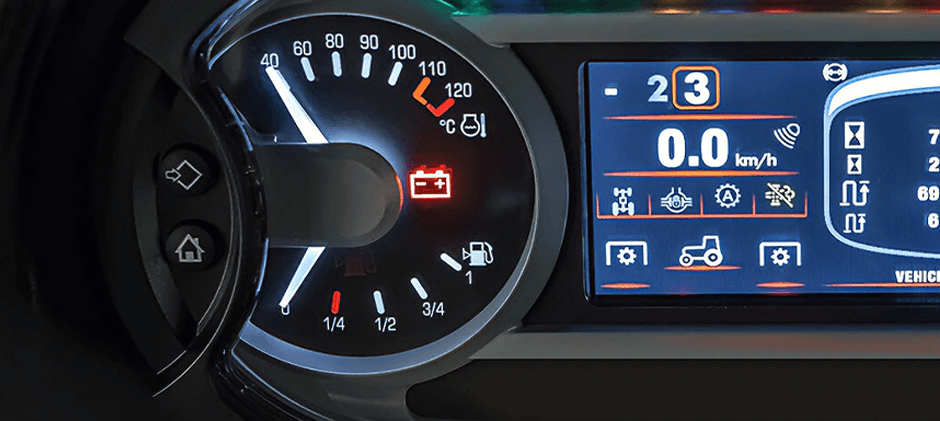
Have you noticed a red battery-shaped light on your dashboard? When this warning comes on, it means there’s a problem with the system that charges the battery and powers the machine. But many different issues can cause it. This article explains what the service battery charging system Warning Light means and what you should do when it turns on.
What Does the Service Battery Charging System Light Mean?
If the service battery charging system warning light comes on, your machine’s battery isn’t charging properly.
When the engine is running, the charging system should make electricity to power all your machine’s electrical parts. This includes lights, radio, and complex electronic control modules (ECMs). It should also recharge the battery at the same time. When this warning light is on, your equipment is running only on battery power. The battery has a limited amount of power, and it will run out eventually.
The charging system is made of several parts that work together: the alternator, battery, drive belt, and all connecting wires and cables. Your machine’s Engine Control Module (ECM) keeps checking the voltage in this system nonstop. If the voltage drops too low (undercharging) or gets too high (overcharging), the ECM will turn on the warning light to let you know.
What Causes the SBCS Warning Light?
The alternator is the most common cause, but many other issues can turn on the charging system warning light.
Alternator Failure
The alternator is the main part of the charging system. It’s driven by the engine’s drive belt and works like a small generator. It makes AC power and turns it into DC power to charge the battery and run the machine’s electronics. Like any other part, it can break over time.
- Worn Brushes: These small carbon parts send electricity to the alternator’s rotor. They wear down with use.
- Failed Rectifier/Diodes: These parts change AC power to DC power. If the diodes fail, the alternator will produce much less power.
- Bad Voltage Regulator: This part controls the alternator’s voltage. It’s often inside the alternator. If it fails, the battery will be undercharged or overcharged.
- Bearing Failure: Dust and vibration can damage internal bearings. This causes noise and can eventually lock up the alternator.
Construction and farm equipment work in dust, mud, and heavy vibration. This makes parts wear out much faster than in regular road vehicles.
Drive Belt Issues
The drive belt (or serpentine belt) connects the engine crankshaft to the alternator pulley. If the belt is faulty, the alternator can’t spin properly to make power.
- Loose or slipping belt: A stretched belt or weak tensioner won’t grip the pulley. This causes slipping and low charging. You may hear a squeal, especially at startup or under heavy electrical load.
- Worn or damaged belt: Belts can crack, fray, or become shiny. A bad belt works poorly and may break suddenly.
- Failed tensioner: Many machines use an automatic belt tensioner. If the spring weakens or the pulley bearing fails, it can’t hold the belt tight enough.
Battery Problems
A dead battery usually won’t turn on the charging light by itself. But a faulty battery can still cause the warning. For example, If the battery has an internal short circuit (a bad cell), it creates a very heavy electrical load. Even a good alternator may not keep up. System voltage drops quickly, and the warning light comes on.
Heavy‑duty equipment needs strong, vibration‑resistant batteries. A standard car battery won’t last long in these conditions.
Corroded or Loose Connections
The whole charging system needs clean, tight connections.
- Battery Terminals: Dirt and moisture cause corrosion (white or green powder) on the posts and clamps. Corrosion blocks electricity flow.
- Alternator Connections: The main power wire and ground wires can loosen or corrode from vibration.
- Ground Straps: Heavy straps connect the engine and chassis. If they break or corrode, they cause many electrical issues, including charging problems.
ECM or Sensor Malfunctions
In rare cases, the problem is not the charging system itself — it’s the computer that monitors it. The ECM uses sensors like the battery current sensor or battery temperature sensor. If a sensor fails and sends wrong data, or if the ECM has an internal fault, it may turn on the warning light for no real reason. This is usually the last thing to check after you’ve tested all other parts.
How to Fix the SBCS Light? A Step-by-Step Troubleshooting Guide
When the charging light comes on, follow these steps to find the problem quickly. Before you start, park the machine on level ground, turn off the engine, and set the parking brake. For safety, always disconnect the negative battery terminal first.
Perform a Visual Inspection
Check the drive belt. Is it cracked, frayed, or shiny/glazed? Press it with your thumb — it should be tight with very little movement. Look at the battery terminals for corrosion. Are the cable clamps tight? Wiggle them to check. Follow the main wires from the alternator and battery. Look for any obvious damage or loose connections.
Test the Battery
Set a digital multimeter to DC volts. Test the battery’s charge. With the engine off, touch the red probe to the positive (+) terminal. Touch the black probe to the negative (-) terminal. A healthy, fully charged battery should read 12.4V – 12.7V. Below 12.2V means the battery is weak or failing.
Note: Many heavy machines use a 24V system (two 12V batteries in series). For these, you should see 24.8V or more.
Test the Alternator Output
Reconnect the battery if you disconnected it. Start the engine and let it run at high idle. Use the multimeter (still on DC volts) to measure voltage across the battery terminals again. You should see: 13.8V – 14.5V for 12V systems; 27.6V – 29V for 24V systems.
- If the voltage is in this range, your alternator is probably working. The issue may be intermittent, from a bad connection, or a battery that won’t hold a charge.
- If the voltage stays the same as the battery voltage (or lower), the alternator is not charging. This means a problem with the alternator, drive belt, or main wiring.
- If the voltage is too high (over 15V), the voltage regulator has failed. The alternator is overcharging, which can damage the battery and electronics.
Inspect Wiring and Fuses
If the alternator and battery seem okay, check the wiring again. Look closely at: The main power cable from the alternator to the battery. The smaller exciter wire that activates the alternator. Check any inline fuses or fusible links that may have blown.
Is Operating with the SBCS Light on Safe?
Keep running is risky. Big risk. Your machine is running only on the battery. No charging. When the battery dies, the engine will stop. If power cuts out while lifting a load, working on a slope, or near other workers, people can get hurt. When the Service Battery Charging System light comes on: Stop the job. Move the machine to a safe, flat spot. Shut it down. Start checking the problem. Don’t try to “finish the day.”
Conclusion
If you can fix it yourself, you can order most parts you need from FridayParts. If you don’t want to do it yourself, hire a good technician to install them. Either way, you now know where to start. When the warning light comes on, check the belt, test the battery and alternator, and inspect the connections right away. Do NOT run the machine for a long time with this light on. The risk of sudden power loss is very high.
