

When we talk about the John Deere 5075E, we’re usually talking about a utility tractor that spends its life doing real off-road work: loader cycles on uneven ground, brush cutting, feeding, moving pallets, pulling implements, and running PTO-driven tools in dust, heat, and mud. That workload is exactly why a “specs + parts lookup” guide matters. Specs tell us what the machine can do; smart maintenance and correct parts sourcing decide whether it keeps doing it week after week.
Below, we’ll cover the practical context around the 5075E—what owners care about when the tractor is a tool, not a hobby—and we’ll lay out maintenance priorities, common problems, and a parts-lookup workflow that reduces wrong orders and downtime.
About John Deere 5075E
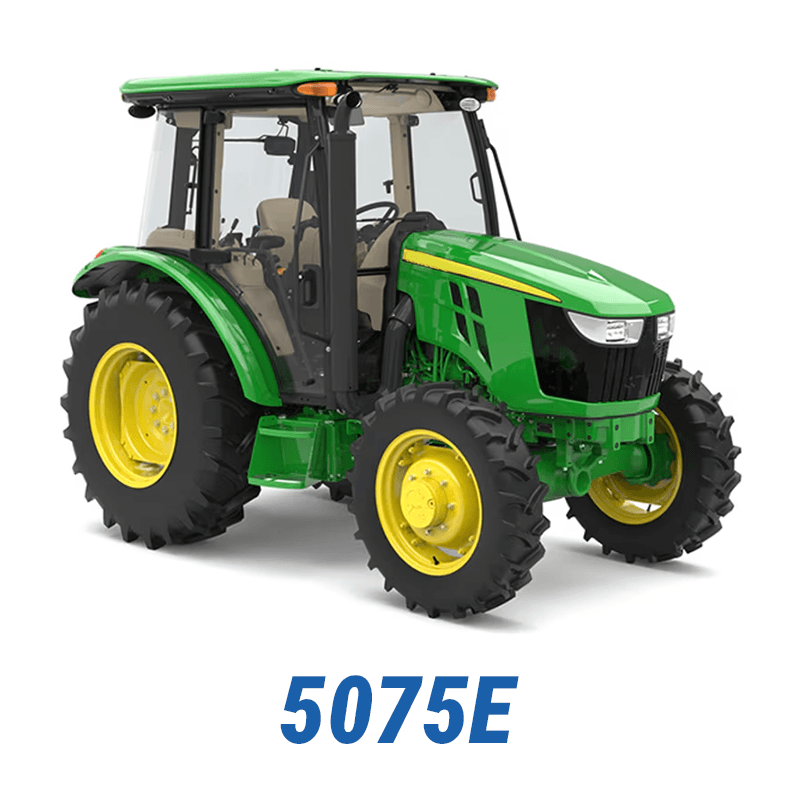
- Work role: A mid-size utility tractor commonly used for loader work, mowing/brush cutting, and general property/farm tasks where traction and stability matter off-road.
- Configuration choices matter: The platform is seen in 2WD or MFWD setups and can be found as a premium cab, standard cab, or open operator station. Those choices change comfort, visibility, and how you prioritize service items (filters, HVAC, electrical connectors, lighting).
- Operator time is part of “cost”: If you run long days, cab features (seat, lighting, controls layout) can reduce fatigue and help you work safer—especially around attachments and when backing to hook up implements.
- Emissions/aftertreatment note: Some 5E 3-cylinder configurations are described as “No Regen required.” That’s good from an uptime standpoint, but we still treat air flow, clean fuel, and correct oil as non-negotiable.
John Deere X700 Specs
Engine Detail
| John Deere PowerTech 3029H turbocharged diesel 3-cylinder liquid-cooled |
– |
|---|---|
| Displacement | 179 ci 2.9 L |
| Bore/Stroke | 4.19×4.33 inches 106 x 110 mm |
| Rated Power (gross) | 75 hp 55.9 kW |
| Air cleaner | two paper elements |
| Pre-heating | coolant heater (optional) |
| heavy-duty air pre-heater (optional) | |
| Compression | 17.8:1 |
| Rated RPM | 2400 |
| Idle RPM | 800-2600 |
| Operating RPM | 1800-2400 |
| Torque | 195.5 lb-ft 265.1 Nm |
| Torque RPM | 1700 |
| Firing order | 1-2-3 |
| Starter volts | 12 |
| Coolant capacity | 10 qts 9.5 L |
| Intake valve clearance | 0.014 inches 0.356 mm |
Transmission options
| Transmission | SyncReverser |
|---|---|
| Gears | 9 forward and 3 reverse |
| Clutch | dry disc |
| Oil capacity | 40.15 qts 38.0 L |
| Oil type | JD Hy-Gard |
John Deere 5075E Tires
| Standard tires (ag) | Front: 7.50-16. Rear: 16.9-28 (2WD) |
|---|---|
| Front: 9.5-24. Rear: 16.9-28 (4WD) | |
| Lawn/turf front | 27/12LL-15 (2WD) |
| 9.5-16 (4WD) | |
| Lawn/turf rear | 21.5L-16.1 |
| Industrial front | 11L-15 (2WD) |
| 12.5/80-18 (4WD) | |
| Industrial rear | 16.9-24 |
Source from: www.tractordata.com
Related John Deere 5075E Parts
Maintenance Tips for John Deere 5075E
This is the section we don’t keep short, because it’s where most owners win or lose time. The 5075E’s work profile (loader cycles + PTO + rough ground) pushes wear into a few predictable places: fuel cleanliness, cooling airflow, hydraulic connections, and vibration-prone hardware.
1) Build a “daily quick check” that fits real off-road use
We’ve found the simplest routines are the ones operators actually do:
- Walk-around leak check (fuel, oil, coolant, hydraulic wetness at couplers/hoses)
- Cooling air path check (screens and intake area; clear dust/seed fluff)
- Tire and wheel check (pressure, sidewall cuts, lug torque if you’ve done heavy loader work)
- 3-point and PTO glance (guards, pins/clips, abnormal play)
- Lights + warning indicators before heading to the field or jobsite
Why this matters: Loader and PTO work can hide small problems until they turn into a blown hose, overheated engine, or an electrical no-start at the worst time.
2) Fuel system discipline: cheap protection for expensive components
Off-road machines often fail “fuel-first,” especially when they sit between jobs.
What we do (and recommend):
- Keep fuel clean and water-free (use a clean fill process; drain water if your setup supports it).
- Replace fuel filtration on schedule, and sooner if you’re working in dirty storage conditions.
- Don’t ignore small symptoms: long crank, uneven idle, or power fade under load can point to restriction or air intrusion.
Parts categories that matter most here:
- Primary fuel filter (example listing: RE560682 shown for multiple JD tractors)
- Fuel pump (example listing: RE68345 shown for multiple JD engines/tractors)
3) Cooling and airflow: protect power and protect rubber
Even if the tractor isn’t “overheating,” restricted airflow can raise under-hood temperatures and shorten the life of belts, wiring insulation, and seals. In dusty mowing and loader work, this creeps up gradually—operators get used to it until the tractor finally derates or boils over.
Simple rule we follow: if debris is visible on screens/fins, clean it before the next heavy pull.
4) Hydraulics and couplers: keep connections clean, stop contamination early
A lot of 5075E work involves changing attachments. Every connection is a contamination opportunity.
- Wipe couplers before connecting.
- Watch for seepage and drips after coupling—small leaks can become air ingestion, heat, and slow response.
- If you’re swapping implements often, keep spare dust caps and consider stocking common coupler service items.
Your provided catalog data highlights hydraulic connection hardware such as Quick Connect Coupling RE52981 (listed for certain JD tractor applications). Even when a part number isn’t your exact match, it signals which subsystems are “frequent shoppers” in real-world operation.
5) Cab and electrical: small issues cause big stoppages
If you run a cab model, electrical reliability matters more than people expect—lighting, switches, and connectors become daily-use items.
Practical habits:
- Keep battery terminals clean and tight.
- Treat “sometimes starts” as a real problem, not a quirk.
- Protect connectors from moisture and vibration; intermittent faults waste hours.
Conclusion
The John Deere 5075E is most reliable when we treat fuel cleanliness, airflow, hydraulics, and electrical connections as routine—not “fix it later” items. That mindset prevents the common downtime events: hard starts, power loss under load, and hydraulic connection problems. When repairs are needed, using an organized parts lookup and matching by model plus part number saves time. As an aftermarket parts supplier, we focus on high-quality products at affordable prices, a vast inventory, and wide compatibility across many heavy equipment brands.
