

Your AC pressure switch is a safety part that keeps the AC system from getting too much or too little pressure, so it doesn’t get damaged. Before you think your compressor is bad or you have a refrigerant leak, a quick way to narrow things down is learning how to test AC pressure switch with multimeter. Keep in mind this switch only reacts to real pressure in the system, so checking pressure too will give you a much better idea of the problem.
Doing this simple check early can make your equipment last longer and save you from expensive repairs later.
Where to Find an AC Pressure Switch?
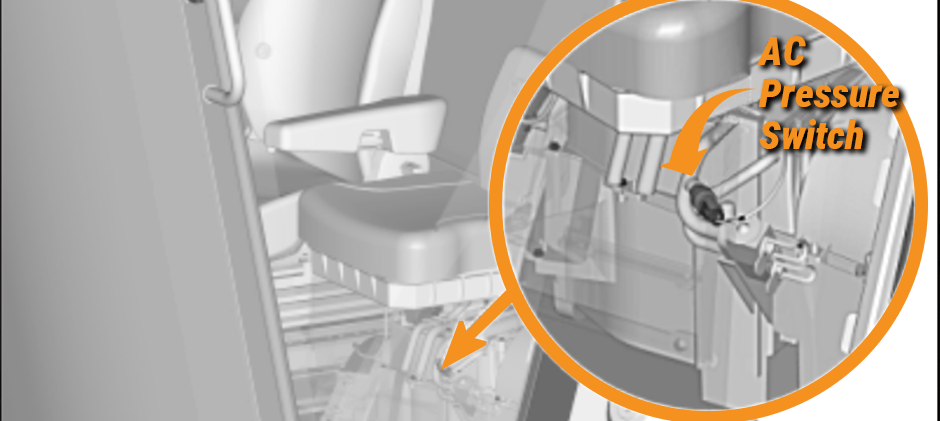
On off‑highway machinery, AC parts are usually hidden in the engine compartment and exposed to harsh conditions all the time — dust, dirt, oil, and constant vibration. The AC pressure switch is a safety part that protects your compressor. It’s normally mounted in one of two places.
Most often, it screws right into the receiver dryer (also called an accumulator). This is a small canister connected to the refrigerant lines that removes moisture from the system. Just look for a small sensor with an electrical plug mounted directly on this can.
Other times, the switch is installed straight into the high‑pressure refrigerant line, usually somewhere between the compressor and condenser. Simply follow the metal line coming from the AC compressor — you’ll see a sensor plumbed into the line with wires coming out of it.
Since conditions are so dirty, these switches and their connectors are often covered in thick grime. You may need a rag and a degreaser to clean the area so you can see clearly.
Safety first: Always disconnect the machine’s battery before testing or touching any electrical components on the AC system. This prevents electric shock or accidental short circuits.
Signs of a Bad AC Pressure Switch
The A/C pressure switch sends electrical signals based on refrigerant pressure. When it malfunctions, it basically gives the AC system false readings, causing all kinds of issues.
- Compressor won’t turn on: The switch is faulty and reads pressure as too low or too high, it cuts power to the compressor clutch to protect the system. The compressor never turns on, and you only get warm air from the vents.
- AC clicks on and off quickly: You may hear the compressor clutch clicking every few seconds. This happens when the switch sends unstable signals, making the system cycle nonstop.
- Cooling works on and off: The AC blows cold for a while, then suddenly warm, then cold again. This is usually from a failing switch with loose or random electrical connections inside.
- AC only cools at certain engine speeds: A bad switch may only work in a small pressure range, which changes with engine RPM. If your AC only gets cold at idle or high speed, the pressure switch is very likely the problem.
Test an AC Pressure Switch with a Multimeter
This is the best way to check if your pressure switch is working electrically. Most AC low‑pressure switches on heavy equipment are normally closed. That means as long as there’s enough refrigerant pressure in the system (even with the engine off), the switch should let electricity flow through it. It only cuts the circuit when pressure gets too low.
Stay Safe and Get Access
Make sure the engine is off and the battery is disconnected. Find the pressure switch and unplug its electrical connector. This separates the switch from the machine’s wiring.
Set Up Your Multimeter
Turn the dial to the continuity setting — it usually looks like a sound wave or a diode symbol. Test it by touching the two probes together; you should hear a beep and see a reading near zero.
Test the Switch
Touch one probe to each electrical pin on the pressure switch itself (not the plug).
Read the Results
- If the meter beeps and shows near 0 ohms: Electricity flows through the switch — it’s working. The problem is probably somewhere else
- If there’s no beep and it shows “OL” or very high resistance: The circuit is open. That means no power is getting through.
- An open circuit on a normally closed switch means one of two things: Either the switch itself is broken, or it’s working correctly — because the system doesn’t have enough refrigerant pressure to keep it closed.
AC Compressor Not Turning On? It Could Be a Bad Switch or a Leak
If your multimeter shows the pressure switch is open, that’s why your compressor won’t start. But is the switch itself faulty, or is it just correctly showing a real problem in the system?
Many find they can make the compressor run by jumping the terminals on the electrical plug with a paperclip or a short wire. While this does prove the rest of the circuit and the compressor clutch are working, it’s a potentially risky test — so be extremely careful.
Never let the compressor run for more than a few seconds with the pressure switch jumped. Refrigerant carries lubricating oil through the system. Running the compressor without enough refrigerant (and therefore no lubrication) is like running an engine with no oil — it will cause catastrophic mechanical damage.
Why Did the Pressure Switch Open in the First Place?
Refrigerant Leak in the System
This is the most common reason the switch opens. Over time, vibration, worn or degraded O‑rings, or damaged lines can cause refrigerant to slowly leak out.
When system pressure drops below a certain point — typically around 25–30 PSI — the low‑pressure switch cuts the circuit as a safety measure to protect the compressor from damage due to lack of lubrication (dry running).
In this case, the pressure switch is working properly. The real issue is a leak. You can confirm this by connecting a set of AC manifold gauges to the system service ports. If the static pressure reading is very low or near zero, you’ve found the problem.
The Pressure Switch Itself Has Failed
Less common, but the pressure switch can indeed fail on its own. It may get stuck open even when refrigerant pressure in the system is full and normal.
If you connect your AC gauges and the static pressure is in a good, healthy range — such as 70 PSI or higher, depending on ambient temperature — but your multimeter still shows an open circuit (OL) on the switch, you can be sure the pressure switch is bad and must be replaced.
Your multimeter shows the electrical condition of the pressure switch, while AC manifold gauges show the actual physical pressure in the system. Only by using both can you make a final, accurate diagnosis.
In Conclusion
Just use a multimeter to test the AC pressure switch first — you’ll quickly tell if its circuit is working. If the test shows the switch is open (no continuity), check the system’s static pressure.
With these two steps, you’ll basically figure out if the problem is just a bad pressure switch, or an issue with the system itself, like a refrigerant leak. Once you find the real problem, you can replace the part right away. FridayParts has a huge stock of pressure switches and other components for all kinds of heavy equipment, at great prices, to help you get back to work faster.
