

Not all tractor tires fit every job. Pick the right tires, and you’ll get way better performance: stronger traction, smoother rides, better fuel economy, and less ground damage. Matching different types of tractor tires to the terrain is also an easy way to make your tires last much longer.
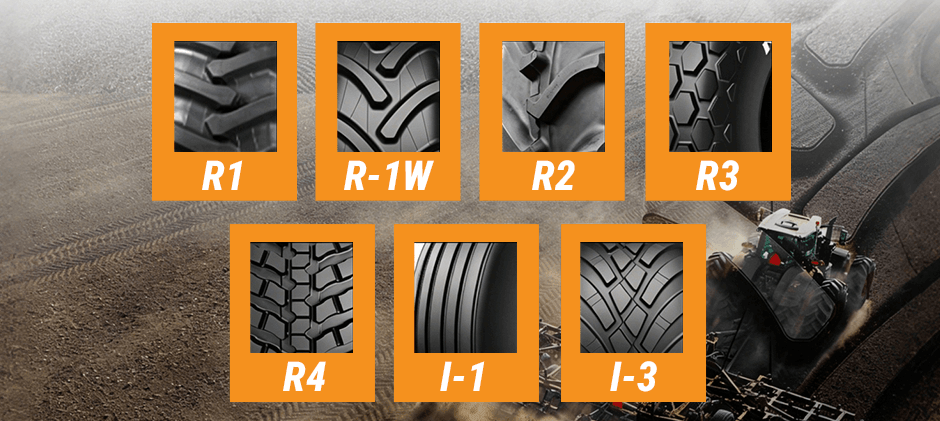
R-1 Agricultural Tires
When you think of a classic farm tractor, you’re almost always picturing it with R-1 farm tires. Most people just call them ag tires. They’re the go-to standard for regular farm work, perfect for dry and slightly wet field conditions.
R-1 tires stand out with deep, tough lugs angled at 23 degrees. The lugs are set wide apart, and this design does two important jobs:
- First, those deep lugs dig firmly into soft soil and gravel, giving great traction for pulling heavy farm tools.
- Second, the wide gaps let the tire self-clean easily. As the wheel rolls, mud and dirt get tossed out naturally, so the tread never clogs up and loses grip.
Main features of R-1 tires
- Deep, sturdy lugs for strong traction
- Wide lug spacing to clean out mud on its own
- Built mainly for off-road field use
- Ideal for plowing, tilling, and everyday farm work
R-1 tires are great all-rounders for farming. But their thick, rough tread can damage soft ground surfaces. They also ride bumpy on paved roads and wear out much faster when used on pavement.
R-1W Tires for Wet Soil
Farmers who often work in damp, sticky or muddy fields will find regular R-1 tires don’t always cut it. That’s where the R-1W tire comes in.
The “W” stands for wet, and this tire is made to perform perfectly in wet soggy conditions. At first look, R-1W tires seem almost the same as standard R-1 tires. They share the same basic lug shape, but there’s one key difference — tread depth.
R-1W lugs are about 20% deeper than regular R-1 ones. The extra depth lets the tire dig further into slippery, muddy ground for a firm grip. It delivers way better traction and stability when standard R-1 tires start slipping and spinning. This makes R-1W tires perfect for areas with heavy rain, or late-season harvesting when fields are fully soaked and waterlogged.
R-2 Rice/Cane Tires
When the ground turns extremely muddy, even R-1W tires aren’t enough. That’s when you need R-2 tires for the wettest, toughest field conditions. They’re often called cane and rice tires, made specifically to handle deep mud.
R-2 tires have super aggressive, extra-deep treads. Their lugs are over twice as deep as standard R-1 tires. This huge depth lets tractors move easily through flooded fields, rice paddies and sugarcane farms without getting stuck.
But there are clear downsides. R-2 tires give a really rough ride, and they’re totally unsuitable for paved roads. The tall lugs would wear out super fast and even damage the road surface.
R-3 Turf Tires
Now let’s look at the complete opposite of the R-2 tire — the R-3 turf tire. If protecting your ground surface is your top priority, R-3 is the ideal pick. These tires give you solid enough traction, while staying gentle on lawns, golf courses and soft pastures.
Unlike deep, rugged lugs, R-3 tires have much shallower tread with tightly packed tread blocks. They also have a wider contact area, which spreads the tractor’s weight more evenly over the ground. This lowers ground pressure and prevents soil compaction and turf damage.
But this gentle design also has a downside. The shallow tread clogs easily with mud or snow, and then it loses almost all traction. R-3 tires are only meant for dry grass and other soft, delicate surfaces.
R-4 Industrial Tires
Need a tire that can handle all kinds of ground? Something that works on pavement, gravel and farm fields — not perfect at just one thing, but good all-round? That’s exactly what the R-4 industrial tire is for.
The R-4 tread is a middle ground between R-1 farm tires and R-3 turf tires. Its lugs are deeper and wider apart than turf tires, so it gets solid traction on dirt and mud. Compared to regular farm tires, the lugs are shallower and tighter together. This makes them wear slower and ride much smoother on hard, paved surfaces.
R-4 tires also have tough sidewalls to handle heavy loads, perfect for front loader work. That’s why they’re the go-to choice for construction, utility and industrial tractors that run both on the road and off in the fields.
Tires for Implements
Tractor tires get all the attention, but the tires on your towed equipment are just as important for a successful operation. These are known as implement tires, or “I” series tires, and their job is less about traction and more about load-carrying and stability.
I-1 Tires
The I-1 tire is the most common type of implement tire, designed for free-rolling wagons, planters, balers, and field cultivators. Its defining feature is a ribbed tread pattern, with multiple parallel ribs running in the direction of travel. This design minimizes rolling resistance for easier towing on roads and provides excellent straight-line stability. They are built with strong casings to handle heavy loads over long distances.
I-3 Tires
Some implements, like manure spreaders or grain carts, need more grip than an I-1 can provide, especially when operating in a soft field. The I-3 tire, or “traction implement” tire, fills this need. It features a bar-lug tread pattern similar to an R-1, but the lugs are shallower. This provides enough grip to prevent slipping on soft ground while still offering good flotation to avoid sinking.
Considerations When Choosing the Right Tread
With so many tire options, how do you pick the right one? Just ask yourself a few simple questions about how you use your tractor:
- What surface do you work on most? If 90% of your time is spent on farm fields, go with R-1 or R-1W. If you mostly drive on well-kept grass lawns, choose R-3. If you constantly switch between paved roads and dirt ground, R-4 is your best option.
- What’s your usual soil condition? Be real about how much mud you deal with. Dry, firm ground works perfectly with R-1. Wet, sticky soil all year round is worth upgrading to R-1W. Deep, extreme mud calls for R-2 tires.
- What kind of attachments do you use? Heavy front loader work puts lots of strain on tires. R-4 tires have tough, reinforced sidewalls made exactly for this kind of heavy load.
- How much road driving do you do? Deep-tread R-1 and R-2 tires wear out super fast on pavement. If you often travel on roads between fields, R-4 or a milder R-1 design will last longer and save you money down the line.
Answer these simple questions, and you’ll easily find the perfect tractor tire tread for your work.
Summary
From the tough traction of R-1 tires for field work, to the gentle performance of R-3 tires on lawns, every tire is built for a specific job. Just pick the right tire based on your work needs. FridayParts supplies compatible tires for all major equipment brands.
