

In the professional groundskeeping and agricultural sectors, we often operate at the mercy of the elements. Whether you are managing a municipal park system, a golf course, or a commercial landscape contract, the conflict between a rigid maintenance schedule and unpredictable rainfall is a constant challenge. Ideally, we would always wait for the dew to evaporate and the soil to firm up. However, there are times when “waiting to dry” isn’t an option—the grass is growing too fast, or the client’s window is closing. As a maintenance specialist, we must be clear: while mowing wet grass is technically possible, it is a high-stakes operation.
Is it Bad to Cut Wet Grass?
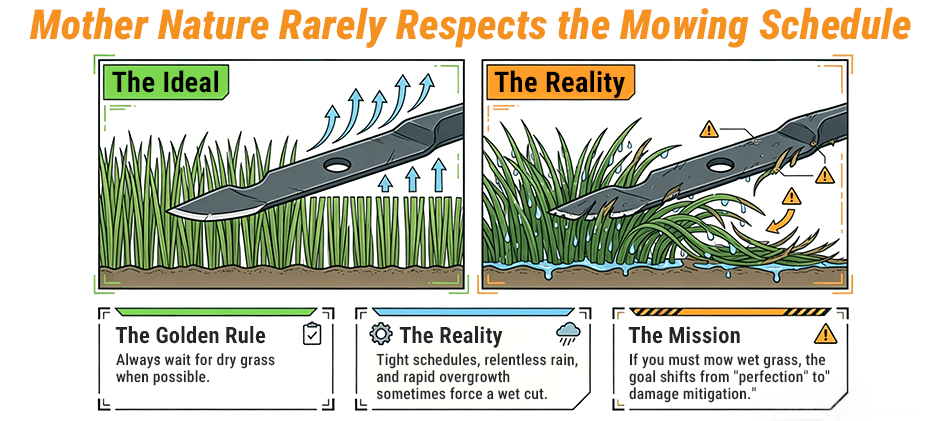
To the casual observer, mowing wet grass is merely a nuisance. To an agricultural consultant, it is a multi-front assault on the health of the soil and the integrity of the mower’s drive system.
Uneven Shearing and Turf Tearing.
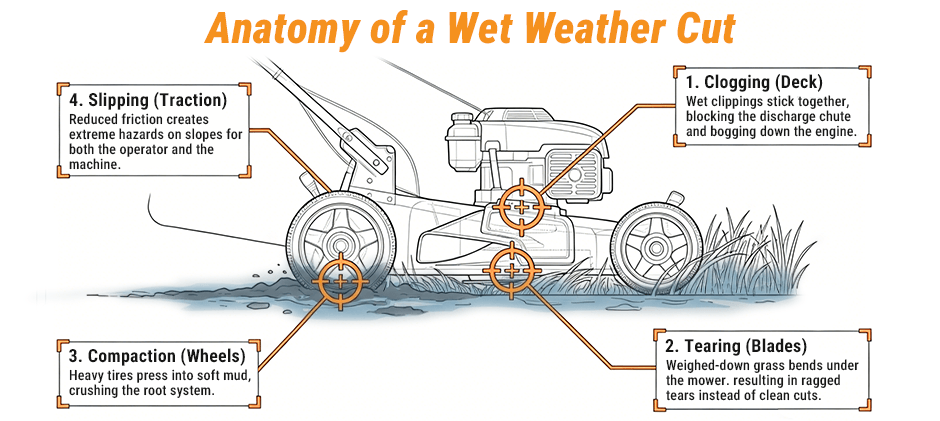
Under dry conditions, a sharp blade cleanly shears the grass blade. When saturated, grass blades become heavy and flexible, often bending away from the blade’s path or lying matted against the soil. Instead of a clean cut, the mower often “tears” the grass. These ragged edges increase the wound’s surface area, causing rapid moisture loss and a distinct “yellowing” or “browning” of the tips within 48 hours. This isn’t just an aesthetic issue; it’s a physiological stressor that stunts growth.
Pathogen Proliferation and Lawn Disease
A torn grass blade is an open door for pathogens. In high-humidity environments, these wounds become primary sites of infection for fungal diseases. We frequently see outbreaks of Red Thread (Laetisaria fuciformis), which leaves gelatinous pink strands, or Dollar Spot, which produces bleached, silver-dollar-sized lesions. Furthermore, the mower acts as a mechanical vector. Wet clippings stick to the deck and tires, transporting fungal spores from an infected patch across the entire property, effectively inoculating the healthy turf with disease.
Mechanical Strain and Transmission Fatigue.
From a maintenance perspective, wet grass is exponentially more difficult to process. It is “viscous” and heavy, significantly increasing the load on the engine’s torque reserves. When the mower deck clogs with wet mulch, the engine must work harder to maintain blade tip speed, often leading to overheating. For machines with hydrostatic transmissions, the added resistance can cause hydraulic fluid to overheat, degrading its lubricating properties and shortening the lifespan of the pumps and motors.
Soil Compaction and Anaerobic Conditions
The most long-term damage occurs beneath the surface. Heavy-duty off-road machinery exerts massive ground pressure. On saturated soil, this pressure collapses the “pore space”—the tiny gaps between soil particles that hold oxygen and water. This compaction creates an anaerobic environment where beneficial soil microbes die off, and roots cannot penetrate. The resulting wheel ruts are not just unsightly; they are structural failures of the turf bed that lead to poor drainage and “ponding” for months to come.
Pro Tip: Wet grass blades are structurally fragile. The cellular turgor pressure is at its peak when saturated, making the blades prone to “bruising” or crushing under the weight of the mower’s deck before the blade even reaches them.
Selecting the Right Fleet for Damp Conditions
In my experience, fleet selection determines whether a wet-weather cut succeeds or fails. Not all machinery is engineered to handle the increased friction and moisture of a damp field.
Mower Performance Matrix
| Mower Type | Wet Condition Effectiveness | Compaction Risk | Maintenance Needs | Expert Note |
|---|---|---|---|---|
| Self-Propelled | Moderate | Moderate | High | Best for smaller, sensitive areas where precision is key. |
| Riding / Zero-Turn | High Power | Critical | Moderate | High torque allows for cutting, but the weight is a massive liability for soil health. |
| Robotic Mowers | High | Negligible | Low | Ideal for maintenance of short grass; fails in overgrown, wet fields. |
| Remote Control (Mowrator) | Excellent | Low | Moderate | The gold standard for slopes; no operator weight reduces compaction significantly. |
Blade Suction and Aerodynamics
When dealing with moisture, the physics of your lawn mower blade becomes the most critical factor. In wet conditions, grass is matted down by its own weight. Standard blades lack the “lift” to pull these blades upright. We recommend “High-Lift” blades, which feature a more aggressive upward curve on the back edge. This creates a powerful vacuum effect (suction) within the deck baffling, pulling the grass into a vertical position for a clean strike. However, this suction also pulls up more moisture, so the deck must be inspected frequently for “clump-welding.”
Before any wet-weather operation, a thorough inspection of high-wear mower parts is mandatory. Specifically, check the deck belts for “glazing”—a shiny, smooth surface that indicates the belt has been slipping under load, which will only worsen when moisture is introduced.
How to Cut Wet Grass When I Must?
If the project timeline leaves you no choice, you must modify your operational parameters to protect the equipment and the soil.
- Strict Adherence to the One-Third Rule: Never remove more than one-third of the grass blade at once. In wet conditions, we often go even shallower. Raising the deck height reduces the volume of material the mower must discharge, which prevents the engine from bogging down and keeps the “discharge velocity” high enough to prevent clumping.
- Modulate Ground Speed, Maintain Engine RPM: You must slow your travel speed significantly. This allows the blades more “strikes per inch” of travel, ensuring a cleaner cut despite the moisture. However, keep your engine at full throttle to maintain maximum blade tip speed and cooling airflow.
- Side-Discharge Over Bagging: Wet clippings are essentially a heavy slurry. They will clog bagging chutes within minutes and add hundreds of pounds of dead weight to your machine, increasing compaction risk. Set the mower to side-discharge, ensuring the chute is clear, and the material is dispersed widely.
- The “Large-Radius” Maneuver: On wet sod, the friction between the tire and the grass is reduced. A sharp zero-turn maneuver will cause the inside tire to pivot and “corkscrew” into the soft soil, tearing the grass out by the roots. Make wide, sweeping turns.
Drive System and Ignition Resilience
The added weight of wet material puts extreme stress on the power transmission. A worn lawn mower belt will act as a slip-clutch if it gets even slightly damp, leading to friction-heat that can snap the belt or damage the pulleys. Similarly, your engine’s combustion efficiency is tested when the deck bogs down. A fouled or old lawn mower spark plug may provide enough spark for light work, but will cause the engine to stumble or stall when it encounters a thick, wet patch of grass. Ensuring these components are fresh is your best insurance against a mid-field breakdown.
How Soon After it Rains Can You Mow the Lawn?
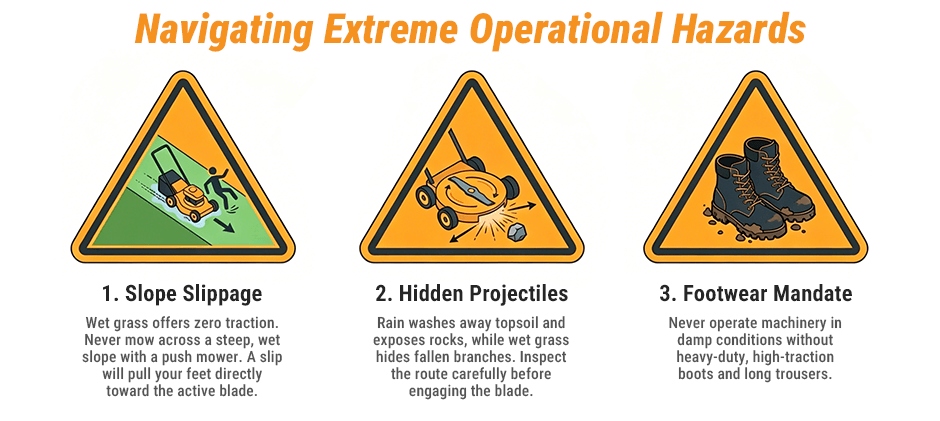
Timing is a function of “evapotranspiration” and soil drainage. While 24 hours is the industry standard for a “wait period,” local variables dictate the actual window.
Field Diagnostic Tests
- The Bounce Test: Reach down and compress a handful of grass. If the blades are “limp” and stay matted, they are still holding too much internal moisture. If they spring back immediately and feel “crisp,” the vascular pressure is stabilized for cutting.
- The Footprint Test: Walk onto the turf. If your boot leaves a depression that immediately fills with water, or if you can see the “sheen” of water in your tread mark, the soil is at “field capacity.” Mowing now will cause permanent rutting.
Environmental Factors for Drying
- Soil Texture: Sandy soils (macropores) drain rapidly, often allowing for mowing within 4–6 hours of a light rain. Clay soils (micropores) retain water through capillary action and may require 48–72 hours to become stable.
- Atmospheric Movement: Wind is often more effective than the sun for drying the “canopy” of the grass, as it breaks the boundary layer of moisture surrounding the blades.
Post-Mowing Maintenance and Soil Recovery
The job isn’t over when the engine stops. Wet mowing creates an acidic, corrosive environment for your machinery.
- Scraping the Deck (Non-Negotiable): Wet grass clippings contain organic acids. If left under the deck, they will ferment and eat through the powder coating and the steel itself, leading to “deck rot.” Once the job is done, disconnect the spark plug for safety and scrape the underside of the deck clean.
- Clearing Air Inlets: Wet debris often gets sucked into the engine’s cooling fins and air intake. Clear these immediately to prevent the engine from running hot on the next cycle.
- Mechanical Aeration: If you were forced to mow on soft ground and left visible ruts, you must remediate the compaction. Use a core aerator or a garden fork to pull soil plugs. This breaks the “crust” created by the mower tires and allows oxygen to reach the suffocating root zone.
Summary
The increased friction, weight, and moisture of wet-weather work will expose any weakness in your machinery. FridayParts is your strategic partner in fleet maintenance, providing an extensive inventory of high-quality, professional-grade mower parts. From high-lift blades that provide the necessary suction for damp turf to heavy-duty belts and precision-engineered spark plugs, FridayParts ensures your equipment has the durability to survive the strain of the season. Keep your fleet in peak condition and your turf healthy by choosing aftermarket solutions that meet the demands of heavy-duty groundcare—no matter what the weather brings.
