

A fuel filter is the part that traps dirt and water before they reach your engine. If you’re searching for what a fuel filter is, you likely want a simple explanation, where it’s located, what types exist, and how to know when it’s failing—without dealership jargon. This guide breaks it down for tractors, skid steers, excavators, loaders, generators, and other off-road equipment. While it shares some similarities with an oil filter, it’s important to understand what the difference between an oil filter and a fuel filter is to appreciate its unique role.
“Clean fuel is cheap insurance; dirty fuel is expensive downtime.”
What Does A Fuel Filter Do?
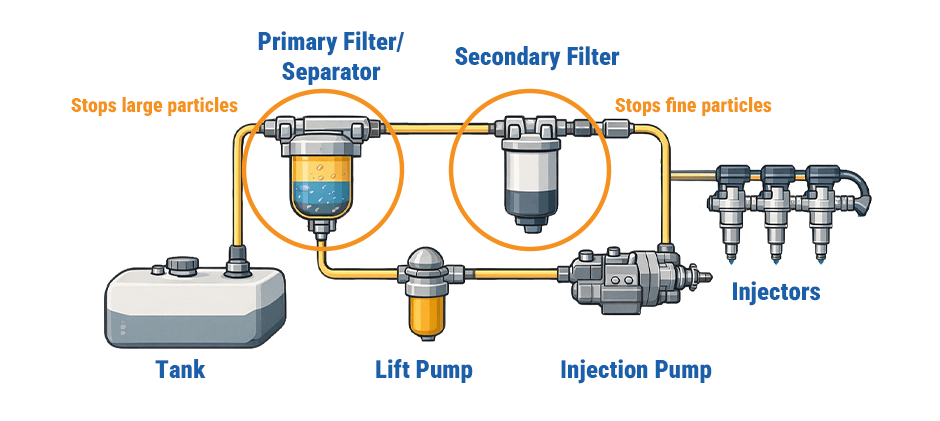
A fuel filter removes contamination from fuel before it reaches injectors and pumps. It captures particles like dust, rust, paint flakes, and tank sediment that can score injection components and reduce fuel flow.
A fuel filter also protects performance. Keeping fuel flow steady, it helps the engine maintain power under load and reduces hard starts and stalling issues.
Clear Statement: The fuel filter’s job is protection first, performance second.
Why Do Off-Road Machines Need Fuel Filters?
Off-road fueling is often dirtier and harder on filters. Jobsite tanks, portable cans, windblown dust, and long storage periods increase the chance of water and debris entering the system. This also raises the question of fuel longevity; it’s useful to know how long diesel fuel can last in your tank.
Diesel equipment is especially sensitive. High-pressure common-rail injectors and pumps operate with extremely tight tolerances, so tiny particles can cause big damage.
“Your injector clearances are measured in microns—your fuel cleanliness has to match.”
What Is Inside A Fuel Filter?
Filter media is the “trap” that catches contaminants. Most filters use pleated paper/synthetic media designed for a specific micron rating and flow rate.
The housing and seals prevent bypass and air leaks. Spin-on canisters, cartridge elements, O-rings, and gaskets must seal correctly, or the system may pull air and act like it’s clogged.
Some filters include a water separator stage. Many diesel systems use a bowl and drain to collect water before it reaches the fine filter. This is a distinct function from other emission control systems like the DPF and DEF, and it’s helpful to understand the difference between DPF vs DEF on diesel equipment.
Clear Statement: A filter that leaks air can cause the same symptoms as a filter that’s plugged.
4 Common Types Of Fuel Filters
Most machines use more than one filter stage. It’s common to see a primary (coarser) filter and a secondary (finer) filter.
What Is A Primary Fuel Filter?
A primary fuel filter catches larger debris early. It often sits closer to the tank and may be combined with a water separator on diesel equipment.
What Is A Secondary Fuel Filter?
A secondary fuel filter protects injectors with finer filtration. It is typically located closer to the injection pump/rail and is the “last line of defense.”
What Is A Diesel Water Separator?
A water separator removes water before it damages injection components. Many systems let you drain water from a bowl or sensor-equipped separator.
What Is A Carbureted Gas Filter?
Gas carbureted systems often use small inline filters. These are simpler than diesel systems but still clog from varnish, rust, and tank debris.
What Does Micron Rating Mean?
Micron rating describes how small a particle the filter is designed to capture. A lower micron rating means finer filtration, but it can also increase restriction if the system wasn’t designed for it.
Match filtration to the machine’s requirements. Using an incorrect micron rating can reduce power, increase hard-starting, or shorten filter life.
Clear Statement: “Finer” is not always “better” if the filter doesn’t match the fuel system’s flow needs.
Where Is The Fuel Filter Located?
Fuel filters are usually between the tank and the engine. On tractors and construction equipment, you’ll often find them along the frame rail, on the firewall/engine side, or mounted near the lift pump.
Diesel systems may place the water separator in an easy-to-service spot. Manufacturers often put the separator where you can drain it without removing panels.
“If you can’t service it easily, it won’t get serviced often enough.”
8 Symptoms Of A Clogged Fuel Filter
Loss of power under load is the classic symptom. The machine may idle fine but bog when you work the hydraulics or drive uphill.
- Hard starting or long crank time
- Stalling when the throttle increases
- Surging at a steady RPM
- Reduced top-end power or sluggish response
- Rough idle (sometimes)
- Abnormal lift pump noise (working harder)
- Fuel pressure codes or warning lights (newer machines)
- Visible water/debris in separator bowl (diesel)
Clear Statement: If a new filter fixes it immediately, the old filter was your restriction.
When Should You Replace A Fuel Filter?
Replace the filter on schedule or when symptoms appear. Off-road duty cycles vary, so “hours,” fuel quality, and environment matter more than calendar time.
Replace immediately after contamination events. If you accidentally fueled from a dirty source, had water in the tank, or found microbial slime, don’t wait for the interval.
“A filter change costs minutes; injector damage costs days.”
How To Choose The Right Fuel Filter?
Replace the filter on schedule or when symptoms appear. Off-road duty cycles vary, so “hours,” fuel quality, and environment matter more than calendar time. A common question is how often to change a fuel filter, and the answer depends on these factors.
Replace immediately after contamination events. If you accidentally fueled from a dirty source, had water in the tank, or found microbial slime, don’t wait for the interval. When it’s time for a change, this guide on how to change a fuel filter can walk you through the process.
Clear Statement: The “right” filter is the one that meets spec and keeps fuel flow stable under load.
6 Tips To Extend Fuel Filter Life
Clean fueling is the biggest filter-life extender. Use clean cans, capped funnels, and filtered transfer pumps whenever possible.
- Keep storage tanks clean and sealed
- Drain water separators regularly (diesel)
- Replace cracked fuel caps and bad vents
- Avoid long-term storage with half-full tanks (reduces condensation)
- Use fuel treatment when appropriate (follow label guidance)
- Fix small suction leaks early (air ingestion accelerates problems)
“Most fuel filter failures begin at the fuel source, not at the filter.”
Final Thoughts
A fuel filter is a protective barrier that keeps dirt and water out of your fuel system, helping your equipment start easier, pull harder, and last longer. Understanding filter stages, micron ratings, symptoms, and replacement timing helps you prevent downtime and expensive injector/pump repairs. If you’re ready to replace a worn or clogged filter with a correct-fit option for off-road use, explore FridayParts’ fuel filter selection and keep your machines running clean and dependable.
