

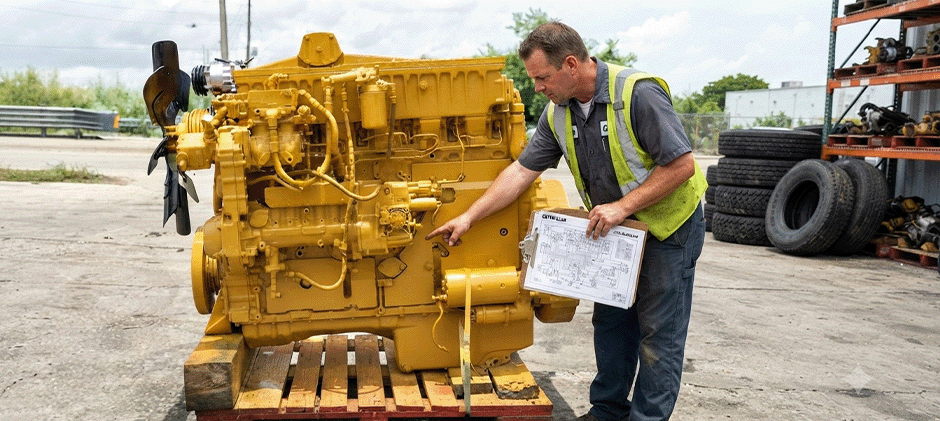
The 3406 CAT Engine has over 30 years of heavy-duty history behind it, and its specs—14.6L displacement, power ratings from 275 to 800 hp, and both mechanical and electronic fuel system variants—have made it a versatile choice across a wide range of applications. This guide covers the essentials. We’ll cover the engine’s history, model identification, key specifications, and a straightforward diagnostic and maintenance approach.
CAT 3406 History: From A to E
The 3406 series went through four main versions over more than three decades. Each one brought something new—from the mechanical simplicity of the first model to the electronic precision of the last.
- The 3406A (1973–1987) kicked off the series. It was a mechanical inline-six, 14.6 liters, with injection from the factory. Power fell between 275 and 425 hp, torque between 1,090 and 1,460. It didn’t have the grunt of the electronic versions that followed, but it had something just as valuable—overbuilt construction and bulletproof reliability. You still see plenty of them in the field, running strong after all these years.
- 3406B (1987–1993) – Brought direct injection, which boosted both power and fuel efficiency. Still mechanical, but better.
- 3406C (1993–1998) – A transitional engine. It added Caterpillar’s PEEC electronic control system but kept mechanical injection—a hybrid approach that improved emissions and fuel economy.
- 3406E (1993–2007) – Went fully electronic. It used Electronic Unit Injection (EUI) for precise fuel delivery, better diagnostics, and cleaner emissions. Many consider it the best of the series—reliable like the mechanical versions, but with electronic refinement.
Core Specifications of the 3406 CAT Engine
Here are the numbers that matter:
| Specification | Detail |
|---|---|
| Configuration | Inline 6-cylinder, 4-stroke diesel |
| Displacement | 14.6L (893 ci) |
| Bore x Stroke | 5.4 in x 6.5 in |
| Compression Ratio | 14.5:1 |
| Aspiration | Turbocharged Aftercooled |
| Dry Weight | Approximately 2,866 lb |
Power Output by Version
| Version | Column 2 | Torque Range |
|---|---|---|
| 3406A | 275–425 HP | 1,090–1,460 lb-ft |
| 3406B | 350–525 HP | 1,350–1,750 lb-ft |
| 3406C | 365–625 HP | 1,350–2,050 lb-ft |
| 3406E | 435–800 HP | 1,450–2,250 lb-ft |
Rated speed for all versions is between 1,800 and 2,100 rpm.
How to Identify Your Engine Version by Serial Number?
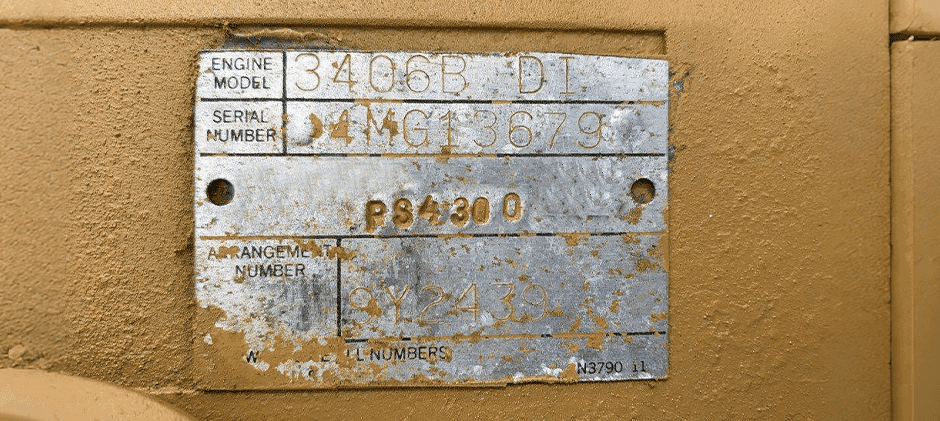
Start with the serial number. It’s stamped on the cylinder block on the turbo side, near the top, close to the cylinder head. If the tag is gone, the stamping is still there.
The prefix tells you exactly which version you have:
| Engine Version | Serial Number Prefixes |
|---|---|
| 3406B | 2EK, 3ZJ, 4CK, 4MG, 5KJ, 7FB, 8TC |
| 3406C | 3ZJ, 4CK, 5KJ, 8PN |
| 3406E | 1LW, 2WS, 5DS, 5EK, 6TS |
For the 3406A, identification is different. Instead of a standard prefix, look for the Arrangement Number or CPL (Critical Parts List) number on the engine data plate. Common examples include 92U, 7XC, 4X series, 6NC, or CPL numbers like 1096, 1223, 1380. Use these numbers when ordering parts.
Note: Some prefixes like 3ZJ, 4CK, and 5KJ show up for both 3406B and 3406C. Always verify the full serial number when ordering parts.
Ordering a rebuild kit or replacement parts without checking this prefix is a gamble you don’t need to take.
How to Troubleshoot Common Faults Quickly?
Here are the most frequent problems and a clear order to check them.
Problem: Engine surges under load, blows black smoke, or loses power
Run through this checklist in order:
- Check the turbocharger – Remove intake and exhaust piping. Inspect for damage, excessive shaft play, or blade wear. This is a common failure point. A turbocharger rebuild kit can address wear issues if caught early.
- Check the air-fuel ratio valve – Located at the rear of the fuel system. Disconnect the charge air line and look for oil. Oil means the diaphragm is torn and the valve needs replacement.
- Check governor flyweights and seat – Wear here causes sticking, which leads to surging.
Problem: Engine overheats with radiator back-pressure
You’ve replaced the thermostat and flushed the radiator, but it still overheats? Try this sequence:
- Radiator blockage – External debris is easy to clean. Internal blockage requires professional service—flushing won’t fix it.
- Coolant return line – Check the 1-inch line from the radiator top to the water pump inlet. Kinked or blocked? That stops circulation.
- Water pump backing plate – The aluminum plate can corrode and restrict flow. Remove it with two 3/8-inch bolts to inspect.
- Head gasket, compressor gasket, liner flange, or radiator cap – Check these only after the items above.
If a head gasket is blown, it typically pushes coolant out first, then the engine overheats—not the other way around.
Problem: Engine oil level keeps rising
Fuel is getting into the crankcase. Common causes:
- Faulty fuel transfer pump leaking internally
- Injector O-rings failing
- Injector nozzle sticking open
Check the transfer pump first—it’s the most likely culprit.
A worn fuel transfer pump is often the source of fuel dilution issues. Replacing it early prevents damage to bearings, liners, and other internal components.
Problem: Electronic issues (3406E)
The 3406E uses a 70-pin ECM. If you get an “ECM Not Responding” message, check the power supply and ECM fuse first. The ECM has an internal battery that can fail over time—if that happens, the ECM needs replacement.
How to Maintain Your CAT 3406 Right: Preventive Essentials
Stick to these intervals, and most major failures never happen. With good maintenance, the 3406 can go 12,000–15,000 hours before an overhaul—some push it to 18,000 hours.
Daily (8–10 hours)
- Check oil level 15 minutes after shutdown. Keep it between MIN and MAX. Overfilling builds crankcase pressure that blows out seals.
- Check coolant level at the “COLD FULL” line. Use Cat EC-1 certified coolant.
Every 250 hours
Change oil and filters. Warm the engine first so contaminants stay suspended. Full-flow filter (1R-1809) and bypass filter (1R-0711), total capacity 28.4 liters.
Every 500 hours
- Replace fuel filters—primary (8C-8196) and secondary (1R-0751)
- Fill new filters with clean fuel before installing—dry start damages the injection pump
- Pull an oil sample for analysis
Every 1,000 hours
Adjust valve lash cold (under 60°C). Intake: 0.38mm, exhaust: 0.76mm. Change coolant to prevent corrosion.
Every 2,000 hours
Inspect the turbocharger. Compressor wheel radial play limit is 0.15mm, axial float under 0.08mm.
At overhaul (12,000–15,000 hours)
Replace cylinder kits, piston rings, and main bearings. Use a quality overhaul kit that includes liners, pistons, rings, bearings, gaskets, and seals. During this work, inspect the fuel transfer pump too—worn units are a common source of fuel dilution that shortens the life of new components.
Conclusion
The 3406 CAT engine has earned its reputation for a reason. It’s durable and reliable when you treat it right. Know your version by the serial number prefix. Follow the diagnostic flow—start with the simple stuff before tearing into the block. Stick to the maintenance schedule and pull oil samples regularly. When it’s time for replacement parts, FridayParts offers a full range of overhaul kits, fuel system components, and engine parts built to keep your CAT 3406 on the job.
