

A skid steer loader is one of the most common compact machines on construction sites, farms, and landscaping jobs. The reason is simple: it handles a long list of tasks without taking up much space. With the right attachment, the same machine can load material, grade a pad, drill fence-post holes, clear snow, or handle general cleanup — often in places where a full-size loader simply won’t fit.
Strictly speaking, a skid steer is a wheeled machine, and a compact track loader (CTL) is the tracked version. In the field, though, people often use “skid steer” as shorthand for both unless the undercarriage difference actually matters to the job.
Why Is It Called a “Skid Steer”?
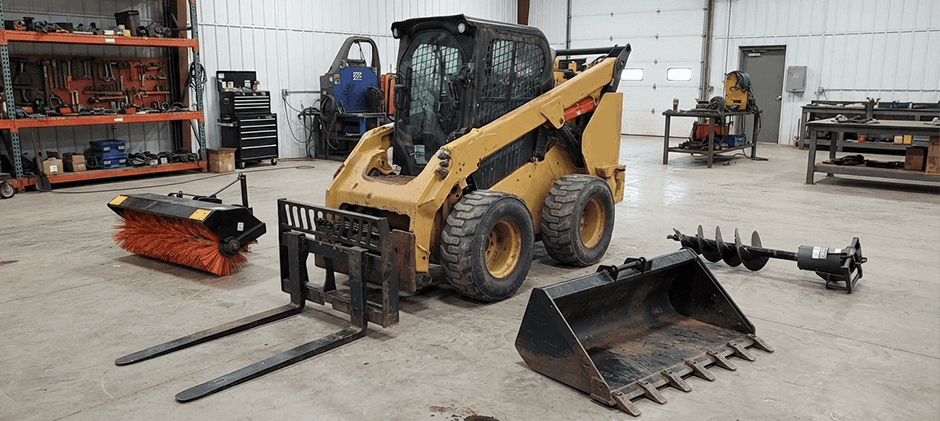
The wheels point straight ahead — they don’t pivot like a car’s front wheels. To turn, one side is driven faster than the other, and the slower side skids across the ground. Operators call this differential steering. Push it to the extreme — one side forward, the other in reverse — and the machine spins around its own center. That turning method is why skid steers work so well in backyards, narrow access lanes, and crowded job sites. In those spots, a machine with a normal turning radius would be stuck maneuvering back and forth all day.
How does a Skid Steer Loader Work?
Three systems define how a skid steer operates:
- Independent side drive — the machine powers each side separately, which is what makes skid steering possible in the first place.
- Loader arms with a quick-attach coupler — a universal mounting plate lets operators swap attachments in under a minute.
- Auxiliary hydraulics — a dedicated hydraulic circuit at the front runs powered attachments.
Without auxiliary hydraulics, a skid steer is basically just a compact loader. With them, it can run everything from augers and trenchers to brooms, grapples, and snow blowers. Because those circuits work under high pressure and constant load. As a result, owners often replace the hydraulic pump ion older machines — often before the rest of the machine is anywhere near end-of-life.
Two Numbers That Matter Most: ROC and Tipping Load
When comparing machines, two capacity ratings usually drive the decision:
- Rated Operating Capacity (ROC) — the safe lifting capacity used for spec comparison.
- Tipping Load — the point at which the machine begins to tip forward under load.
ROC is derived from tipping load: roughly 50% for wheeled skid steers and 35% for CTLs.
On paper, ROC is the headline number. However, in real use, plenty of operators care just as much about lift height, machine width, and hydraulic flow. After all, the machine needs enough flow to run the attachment they use every day. Undersizing leads to instability and premature wear; oversizing means unnecessary cost and, on residential work, more ground damage than the job justifies. Matching ROC to typical task weight — not peak task weight — is usually the more sensible approach.
What Is a Skid Steer Loader Used For?
Skid steers earn their spot on job sites for one reason: attachment versatility. The same machine can move dirt in the morning, sweep pavement at lunch, and drill post holes in the afternoon.
In practice, most owners use them for three kinds of work most often: moving material, grading, and running hydraulic attachments such as augers or trenchers. Snow work, brush clearing, and general farm chores also come up a lot. This is especially true when the machine stays on the property year-round and replaces two or three dedicated pieces of equipment. Because the base machine stays the same, the real question on most jobs isn’t “can a skid steer do this?” — it’s “which attachment do I need, and does my machine have the hydraulic flow to run it?”
Types of Skid Steer Loaders
Skid steers are classified in two ways: by undercarriage (how they move) and by lift path (how the arms travel).
Wheeled vs. Tracked
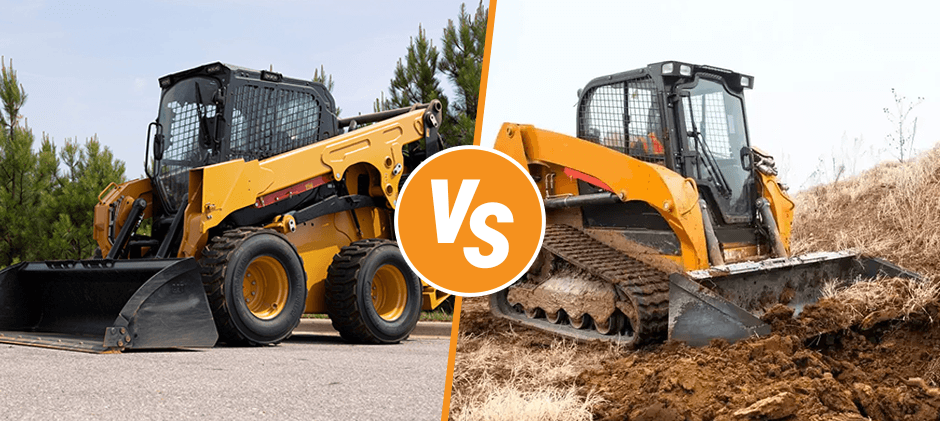
Wheeled skid steers run on four tires. They’re faster on pavement, cheaper to buy and maintain, and best suited to hard, dry surfaces — asphalt, concrete, packed gravel, and indoor work. On soft or muddy ground, they lose traction quickly and tend to leave ruts.
Tracked machines — the CTLs mentioned earlier — run on rubber tracks that spread the machine’s weight over a larger area. That gives them better traction and flotation on wet, soft, sandy, or sloped ground.
Tracks usually win on soft ground, but plenty of owners avoid them if most of their work is on asphalt or concrete, because undercarriage wear gets expensive fast. Zero-radius turns on hard surfaces are especially rough on rubber tracks, and a set of tracks costs several times what a set of tires does. As a rough rule of thumb: hard surfaces lean toward wheels, soft or uneven ground leans toward tracks. Either way, tires, tracks, and rollers are consumables, and their replacement cost should factor into the buying decision — not just the purchase price of the machine.
Radial vs. Vertical Lift
The lift path is how the loader arms move as they raise.
Radial-lift machines swing the bucket in an arc, so reach is greatest at mid-height. That suits digging, grading, backfilling, and general dirt work. Vertical-lift machines keep the bucket closer to vertical as it raises, so reach is greatest near the top of the lift — better for loading high-sided trucks, stacking pallets, and lifting into hoppers.
Operators who dig more often tend to prefer radial; operators who lift and load more often tend to prefer vertical. Most manufacturers offer both in their mid- and large-frame lineups.
Skid Steer Loader Sizes
Skid steers are typically grouped by ROC. Exact boundaries vary by manufacturer, but a common breakdown looks like this:
- Small-frame (light-duty) — under about 1,750 lb ROC. Narrow enough for indoor work, doorways, and residential landscaping.
- Medium-frame — around 1,750–2,200 lb ROC. The most common size on general construction and landscape sites.
- Large-frame — 2,200 lb ROC and above. Higher lift height and breakout force for heavier site work, land clearing, and demanding attachments.
ROC is only half the picture. When sizing a machine, also check lift height, hydraulic flow (standard vs. high-flow), machine width, and operating weight against the actual constraints of the sites you work on.
Common Skid Steer Attachments
The attachment library is what makes a skid steer worth owning. The most widely used tools fall into a few functional groups:
- Material handling — buckets, pallet forks, grapples, bale spears
- Digging and earthwork — backhoes, augers, trenchers
- Grading and finishing — box blades, land planes, dozer blades
- Grounds and site maintenance — rotary brooms, sweepers, mulchers
- Winter work — snow blades, snow blowers, snow pushers
- Land clearing — brush cutters, stump grinders, tree shears
Most hydraulic attachments require adequate auxiliary hydraulic flow, so before pairing a tool with a machine, match the attachment’s flow rating to the loader’s spec. Attachment condition matters as much as machine condition — a worn cutting edge, a dull auger bit, or a torn hydraulic hose all cut into productivity, which is why operators tend to keep replacement parts on hand for the tools they actually use most.
Who Should Choose a Skid Steer Loader?
A skid steer is usually the right fit when the worksite is tight, the tasks change often, and attachment flexibility matters more than raw bucket capacity. That covers most general contractors on small-to-mid-sized sites, landscape and hardscape crews who need one machine to grade, dig, and haul pallets on the same job, and farmers or property owners looking to consolidate a shed full of single-purpose equipment into one versatile machine. Municipalities and facility teams often lean the same way for snow, sweeping, and grounds work.
If the job mostly involves moving high volumes of material in an open area, a wheel loader is usually the better tool for the money.
Final Thoughts
In simple terms, a skid steer loader is a compact machine built to do many jobs with the help of quick-change attachments. That flexibility is why it shows up everywhere from residential landscaping projects to commercial construction sites. If you own one, keeping the right wear parts and hydraulic components on hand matters just as much as choosing the right attachment in the first place. For aftermarket skid steer parts that fit most major brands — from hydraulic components to undercarriage wear parts — FridayParts is a solid place to start.
