

Four figures matter most when picking Boom Lift Sizes: working height, horizontal reach, width, and weight. A small sizing mistake can lead to access issues, hard movement on site, or trouble with safe setup. To help avoid that, the guide below breaks down the key specs and shows which ones matter most in real jobs.
What Boom Lift Sizes Usually Mean?
When people talk about boom lift sizes, they usually mean height first. In real use, size is a combination of several dimensions that affect access, safety, transport, and productivity.
The two main boom lift types are:
| Type | Best use | Main advantage | Main limit |
|---|---|---|---|
| Articulating boom lift | Working around roofs, pipe racks, steel, and obstacles | Up-and-over access | Usually less direct outreach than a straight boom |
| Telescopic boom lift | Long, direct reach to open work areas | Strong horizontal reach | Less flexible around obstacles |
That is the first choice. The second is the size range.
Common Size Ranges

Most boom lift sizes fall into these groups:
| Size range | Typical working height | Typical use |
|---|---|---|
| Compact | 30 ft to 45 ft | Indoor work, light exterior service, tighter access |
| Mid-range | 45 ft to 80 ft | General construction, facility work, sign work, utility tasks |
| High-reach | 80 ft and up | Large commercial jobs, industrial sites, bridges, tall structures |
This is where many buying mistakes begin. A taller lift is not always the better lift. On rough ground, machine width and weight can matter just as much as height.
To keep the decision simple, ask these questions first:
- How high is the work point
- How far out does the platform need to reach
- How narrow is the access route
- How firm is the surface under the machine
If one of those answers is off, the lift size is probably off too.
A quick parts note also helps here. When checking used machines, it makes sense to inspect boom lift control parts, hydraulic cylinder seal kits, and platform basket components early, because wear in those areas can affect daily use and repair costs.
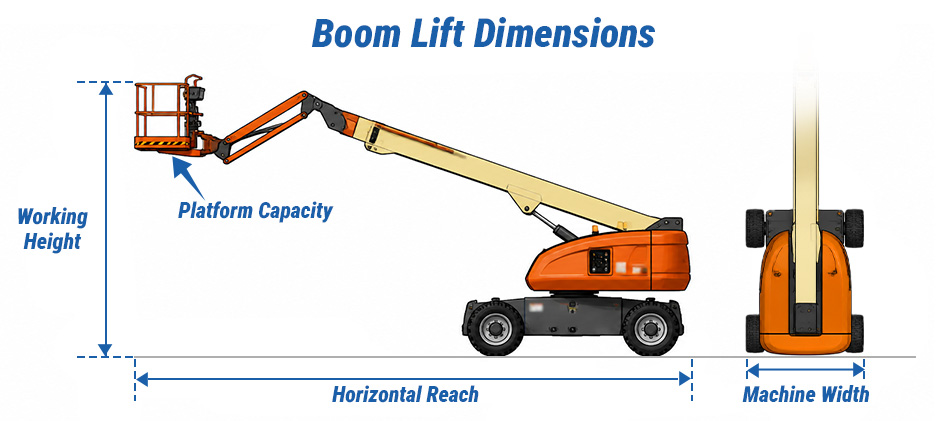
The Four Boom Lift Dimensions That Matter Most
A spec sheet may list many numbers, but four of them decide most jobs. This is the part readers usually want answered early, so it helps to keep it plain.
Working Height
Working height is the estimated height a worker can reach from the platform. It is usually higher than the platform height.
For example:
- A 40 ft platform height machine may offer about 46 ft of working height
- A 60 ft platform height machine may offer about 66 ft of working height
This is useful, but it is not enough by itself.
Horizontal Reach
Horizontal reach tells you how far the platform can extend outward. This often matters more than extra height when the job is blocked by obstacles.
Common examples:
- Wall work with setbacks
- Roof edge access
- Pipe racks
- Equipment placed behind barriers
- Work on landscaping or uneven shoulders
A lift that is tall enough but short on outreach can cause constant repositioning.
Machine Width
Width decides whether the machine can get through gates, between materials, or into a narrow work area. This is one of the most overlooked parts of boom lift sizes.
Check width against:
- Site gates
- Yard entrances
- Aisles
- Trailer space
- Stored material lanes
- Building access points
Even a few inches can decide whether the machine fits or not.
Operating Weight
Operating weight affects transport, delivery cost, storage planning, and site suitability. Heavy machines can become a problem on soft ground or sensitive slabs.
Weight matters on:
- Muddy or wet ground
- Recently filled areas
- Trench edges
- Suspended slabs
- Curbs and paved shoulders
This is also a good time to inspect steer axle parts, tire and wheel assemblies, and outrigger sensor parts on applicable models, because wear there changes how the machine handles on site.
Quick Reference Table
| Spec | What it tells you | Why it matters |
|---|---|---|
| Working height | Maximum reach upward for the operator | Confirms the job can be reached |
| Horizontal reach | Maximum distance outward | Helps clear obstacles |
| Machine width | Overall width in travel position | Confirms site access |
| Operating weight | Total machine mass | Affects ground load and transport |
Boom Lift Sizes by Job Type
The easiest way to choose among boom lift sizes is to match the machine class to the work environment. Height is still part of the answer, but the job usually points to the right size range first.
Compact Boom Lift Sizes
Compact units in the 30 ft to 45 ft class are useful when access is limited, and the work is not extremely high.
Typical uses include:
- Interior maintenance
- Low-rise exterior repair
- Sign installation
- Warehouse access
- Mechanical and electrical work
Main advantages:
- Easier to transport
- Easier to store
- Better fit for tighter sites
- Lower operating burden in many cases
Main limits:
- Less outreach
- Lower platform height
- Not ideal for larger exterior jobs
Mid-Range Boom Lift Sizes
Mid-range units from about 45 ft to 80 ft are often the most practical choice for mixed-use fleets and owner-operators.
Typical uses include:
- Commercial construction
- Building envelope work
- Utility maintenance
- Steel and framing access
- Exterior service work
Why this class works well:
- Good mix of reach and mobility
- Broad job coverage
- More useful across changing sites
- Often, the best balance between capability and cost
This size class is also where regular inspection of boom section wear pads, lift cylinder pins, and joystick control parts can help prevent downtime. For fleet owners and service managers, sourcing aftermarket parts from brand-specific suppliers—such as JLG boom lift parts and Skyjack boom lift parts—can simplify inventory planning.
High-Reach Boom Lift Sizes
Large units above 80 ft handle taller and more open work areas, but they ask more from the site.
Typical uses include:
- Industrial plants
- Stadiums
- Bridges
- Tall commercial exteriors
- Large structural work
What to expect:
- More setup space
- Higher transport demands
- More weight on the ground
- More planning before delivery
For many owners, this class only makes sense if jobs truly need the extra reach often enough to justify the extra operating burden.
How To Choose The Right Boom Lift Size?
Off-road work changes the decision. A boom lift that looks right on paper may not work well on soft or uneven ground. This is where boom lift sizes need to be checked against the site, not just the task.
Check The Work Envelope First
Before looking at brands or machine age, map the work area.
Measure:
- Required working height
- Required horizontal reach
- Obstacle height
- Setback distance from the work face
- Clearance around the machine path
This helps answer a basic question: is the machine reaching up, reaching out, or reaching over something?
Check Ground Conditions Early
Off-road sites often have changing surfaces. A lift may work well in one part of the property and struggle in another.
Look at:
- Soil firmness
- Gravel depth
- Mud and standing water
- Slopes
- Trench edges
- Fresh fill
- Surface rutting
On these sites, a large machine can create more trouble than benefit if the ground is marginal.
Check Access Route Before Delivery
A lift may fit the job area but still fail to reach it.
Measure the route for:
- Gate width
- Tight turns
- Overhead limbs or piping
- Trailer unload space
- Surface slope at entry points
This step saves time and prevents expensive delivery problems.
Match Size With Rough-Terrain Features
Not every rough-terrain machine behaves the same. Size and off-road ability are related, but they are not the same thing.
Check for:
- Four-wheel drive
- Tire type
- Axle movement
- Ground clearance
- Gradeability rating
- Platform capacity at reach
That last point matters. Some machines lose platform capacity when fully extended.
A machine in good shape should also have dependable drive motor parts, hydraulic hose assemblies, and boom angle sensor parts, especially if it works on rough jobs often.
Common Boom Lift Sizing Mistakes
Many sizing errors are easy to avoid once the selection process is slowed down for a few minutes.
Choosing By Height Alone
This is the most common mistake. A lift can have enough vertical reach and still fail the job because it cannot clear a barrier or extend far enough outward.
Ignoring Width And Stowed Size
A machine that cannot pass through the entrance is not a real option. Width should be checked before comparing extra features.
Going Too Large For The Site
A bigger lift may look safer because it has more reach in reserve. In practice, it can create transport issues, storage issues, and access limits.
Underestimating Weight
Weight affects:
- Site damage risk
- Trailer choice
- Ground pressure
- Maneuvering on weak surfaces
Forgetting The Service Side
A low-priced used lift may still become expensive if key service parts are neglected. It helps to review platform control boxes, charger units for electric boom lifts, and swing bearing components when comparing ownership costs.
Mistake Table
| Mistake | What happens | Better check |
|---|---|---|
| Choosing by height only | Repositioning or failed access | Check outreach and obstacle path |
| Ignoring width | The machine cannot enter the site | Measure the gate and lane width |
| Choosing too large a class | Transport and site handling issues | Match lift to actual job frequency |
| Ignoring weight | Surface damage or poor mobility | Review the ground condition and haul plan |
Ownership Factors By Boom Lift Size
For owners, the best machine is not just the one that can do the biggest job. It is the one that earns steady use without creating constant extra cost.
Compact Classes
Compact machines usually offer:
- Simpler storage
- Easier hauling
- Lower site impact
- Good use of repeat service work
They are a practical fit when most jobs stay in the lower height range.
Mid-Range Classes
Mid-range boom lift sizes are often the best fit for owners who need flexibility. They cover a wide range of commercial and off-road tasks without moving into the highest transport and ground-load demands.
This class often gives the best balance of:
- Reach
- Job versatility
- Resale appeal
- Manageable service cost
High-Reach Classes
Large boom lifts can be productive, but only when the workload supports them. If tall jobs are occasional, ownership may be harder to justify than rental.
Review these cost factors:
- Delivery and hauling
- Tire replacement
- Hydraulic service
- Battery or engine system upkeep
- Inspection workload
- Downtime exposure
This is where dependable replacement engine service parts, hydraulic pump parts, and electrical harness components become important to long-term uptime.
Final Words
The right boom lift size choice comes from matching height, reach, width, and weight to the real jobsite. For off-road work, ground conditions and access limits matter just as much as lift height. If replacement parts are needed, FridayParts offers aftermarket parts with affordable pricing, a vast inventory, and wide compatibility across many heavy equipment brands.
