

Don’t price a new radiator just yet—most clogs are repairable. The issue is either airflow blocked by dirt and debris, or coolant flow choked off by rust and scale on the inside. A few early warning signs of a clogged radiator can save you a lot of trouble—temps climbing when you work the machine, coolant dumping into the overflow, or cold spots on the radiator even after it’s been running a while. This guide shows you the signs to spot, how to confirm the problem, and what to do about it—before the heat starts taking a toll on the rest of the system.
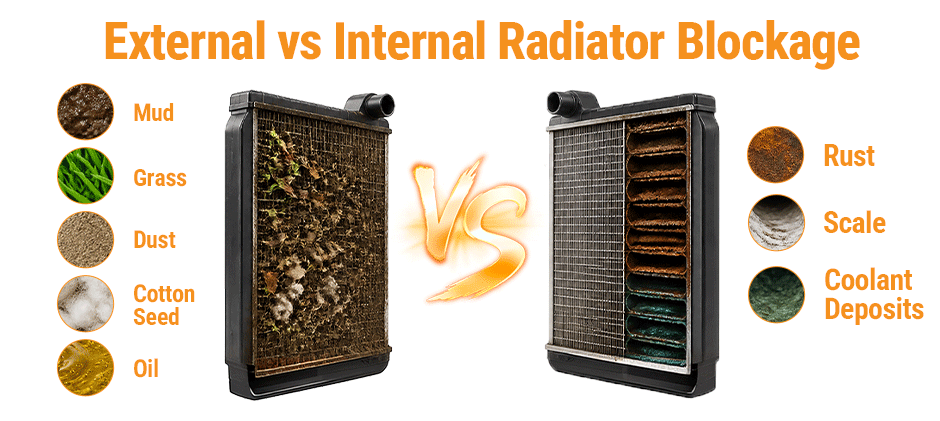
Symptoms That Point to a Clogged Radiator
The quick take: if your machine runs hot when you push it, the coolant keeps ending up in the overflow, and the radiator feels cool or inconsistent even with the fan on—that’s the radiator crying out for attention. Those three signs are your best clue.
Still, not every hot-running machine has a blocked core. That is why the next step is to look for patterns, not just one symptom.
1. Overheating during work
This is the most common warning sign. If the temperature gauge climbs while digging, pushing, lifting, grading, or running long work cycles, but drops once the load is reduced, restricted cooling is a likely cause. The engine is making heat faster than the radiator can remove it.
This pattern often points to one of two problems:
- External blockage on the fins
- Internal restriction in the coolant passages
If overheating appears mostly during heavy use, a clogged radiator is more likely than a random sensor fault.
2. Coolant loss or overflow
A blocked radiator can create hot spots inside the system. When coolant cannot move or cool down properly, pressure rises, and coolant may be pushed into the tank or out past the cap. You may notice:
- The overflow tank stays too full after work
- The radiator level is low after cool-down
- There is coolant smell but no major external leak
At this stage, checking the radiator cap is also a smart move. A weak cap can worsen boil-over and make diagnosis harder.
Also see:
How Does a Radiator Cap Work and What is its Function?
Is Your Radiator Cap Really Bad? 7 Warning Signs to Tell You
3. Cold spots across the core
A healthy radiator usually warms up evenly. If one area is hot and another stays much cooler, internal passages may be blocked. This is one of the most useful signs of a clogged radiator, especially when overheating is already happening.
Always inspect temperature only after safe shutdown and cooling procedures. Never remove the cap on a hot system.
4. Poor cooling even with the fan working
If the fan is running, belt tension is correct, and airflow still seems weak, the radiator may not be able to release heat. This often happens when mud, dust, seed fluff, or oily dirt packs into the fins or between cooling cores.
In field and jobsite conditions, this is often the first place to look.
How to Confirm the Problem Before Replacing Parts?
Replacing parts too early wastes time and money. A better approach is to confirm whether the problem is airflow, coolant flow, or another cooling-system fault.
1. Inspect the outside of the core first
Start with the simplest check. Look at the face of the radiator and the space between stacked coolers. Debris often hides between the radiator and nearby oil coolers, not just on the front surface.
Use a flashlight test:
- Shine light through one side of the core
- Look from the opposite side
- Poor light pass-through usually means blocked airflow
Also look for bent fins, packed mud, and oily dust.
2. Check coolant condition
Once the system is fully cool, inspect the coolant. Dirty coolant does not prove a clogged radiator by itself, but it is a strong warning sign.
Signs to watch for:
- Rust-brown color
- Thick or cloudy fluid
- Visible particles
- Sludge around the filler neck
If coolant looks dirty, internal restriction becomes more likely. At that point, a flush may help, but only if the core is not badly damaged.
A good time to inspect the condition of the coolant reservoir tank and radiator hoses (including the upper and lower radiator hoses) is during the same check.
Also see: The Top 8 Signs of a Bad Radiator Hose
3. Rule out other cooling problems
A clogged radiator is common, but it is not the only cause of overheating. Before pulling the radiator, check these parts:
| Part | What to Check | Why It Matters |
|---|---|---|
| Thermostat | Opens at the correct temperature | A stuck thermostat can mimic radiator blockage |
| Water pump | Leaks, noise, belt drive, circulation | Weak flow can cause the same overheating pattern |
| Radiator cap | Seal and pressure holding ability | Low pressure lowers boiling point |
| Fan system | Belt, clutch, motor, or hydraulic drive | Poor airflow reduces cooling even with a good radiator |
| Hoses | Soft spots, collapse, leaks | A collapsed hose can restrict flow |
This step matters because a clogged radiator should be confirmed, not assumed.
Best Fixes for a Clogged Radiator
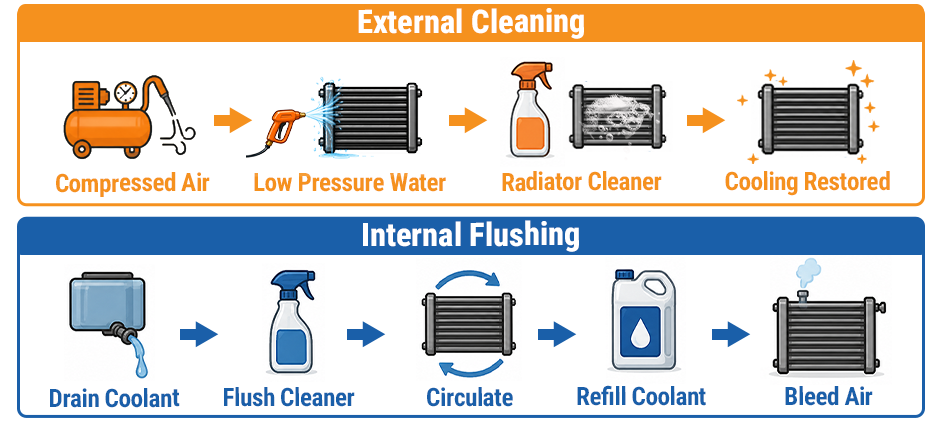
The repair depends on where the blockage is. External blockage and internal blockage are different problems, so they need different fixes.
1. Clean external blockage
If the fins are packed with dust, mud, grass, or oily dirt, start with external cleaning. In many cases, this restores cooling quickly.
Best practice:
- Use low-pressure compressed air first
- Blow from the fan side outward when access allows
- Keep enough distance to avoid folding fins
- Use low-pressure water only if dry debris will not come out
- Use a radiator-safe cleaner for oily buildup
Do not force a high-pressure stream directly into the fins. Flattened fins reduce airflow and create a new problem.
If your unit uses a cooling stack, clean the entire stack, not only the front face.
2. Flush internal deposits
If the core is blocked inside, cleaning the fins will not solve the problem. Rust, scale, and old coolant deposits need a proper flush.
Basic process:
- Let the engine cool fully
- Drain old coolant from the system
- Add a suitable cleaning solution as directed
- Run the engine long enough for circulation
- Drain and flush with clean water
- Refill with the correct coolant mix
- Bleed air from the system if required
This can help when blockage is moderate. However, a flush may not restore full flow if many tubes are already restricted.
3. Repair or replace when flow does not recover
If the machine still overheats after cleaning and flushing, the radiator may be too restricted or too damaged to save. Cracks, leaks, corroded tubes, or a weak fin structure usually indicate the core is near the end of its service life. When replacement becomes the right call, upgrading to a new radiator is often more cost-effective than chasing recurring issues.
Also see: How to Repair a Radiator Leaking?
What Usually Causes a Clogged Radiator?
Once the immediate problem is solved, the next job is stopping it from coming back.
Debris blocking airflow
This is the most common cause in dusty, muddy, and plant-heavy work areas. Dry material packs into the fins, then oil and moisture help it stick. Over time, airflow drops sharply.
Rust and scale inside the core
Using the wrong coolant, delaying coolant service, or filling with poor-quality water can lead to corrosion and mineral buildup. Since radiator tubes are narrow, it does not take much buildup to reduce flow.
Poor cooling system maintenance
A clogged radiator often starts long before the first overheating event. If coolant is not checked, the cap is weak, or hoses are aging, heat control becomes less stable, and deposits build faster.
How to Reduce Future Radiator Blockage?
A few routine checks can prevent most clogged radiator problems and cut downtime.
- Inspect the core face often in dusty or muddy conditions
- Clean debris before it hardens into the fins
- Check coolant level and condition on a schedule
- Replace coolant at the interval listed for the machine
- Inspect the radiator cap, radiator hose, and thermostat during cooling service
- Watch for repeated overflow after hard work
If the same overheating pattern returns after cleaning, do not keep running the machine hot. Early repair costs far less than engine damage.
Final Words
A clogged radiator is often salvageable if you don’t ignore it too long. The main signs are pretty straightforward—overheating under load, coolant getting pushed into the overflow, and cold spots on the radiator face. Before you pull the trigger on a new one, check airflow, take a look at the coolant, and check the other components that help keep things cool. If replacement is needed, FridayParts offers aftermarket cooling parts with solid quality, fair pricing, broad compatibility, and a large inventory to help reduce downtime.
