

If you need to order replacement parts or confirm exact specifications for a Fendt tractor, the safest starting point is a chassis number lookup. The chassis number identifies the exact machine, version, and production configuration, which makes parts matching far more accurate than searching by model name alone. This guide explains where to find the number on North American Fendt tractors, how to read its structure, and how to use it to narrow down model family, version, braking setup, and production series.
Where Is the Fendt Chassis Number Located?
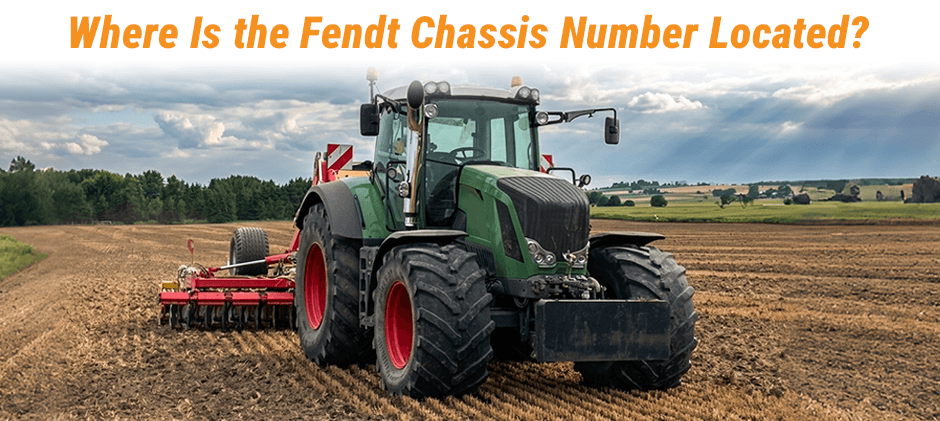
Depending on the model and production year, the chassis number may be stamped directly into the tractor or shown on the factory identification plate. Common locations include:
- The right-hand frame rail, often near the front axle
- The identification plate, such as inside the cab door frame, near the steps, or on the firewall
- Service records or delivery paperwork, if the plate is dirty, worn, painted over, or hard to read
Before recording the number, clean the area carefully and copy the full sequence exactly as shown. Even one incorrect digit can send a chassis number lookup in the wrong direction and return parts for the wrong machine.
How to Decode a Fendt Chassis Number?
Many North American Fendt chassis numbers follow a three-part structure:
XXX / XX / XXXX
Each part helps identify a different aspect of the tractor:
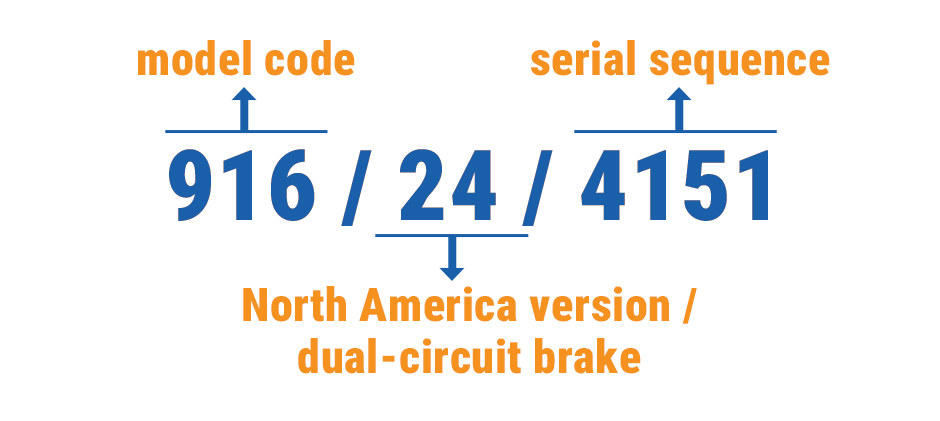
| Section | Meaning |
|---|---|
| First part | Model code or tractor family |
| Middle part | North American version code |
| Last part | Sequential serial number |
In many cases, the first part identifies the tractor series or internal model family. The middle part identifies the North American version and, on some series, may also help distinguish braking configuration. The last part is the sequential serial number, which can help separate pilot units, early production tractors, later production updates, or important build changes within the same family.
In certain North American Fendt series, /22 is commonly associated with a single-circuit trailer brake configuration, while /24 is commonly associated with a dual-circuit configuration, although exceptions do exist. Because this is not a universal rule across all Fendt families, the full chassis number should always be used when confirming fitment for brake system parts.
Farmer 200 Series
For the Farmer 200 series, the chassis number format is based on the 2XX code group.
| Chassis Code | Model |
|---|---|
| 210 | 206V |
| 212 | 207V |
| 213 | 208V |
| 214 | 209V |
| 221 | 208P |
| 222 | 209P |
Example: 210/22/1270 identifies a North American tractor in the 206V family.
400 Vario
For the 400 Vario series, the model code references are:
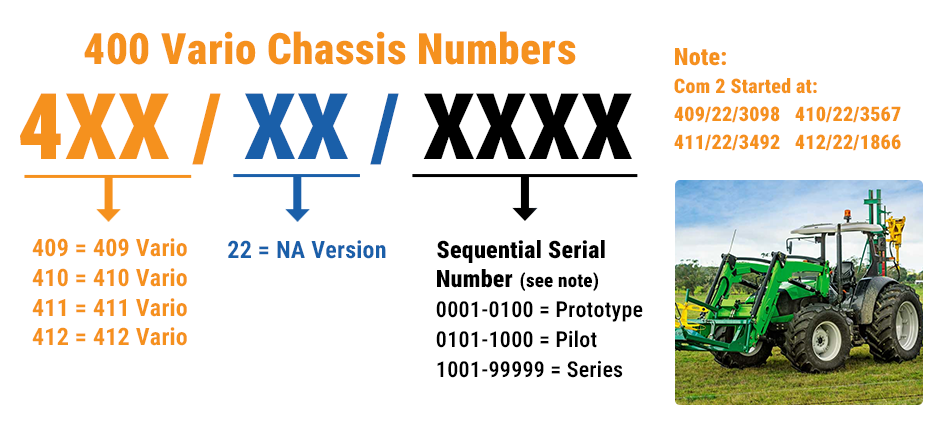
| Chassis Code | Model |
|---|---|
| 409 | 409 Vario |
| 410 | 410 Vario |
| 411 | 411 Vario |
| 412 | 412 Vario |
Important Com 2 starting points in this series include:
- 409/22/3098
- 410/22/3567
- 411/22/3492
- 412/22/1866
These breakpoints matter because tractors before and after the same threshold may use different configurations within the same model family.
700 Vario
For the earlier 700 Vario series, the main code references are:
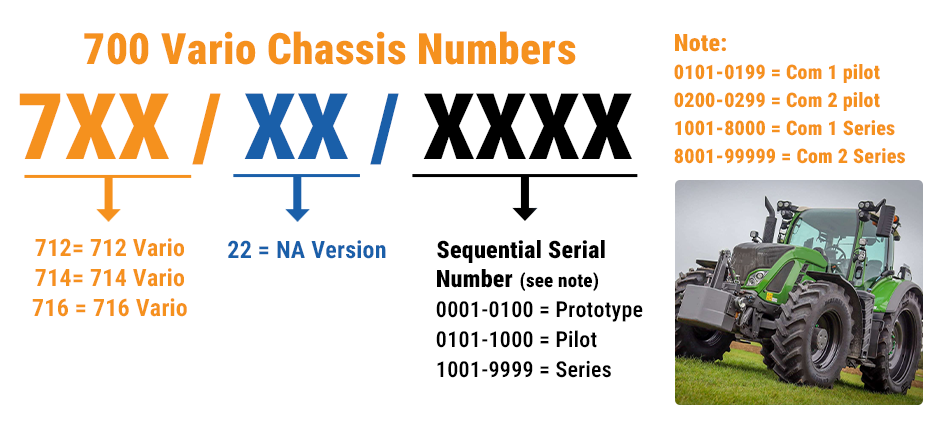
| Chassis Code | Model |
|---|---|
| 712 | 712 Vario |
| 714 | 714 Vario |
| 716 | 716 Vario |
Within this family, the serial ranges also distinguish production stages:
- 0101–0199 = Com 1 pilot
- 0200–0299 = Com 2 pilot
- 1001–8000 = Com 1 series
- 8001–99999 = Com 2 series
700 Vario Com 3
For 700 Vario Com 3 tractors, the code references change to:
| Chassis Code | Model |
|---|---|
| 724 | 712 Vario |
| 725 | 714 Vario |
| 726 | 716 Vario |
| 727 | 718 Vario |
800 Vario
For the earlier 800 Vario series, the relevant model code references are:
| Chassis Code | Model |
|---|---|
| 715 | 815 Vario |
| 717 | 817 Vario |
| 718 | 818 Vario |
It is important not to confuse a chassis code with a sales model name. In Fendt numbering, the same digits may appear in different contexts, so code 718 in one family does not automatically mean the tractor is a 718 Vario model.
800 Vario Com 3
For 800 Vario Com 3, the code references are:
| Chassis Code | Model |
|---|---|
| 729 | 818 Vario |
| 731 | 820 Vario |
800 Vario S3b (Tier 4i)
For 800 Vario S3b (Tier 4i) tractors, the model code references are:
| Chassis Code | Model |
|---|---|
| 832 | 819 Vario |
| 833 | 822 Vario |
| 834 | 824 Vario |
| 835 | 826 Vario |
| 836 | 828 Vario |
In this family, the middle code may help distinguish North American version differences and should be checked together with the full chassis number when confirming parts fitment.
900 Vario Series: Read This First
The 900 Vario family needs extra care because several chassis codes appear in more than one generation. For example, 916, 920, 924, and 926 are repeated across different 900-series groupings, so the first code alone is not enough to identify the exact tractor generation.
If your chassis number begins with one of these repeated codes, compare the complete number, including the serial section, before deciding which generation table applies. This is especially important when replacing bearing, gear & shaft parts.
900 Vario Gen 1
For 900 Vario Gen 1, the model code references include:
| Chassis Code | Model |
|---|---|
| 920 | 920 Vario |
| 924 | 924 Vario |
| 926 | 926 Vario |
900 Vario Gen 2
For 900 Vario Gen 2, the model code references are:
| Chassis Code | Model |
|---|---|
| 916 | 918 Vario |
| 920 | 920 Vario |
| 924 | 924 Vario |
| 926 | 926 Vario |
Important Com 2 starting points in this generation include:
- 916/24/4151
- 920/24/4141
- 924/24/4126
- 926/24/4441
These are useful reference points when checking build differences within Gen 2 tractors.
900 Vario Gen 3
For 900 Vario Gen 3, the model code references are:
| Chassis Code | Model |
|---|---|
| 916 | 918 Vario |
| 920 | 920 Vario |
| 924 | 924 Vario |
| 926 | 926 Vario |
| 930 | 930 Vario |
900 Vario Com 3
For 900 Vario Com 3, the model references differ from the standard 900 Vario tractors:
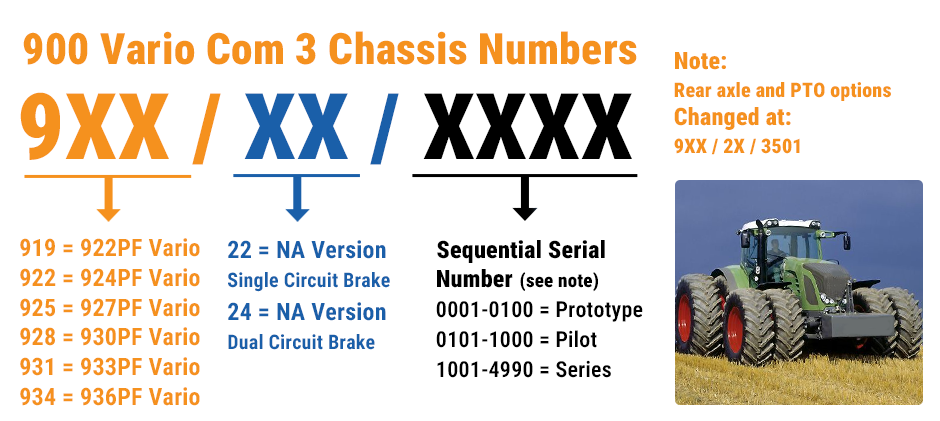
| Chassis Code | Model |
|---|---|
| 919 | 922PF Vario |
| 922 | 924PF Vario |
| 925 | 927PF Vario |
| 928 | 930PF Vario |
| 931 | 933PF Vario |
| 934 | 936PF Vario |
A key breakpoint in this group is serial number 3501. Tractors on either side of that threshold may require different checks when replacing certain transmission parts.
900 Vario S3b (Tier 4i)
For 900 Vario S3b (Tier 4i), the model code references are:
| Chassis Code | Model |
|---|---|
| 941 | 924PF Vario |
| 942 | 927PF Vario |
| 943 | 930PF Vario |
| 944 | 933PF Vario |
| 945 | 936PF Vario |
As with other North American Fendt families, the middle code may help distinguish version differences and should be verified together with the full chassis number before ordering parts.
How to Use a Fendt Chassis Number Lookup?
Once you find the chassis number, a chassis number lookup works best in a practical sequence:
- Write down the full number exactly as shown.
Do not rely on memory, and do not drop the middle or last section. - Identify the first code section.
This helps narrow the tractor to the correct family or internal model group. - Check the middle code.
On some North American models, it helps distinguish the version and brake-related configuration. - Use the final serial section to check the production stage or breakpoints.
This is especially important on series where the same model code appears across more than one generation or update. - Use the full chassis number when ordering parts or confirming specifications.
If a parts listing, dealer, or supplier asks for the serial number, provide the entire chassis number rather than only the model name.
Common Mistakes to Avoid
Production Year as a Cross-Check
Approximate production year can still be helpful, but it should be treated as a cross-check against the chassis number lookup, not the primary identifier.
This is most useful when:
- The same chassis code appears across more than one generation
- The tractor falls near a known production breakpoint
- The machine has features that suggest a later update or platform change
If the tractor’s year, model badge, and full chassis number do not all point in the same direction, trust the complete chassis number first and verify the rest against it.
Conclusion
A Fendt chassis number lookup does more than confirm the tractor’s model name. It helps narrow down the correct family, version, and production stage, which makes parts matching more accurate and helps reduce costly ordering mistakes. Once the full chassis number has been confirmed, sourcing the correct replacement parts becomes much easier. If you are looking for parts for Fendt tractors or other off-road heavy equipment, FridayParts can be a practical place to start.
