

This guide covers an off-road Cummins diesel engine — the kind you’ll find in construction, farming, industrial work, and power generation equipment. Two engines with the same model name can still leave the factory with different injectors, turbos, emissions components, and calibrations. That is why accurate parts fitment usually starts with the ESN and CPL, with the engine rating used as an additional check where needed.
Everything below comes down to three steps:
- Step 1 — Identify the engine by ESN and CPL, not by model name.
- Step 2 — Maintain it by duty cycle, not by a generic schedule.
- Step 3 — Match parts to the exact build before ordering, especially on rebuilt engines or machines with unclear service history.
In off-highway equipment, service intervals are typically tracked in hours, and this convention is used throughout this guide.
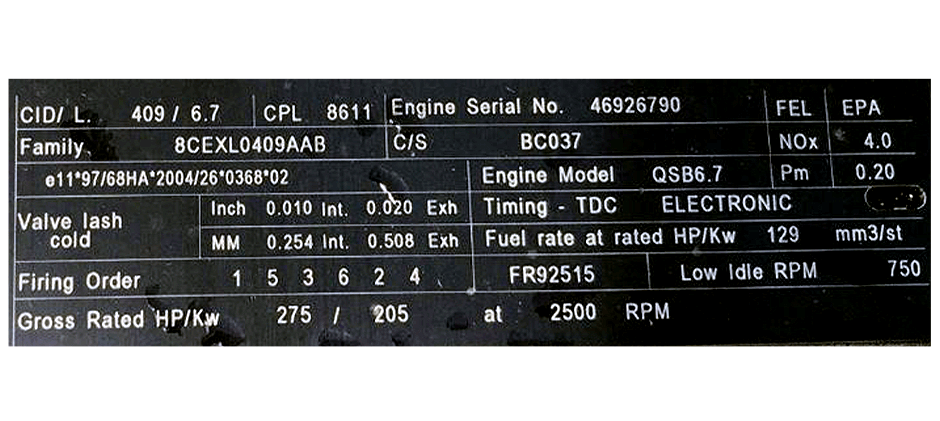
How to Identify a Cummins Diesel Engine?
Identifying the engine correctly is the foundation of every parts and service decision that follows. It starts with the model family, then narrows down to the exact build through the ESN and CPL. Skipping this step is the single most common reason parts don’t fit or get returned.
The Cummins Off-Highway Engine Family
Off-highway Cummins diesel engines commonly use the QSB, QSL, QSX, and QSK names, covering construction, agricultural, mining, and industrial applications.
| Model | Displacement | Typical Use |
|---|---|---|
| QSF2.8 / QSF3.8 | 2.8–3.8 L | Skid steers, compact loaders |
| QSB4.5 / QSB6.7 | 4.5–6.7 L | Excavators, backhoes, tractors |
| QSL9 | 8.9 L | Wheel loaders, cranes, gensets |
| QSX15 | 15 L | Large dozers, mining support |
| QSK19 – QSK60 | 19–60 L | Mining trucks, large industrial power |
Knowing the family narrows the engine down, but ordering parts still requires the ESN and CPL.
Where is the Cummins Diesel Engine Data Plate Located?
The data plate is usually found on the valve cover, rocker housing, gear cover, or the side of the block near the fuel pump. On machines that have spent a few years on site, the plate is often oil-soaked, painted over, or partly unreadable. If that’s the case, clean off the ESN stamped directly into the block and verify it there — it’s the more reliable source.
Reading the ESN
The ESN (Engine Serial Number) is typically 8 digits, sometimes with additional characters on newer builds. It appears both on the data plate and stamped into the block. Without it, everything downstream — CPL lookup, service records, part numbers — is guesswork.
Reading the CPL
The CPL (Critical Parts List) is a 4-digit code covering the exact factory build: pistons, camshaft, injectors, turbo, emissions calibration. Two engines with the same model and even the same rating can carry different CPLs, and the internal parts will not always cross over.
As a rule of thumb, CPL matters most for injectors, turbochargers, pistons, head gaskets, and emissions-related parts. For basic consumables like standard filters or belts, model and rating are sometimes enough — but ESN is still safer.
What “Rating” Actually Means?
The engine rating usually refers to the horsepower and governed RPM shown on the data plate. It helps distinguish engines that share the same model but are tuned for different applications — for example, two QSB6.7s can leave the factory with very different power settings depending on the machine they were built for.
Common mistake — ordering by model only.
This happens most on rebuilt engines, repowered machines, and units that have changed hands a few times. The model on the tag tells you the family; the ESN and CPL tell you the actual engine.
Using QuickServe Online — and Where It Falls Short
Cummins offers a free lookup tool called QuickServe Online. Enter the ESN, and you’ll see the original factory build, part numbers, and service documents. For a stock engine still in original condition, it works very well.
Where it gets misused: QuickServe reflects what left the factory, not what’s currently installed. On rebuilt engines, it’s common to see a turbo, injectors, or ECM that no longer match the original CPL record. On any engine that has been rebuilt or has unclear service history, treat QuickServe as a starting point, then confirm the installed part physically before ordering.
Three Ordering Mistakes to Watch For
- Ordering by model only. “It’s a QSB6.7” is not enough. Two QSB6.7s can have different injectors, different turbos, and different aftertreatment.
- Trusting the original data plate on a rebuilt engine. The plate rarely gets updated when internals change.
- Matching by photo or appearance. Fuel filters that look identical can have different micron ratings; water pumps with the same bolt pattern can have different impeller directions; sensors with matching connectors can still have different signal ranges.
Four Pieces of Info to Have Ready Before You Order
- Engine model (e.g., QSB6.7)
- ESN (stamped on block, ideally verified against the plate)
- CPL (4 digits)
- Engine rating (horsepower and governed RPM)
If you provide all four when you ask for a quote, the supplier can usually confirm whether the part is correct much more quickly.
How to Maintain a Cummins Diesel Engine by Duty Cycle?
Cummins publishes service intervals, and you should follow them — but the interval that actually keeps the engine alive depends on what the machine does day to day. A 500-hour oil interval on a genset running clean load is not the same as 500 hours on a wheel loader in a quarry. Proper maintenance of a Cummins diesel engine always depends more on operating conditions than on a generic schedule.
Before choosing an interval, ask three simple questions:
- Does the machine work in dust?
- Does it spend long hours idling?
- Does it often run under light load?
Those three conditions usually matter more than the calendar.
Engine Oil & Cummins CES Specs
Cummins publishes its own oil standards on top of API grades:
- CES 20086 — current, aligns with API CK-4
- CES 20081 — older EGR engines, aligns with API CJ-4
- CES 20087 — low-viscosity FA-4 for select applications
If you are buying oil, match the CES number in the engine manual before looking at the marketing label on the container — the API category on the front isn’t always enough on its own.
Adjusting Intervals to the Job
Dusty sites (quarries, demolition, dry agriculture). Air filtration problems usually show up before oil issues. Watch the restriction gauge rather than the hour meter, and inspect both the primary and safety elements together. Fuel filters also load faster because of refueling contamination, so keep the standard water-separator-plus-fine-filter layout intact even on aftermarket setups.
High-idle operation (urban construction, port equipment, standby gensets). Long idle time is harder on engines than most owners realise — injectors carbon up, and oil ages by hours the engine is barely doing work. Shorten oil intervals here rather than stretch them. On emissions-equipped engines, watch for signs that the DPF is not regenerating properly — frequent regen attempts or warning lights usually mean the duty cycle is too light for passive regen to work.
Low-load or cold-climate duty. Chronic under-loading is one of the more common causes of turbo carbon build-up and DPF issues — the fix is usually operational (occasional loaded runs), not a new turbo. Before shutdown, give the turbo 2–3 minutes at idle. In cold climates, coolant condition matters more than most schedules suggest.
A Note on Coolant Chemistry
Cummins runs two coolant families — conventional coolant with a DCA4 additive that’s topped up on a test schedule, and ES Compleat OAT, which uses an extender instead. These two chemistries should not be mixed; cross-contamination causes gel and blocked passages. On used machines with unclear service history, a full flush before topping up is the safer starting point. For DEF, only ISO 22241-compliant fluid should be used, and it should be protected from freezing in winter and from long summer heat in storage.
Service Intervals — Adjust to Duty Cycle
| Task | Baseline Interval | Notes |
|---|---|---|
| Oil & oil filter | 250–500 hrs | Shorter for dusty or idle-heavy work |
| Fuel filters | ~500 hrs | Primary + secondary |
| Air filter | On restriction | Not by hours |
| Coolant test | ~500 hrs | Add DCA4 or extender as needed |
| Coolant change | 6,000 hrs / 6 yrs | Full flush if service history is unclear |
| Overhead adjustment (checking and setting valve lash and injector height) | 4,000–6,000 hrs | Skipped more often than it should be; the first symptom is usually reduced fuel economy. Refer to the engine manual for application-specific intervals. |
Emissions tier makes a real difference here. Tier 3 and Tier 4 engines may share the same model name, but they often use different service parts. If you are not sure which emissions tier your engine belongs to, confirm it before ordering filters, sensors, or aftertreatment-related components.
How to Order the Right Parts — What to Match On
In practice, wrong-part orders are more often caused by incomplete engine information than by catalog errors. If you provide the ESN, CPL, and rating up front, the supplier can usually confirm fitment much more quickly.
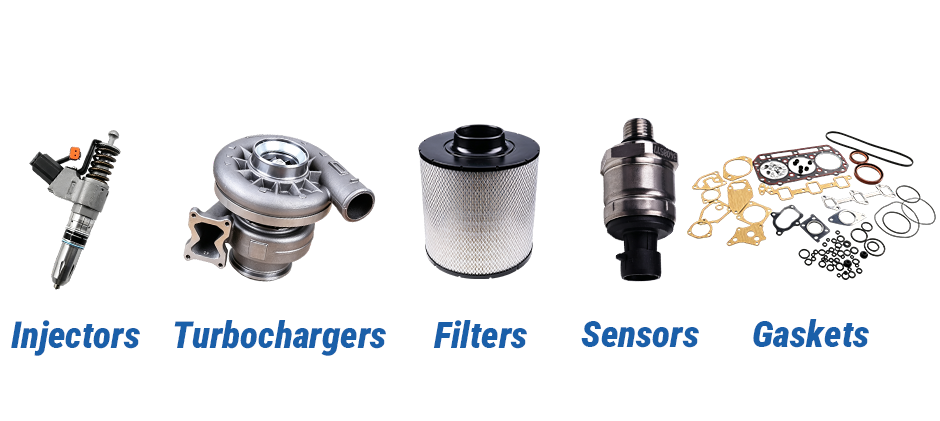
What to Match On, Not Just Around
Every replacement part has one or two details that actually decide fitment — and they aren’t always the ones visible in a photo:
- Injectors — matched to CPL and rating; two visually identical injectors can have different flow calibration
- Turbochargers — the internal cartridge and the wastegate or actuator specification can differ even when the housing looks the same
- Water pumps — same bolt pattern, different impeller direction on some platforms
- Sensors — the connector may match, but the signal range or calibration may still be different
- Filters — same physical size, different micron rating or bypass setting
- Gaskets and seals — head gaskets in particular are CPL-specific on many platforms
For cross-reference, Cummins-linked brand names you’ll see in catalogs include Fleetguard (filtration), Holset / Cummins Turbo Technologies (turbos), and Cummins Emission Solutions (DPF/SCR/DEF). Matching part numbers against these references, checked against the ESN, is a reliable way to confirm fitment. For machines where downtime is costly, keeping a small stock of filter kits, belts, thermostats, and common sensors on hand can shorten repair time significantly.
Symptoms That Often Lead to the Wrong Parts
Hard starting or rough idle. Check the fuel side first (filters, air in lines, lift pump pressure) before condemning injectors. On higher-hour engines, valve lash out of spec is a commonly overlooked cause.
Smoke color as a first clue.
| Color | Likely Cause |
|---|---|
| Black | Excess fuel, restricted air, worn injectors, tired turbo |
| Blue | Oil burning — rings, valve seals, or turbo seal |
| White | Coolant in cylinder, unburnt fuel, or injector timing |
Power loss on emissions-equipped engines. A large share of “turbo problems” reported on Tier 4 machines are actually intake restriction, DPF loading, or a failing NOx or DEF quality sensor. Work through the air-and-emissions chain before replacing the turbo.
Overheating. Check coolant condition first, then thermostat, water pump, and radiator. On machines with unclear cooling history, a coolant analysis is cheaper than the parts you might otherwise replace by process of elimination.
Final Note
In the end, most Cummins diesel engine service and parts decisions get much easier once the engine is identified correctly and maintained according to how it actually works. For off-highway engines, the ESN, CPL, and engine rating are the details that make the biggest difference when parts need to be matched. If you are sourcing replacement parts for a QSB, QSL, QSX, or QSK, FridayParts can help check fitment against your engine information before shipping and make the ordering process more straightforward.
