

When a machine suddenly loses one function, the first question is often whether the problem is electrical or mechanical. This guide explains how to tell if a fuse is blown on heavy equipment, how to confirm the issue with a multimeter, and what to check next if the fuse is not the real cause. For off-road machinery owners, fast diagnosis matters because job site downtime costs money, and electrical faults are often harder to trace in the field than in the shop.
Quick Answer
If only one function fails while the rest of the machine still works, the fuse is the first suspect. That is the fastest field rule.
Here is the short answer:
- One function stops working: check the fuse first.
- A visual check helps, but it is not final proof.
- A multimeter is the gold standard for confirming fuse failure.
- If a replacement fuse blows again, the circuit has a deeper fault.
If only one function fails, the fuse is the first suspect.
This quick rule is useful on off-road equipment because one failed fuse may disable a single electrical function without shutting down the entire machine.
Common Symptoms of Fuse Failure in Heavy Equipment
A blown fuse often affects one circuit, not the whole machine. That is why the symptoms can look minor at first. In practice, these early signs are often the best clue that the problem starts in the electrical protection side of the system.
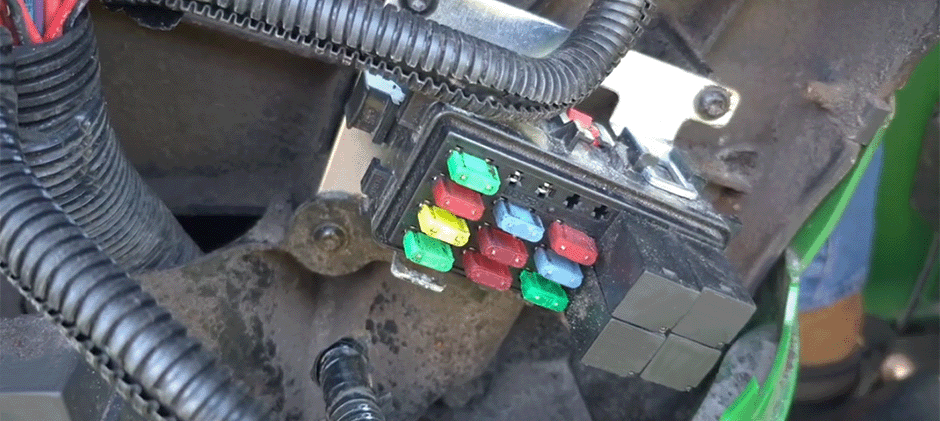
Starter circuit symptoms
In the starting system, fuse-related trouble may appear as:
- The key turns, but the engine does not crank
- The dash lights come on, but there is no starting response
- There is a click from the starter relay, but no engine movement
- The machine starts intermittently and then stops responding
If the fuse is still good, the next checks may include the starter motor, ignition switch, starter relay, or related wiring and battery connections. A replacement starter motor or starter relay is available for most heavy equipment makes and models.
Control system symptoms
A failed fuse in a control circuit may cause:
- A dark display screen
- Dead gauges or warning lights
- One switch-controlled feature to stop responding
- No power to a monitor or panel
If the fuse tests good, the issue may be in the display monitor, relay, switch, connector, or control-side wiring.
Hydraulic control symptoms
Many off-road machines use electro-hydraulic controls, so one electrical fault can shut down one hydraulic function. Common signs include:
- One boom, arm, bucket, or auxiliary function does not respond
- A valve-controlled movement stops working
- One side of a control system works while another does not
- The function comes and goes under vibration
In that case, the next likely components may include a hydraulic solenoid, a connector, or a section of wiring harness. A hydraulic solenoid or replacement wiring harness can be sourced for a wide range of off-road machinery.
Lighting and accessory circuit symptoms
A blown fuse may also show up in lower-priority circuits, such as:
- Work lights are not turning on
- Wipers not operating
- Horn failure
- The cab fan or HVAC panel is losing power
- The accessory socket or charging port is going dead
If the fuse is not the cause, the fault may be in the work light, wiper motor, accessory relay, or the circuit wiring itself.
Not every electrical failure points to a fuse. Still, when one machine function stops while the rest of the equipment continues to operate normally, fuse failure belongs near the top of the checklist.
Can You Tell by Looking at the Fuse?
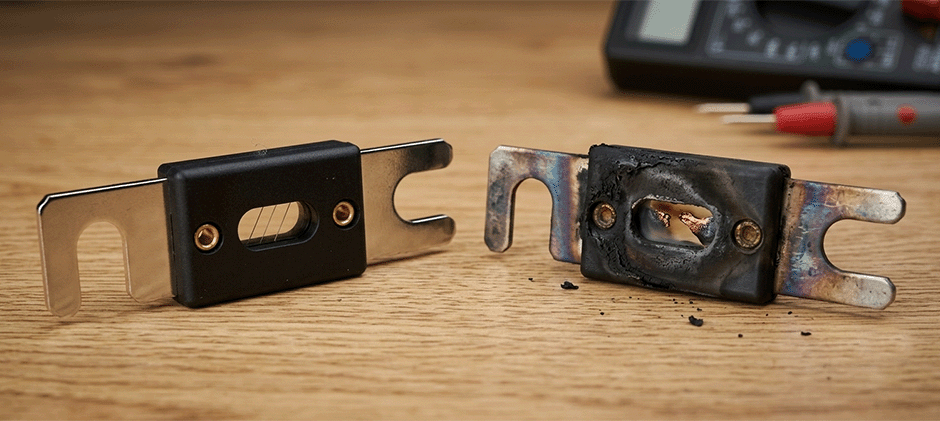
When asking how to tell if a fuse is blown, many operators start with a visual inspection. Sometimes that works, but not always.
A visual inspection is a useful first step, especially on a job site where time is limited. It may show obvious damage such as:
- a broken metal strip
- dark marks inside the fuse body
- melted plastic
- burned or heat-stained terminals
That said, visual checks have limits. On heavy equipment, electrical panels operate in rough conditions. Dust, mud, corrosion, heat, vibration, and moisture can all make a fuse look worse than it is, or hide a failure that is not visible from the outside.
A fuse may also appear normal while the real problem sits nearby, such as:
- a loose fuse holder
- a corroded terminal
- a weak contact point
- a damaged sealed connector
A fuse can fail electrically before it shows clear visible damage.
For that reason, a visual check should be treated as a quick filter, not a final answer.
Types of Fuses Used in Heavy Equipment
Common fuse types on heavy equipment include:
- Blade fuses
- Mini blade fuses
- Maxi fuses
- Glass cartridge fuses
- Ceramic cartridge fuses
- Bolt-down fuses
- Fusible links
Why does fuse type matter?
Blade fuses are often easy to inspect because the internal strip is visible. Glass cartridge fuses may also show a broken element or dark mark. Ceramic and bolt-down fuses are harder to judge by sight alone, so a meter test becomes more important.
On some off-road machines, high-current protection may sit in a main panel, close to the battery, or inside a protected service compartment. In those cases, the problem may involve not only the fuse itself but also the fuse box, terminal hardware, or main power connections.
How to Test a Fuse With a Multimeter?
If you want the most reliable answer to how to tell if a fuse is blown, a multimeter is the confirmation tool. In real maintenance work, this is the most dependable way to verify whether a fuse has failed.
Step-by-step testing process
- Park the machine safely
Place the equipment on stable ground and lower attachments if necessary. - Shut the machine down fully
Turn the engine off and remove the key. - Isolate the circuit when needed
Depending on the machine, disconnecting battery power may be the safer choice - Locate the fuse panel or inline fuse
This may be in the cab, near the battery, under a side panel, or in the engine compartment. - Identify the suspected fuse
Use the machine label or service information if available. - Remove the fuse carefully
Check the fuse body, terminals, and nearby contacts while it is out. - Set the multimeter to continuity or ohms
Continuity mode is often the fastest option. - Touch one probe to each fuse terminal
Make sure the probes contact clean metal. - Read the result
A good fuse should show continuity or very low resistance. - Reinstall or replace correctly
If the fuse is bad, replace it only with the same type and amperage.
Field conditions can affect this process. On a job site, dirty terminals, wet fuse boxes, and vibration-related looseness can create misleading results. A stable reading is more useful than a rushed one.
What do the readings mean?
| Multimeter Result | What It Usually Means | What to Do Next |
|---|---|---|
| Beep or continuity | Fuse is likely good | Check the relay, switch, connector, or component |
| Very low resistance | Fuse is likely good | Continue circuit diagnosis |
| No continuity / OL | Fuse has failed | Replace with the same type and rating |
| Unstable or inconsistent reading | Poor contact, corrosion, or heat damage | Inspect terminals, contacts, and the fuse holder |
This leads to a simple troubleshooting path that works well in the field.
Fuse vs. Component Failure: What to Check Next?
Once the fuse has been tested, the next step becomes much clearer.
Basic decision path
- Fuse is good → check the relay, switch, connector, or failed component
- Fuse has failed → inspect for a short circuit or overload
- Replacement fuse fails again → inspect the wiring harness, hydraulic solenoid, or damaged circuit wiring
This decision path matters because heavy equipment faults are rarely random. In many cases, the fuse is only reacting to a deeper electrical problem somewhere else in the circuit.
Why do Equipment Fuses Blow?
A fuse is a protective device. It opens the circuit when the current rises above the safe limit. If a fuse fails, the important question is not only what happened, but why.
Common causes of off-road machinery include:
- a short circuit in the wiring harness
- insulation rubbed through by vibration
- moisture entering connectors or fuse panels
- corroded terminals causing heat buildup
- a failed hydraulic solenoid
- An overloaded starter motor
- a bad relay
- An accessory drawing too much current
- The wrong fuse rating was installed
- poor previous repairs or bypassed wiring
High-risk inspection areas
When the cause is not obvious, inspect these locations first:
- harness sections near sharp metal edges
- wiring close to moving parts
- connectors in the engine compartment
- starter circuit wiring
- fuse panel contacts
- areas exposed to water, dust, oil, or constant vibration
This is where the job site troubleshooting mindset becomes important. Heavy equipment does not operate in clean indoor conditions. It works in vibration, moisture, mud, and heat. That environment often creates electrical faults that start small and become expensive if they are ignored.
When Replacing the Fuse Is Not Enough?
A single replacement can be part of a normal diagnosis. Replacing the same fuse again and again without finding the root cause is not.
When does a replacement make sense?
One controlled replacement is reasonable if:
- The fuse failed once
- The circuit shows no visible wiring damage
- The correct fuse type and rating are available
- The replacement is part of testing, not repeated guessing
When is the problem deeper?
If the new fuse fails right away or shortly after restart, the real problem is likely elsewhere in the system. Common causes include:
- a shortened section of wiring harness
- a faulty hydraulic solenoid
- a damaged relay
- a melted connector
- an overloaded motor circuit
- a hidden component fault
If a new fuse blows again, the circuit is the problem, not the fuse.
Never install a higher-rated fuse to keep the machine running. That can allow excess current to damage wiring, switches, connectors, and other parts that cost far more to replace.
When to Call a Technician?
Some fuse issues are simple field fixes. Others point to a larger electrical fault that should be diagnosed more carefully.
Professional help is a good idea when:
- The replacement fuse fails again immediately
- Several circuits stop working at once
- The fuse holder is melted
- There is a burnt insulation smell
- Visible harness damage is present
- The issue involves a controller or main power feed
- A hydraulic or safety-related function is affected
Stopping early can prevent a larger repair later. On off-road machinery, an incorrect temporary fix can easily turn a small electrical fault into major downtime.
FAQ
Below are a few common follow-up questions people ask when learning how to tell if a fuse is blown on heavy equipment.
How to tell if a 20-amp fuse is blown?
Same as any other fuse. Look for a broken strip or heat damage if you want, but that only catches the obvious ones. A multimeter doesn’t guess — it tells you yes or no.
Can I check fuses without removing them?
Sometimes. If the terminals are exposed, you can test certain blade fuses in place. But pulling the fuse out takes two seconds and gives you a cleaner reading every time. So just pull it.
Why does a fuse keep blowing after replacement?
That means something else is wrong. Short circuit, chafed wiring, moisture somewhere it shouldn’t be, or a component pulling too many amps. The fuse is just doing its job — you need to find what’s killing it.
Can a fuse be good and the circuit still fail?
Absolutely. A good fuse only tells you that part isn’t blown. The real problem could still be a bad relay, a loose connector, a broken switch, a missing ground, or the component itself. Don’t stop at the fuse.
Conclusion
Knowing how to tell if a fuse is blown saves more than a few minutes on a repair. Less downtime, fewer unnecessary parts swaps, and a much shorter path to the actual fault. Start with whatever function just died. Grab your multimeter and check the fuse — don’t just eyeball it. If a new fuse blows again, stop throwing fuses at it. Start looking at the circuit. The fuse is fine. Something else isn’t. And once your inspection points you toward a relay, solenoid, starter part, or wiring harness — FridayParts has solid aftermarket replacements ready to go. No need to break the bank. Broad fit, fair pricing, and fast shipping.
