

If you are running an International 1086 and wondering whether to leave duals on or take them off, here is a direct answer. Singles are generally the more practical setup for most hay operations. But duals earn their keep if your farm has slopes, soft ground, or hillside bale work where safety and traction are a bigger part of the equation. So it comes down to this: duals or singles? This guide is here to help you decide—based on the jobs you actually do—and settle on a setup that gives you the right feel for safety, comfort, traction, and day-to-day convenience.
Why Duals Matter on the International 1086?
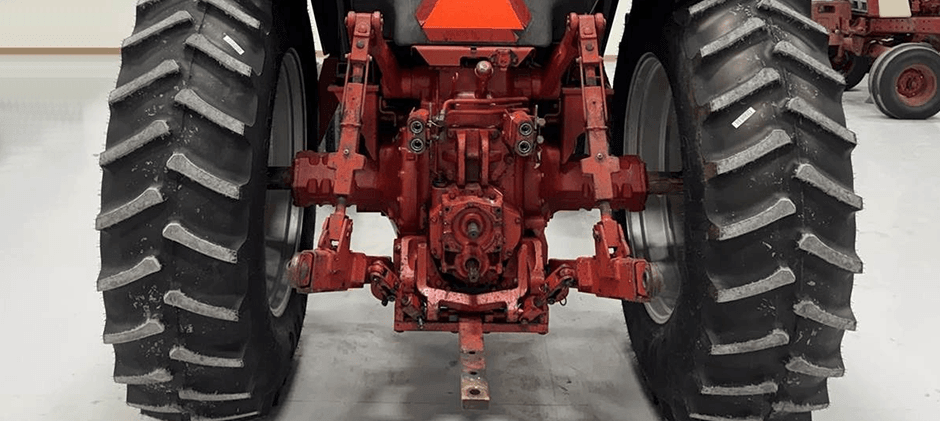
The International 1086 raises this question because it sits right in the middle of two very different kinds of work. It has enough weight and power to benefit from duals in field traction, but it is also commonly used for hay and utility jobs where extra width can become a drawback. On a 2WD tractor like this, the rear tires do most of the pulling, so tire setup has a direct effect on grip, ride, field footprint, and side-slope feel.
For a one-person hay operation, that matters even more. A tractor that spends its week cutting hay, carrying bales, and moving between fields needs to be easy to manage alone. At the same time, if that same tractor occasionally pulls tillage tools or works on hills, stability and traction become hard to ignore.
In simple terms, the International 1086 creates this debate because the main jobs pull in different directions:
- Hay cutting and transport favor easier turning and less width
- Bale handling on uneven ground favors a steadier stance
- Tillage favors more traction and less slip
That is why there is no automatic answer. The better setup depends on which of those jobs takes up most of the season.
When Is It Better to Leave the Duals On?
Dual wheels still make strong sense in the right conditions. If your ground is rolling, soft, or uneven, or if the tractor still sees real draft work, keeping them on may be the safer and more productive choice.
Hillside stability and side-slope safety
This is one of the strongest reasons to keep duals. On side slopes, a wider rear stance usually gives the tractor a more planted feel. It does not remove rollover risk, but it can reduce the light, uneasy feeling that comes with a narrower setup on hills.
That matters during mowing and bale handling alike. A one-person operator often has to make every turn, stop, and correction alone. If the tractor regularly works across slopes, dual wheels can provide useful confidence, especially when the field surface is rough or the weather has left spots soft.
“If hills are part of the job, stability is not a minor comfort issue. It is part of safe daily operation.”
Better support when moving bales
A bale may not seem like tillage, but bale handling still puts demands on the tractor. Repeated lifting, turning, and traveling with a heavy round bale can make a narrow tractor feel less settled, especially on rolling ground. Dual wheels help by widening the stance and making the machine feel steadier from side to side.
If most bale movement happens on level yards, that gain may not be enough to justify the added width. But if bales are handled in fields, on approaches, or across slopes, duals become easier to defend.
Less slip and better fuel use in occasional tillage
Even if tillage is only an occasional job, the International 1086 still benefits from duals when it is pulling hard. With more tire contact area, the tractor usually slips less in plowing, disking, or similar field work. Less slip means more of the engine’s power reaches the ground instead of being lost in wheel spin.
That can lead to:
- Better traction in soft or damp fields
- More consistent pulling under load
- Lower wasted fuel during draft work
If your “occasional” tillage still includes meaningful acres each season, this point should not be brushed aside.
Lower ground pressure and a smoother ride
Dual wheels can also spread the tractor’s weight over a larger area. That helps lower the pressure placed on the soil, which can be useful in softer fields. It may not remove compaction concerns, but it can reduce the concentration of weight compared with a single-wheel setup.
Ride comfort is another practical plus. Many operators notice that a dual-wheel tractor feels calmer over uneven field surfaces. That smoother feel can matter during long mowing days or repeated trips hauling bales.
In this kind of workload, reliable support parts also matter. A sound hydraulic steering pump, durable tie rod end, or well-matched PTO shaft can help the tractor stay steady and predictable when field loads and turning demands increase.
When Is It Better to Take the Duals Off?
For many owners in hay work, this is the better everyday answer. If mowing and general handling work take up most of the year, single wheels often make the tractor easier to use in ways that matter every day.
Hay cutting often favors single wheels
If the IH 1086 spends most of its time on a Macdon R85, single wheels are usually more convenient. The reason is simple: mowing rewards maneuverability. Extra width can make opening rounds less tidy, increase the chance of running over cut crop, and turn easy field-edge moves into wider, slower turns.
That does not mean duals are wrong for every mower tractor. It means the benefit must be large enough to offset the day-to-day inconvenience. On flat or gently rolling hay ground, many operators will find that single wheels make the tractor easier to place, easier to turn, and easier to live with.
Easier movement in yards, lanes, and storage
A one-person operation often depends on efficiency more than sheer pulling ability. If the tractor is constantly moving through gates, around sheds, near trailers, or between fields, width becomes a real issue. Single wheels help in several ways:
- Easier entry through narrow openings
- Less trouble around fences and field edges
- Simpler road travel and transport
- Better maneuverability in tight hay yards
These may sound like small things, but they add up over a season.
A better fit when tillage is not the main job
This point is key. If an International 1086 mainly cuts hay and moves bales, and tillage only comes up once in a while, it usually makes sense to set the tractor up for the jobs it does most. That is why many owners in this exact situation lean toward single wheels.
The dual wheel vs single wheel choice should follow hours of use, not just the heaviest task on the list. If mowing happens every week and tillage only happens a few days a year, the daily-use setup deserves more weight in the decision.
Stability vs. Maneuverability: Which One Matters More?
This is where the decision becomes practical. The question is not whether dual wheels are better than single wheels in general. The question is whether the extra stability is worth the extra width for the jobs your tractor sees most often.
For an IH 1086 that mainly runs hay equipment, carries bales, and only occasionally tills, this is usually the right way to think about it:
| Main Use Pattern | Better Choice |
|---|---|
| Mostly mowing with a Macdon R85 on flat ground | Single wheels |
| Mostly mowing plus bale handling on rolling ground | Dual wheels or widened singles |
| Frequent bale handling on hills | Dual wheels |
| Occasional tillage only | Single wheels, unless slip is a recurring issue |
| They work most of the year, plus tillage in season | Change by season |
This table points to a simple truth. Duals are strongest when traction and side-slope security are hard to replace. Singles are strongest when width and turning ease affect the tractor every day.
“Choose the setup for the work that fills most of the season, not only for the hardest task on the list.”
That is often the best rule for a one-tractor hay operation.
Setup Details That Affect Performance
The choice between dual wheel vs single wheel does not stop at bolting a second wheel on or off. Small setup details can change how much benefit you actually get from either option.
Tire pressure matters more than many owners expect
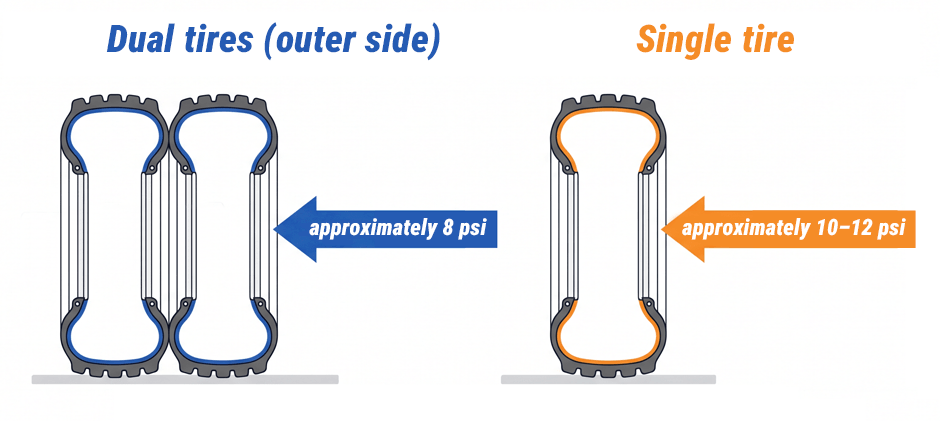
A dual-wheel setup and a single-wheel setup should not simply run the same inflation pressure by habit. Tire pressure needs to match load, field conditions, and the way the tractor is used. If pressure is too high, duals lose part of their traction and flotation benefit. If pressure is wrong in a single-wheel setup, ride quality and grip can suffer too.
A simple check of the tire load chart can prevent a lot of confusion. Sometimes what feels like a poor wheel setup is really a pressure setup problem.
Rear track width can improve a single-wheel setup
If you decide to remove the duals but still work on slopes, widening the inner wheel position is one of the best compromises. It helps recover some of the lost stability without bringing back the full width of a dual-wheel tractor.
For owners leaning toward singles, this can be the smartest middle ground:
- Remove the duals for easier mowing and transport
- Set the rear wheels out for more side-slope confidence
- Refit duals seasonally if tillage needs grow
That approach often fits older tractors that must handle several jobs across the year.
Small maintenance items also support the decision. If the tractor changes between field and utility work often, dependable wheel hub hardware, a clean hydraulic filter, and responsive brake disc components help keep handling more consistent and predictable.
Coclusion
The dual wheel vs single wheel choice should follow your main workload. Flat hay ground usually favors singles. Rolling ground and safety-sensitive work often favor duals. If both matter at different times of year, seasonal changeover is often the most practical solution. When it is time to keep an older tractor working, FridayParts can help with quality aftermarket parts, affordable pricing, wide compatibility, and a large inventory for many machines in regular farm use.
