

The hydraulic system is the lifeblood of a John Deere tractor. It powers all your farm implements and keeps them running smoothly. A faulty hydraulic system will bring your work to a halt. This guide breaks down the John Deere Hydraulic System Diagram and shows you how to use it to diagnose common hydraulic issues.
John Deere Hydraulic System Diagram Explained
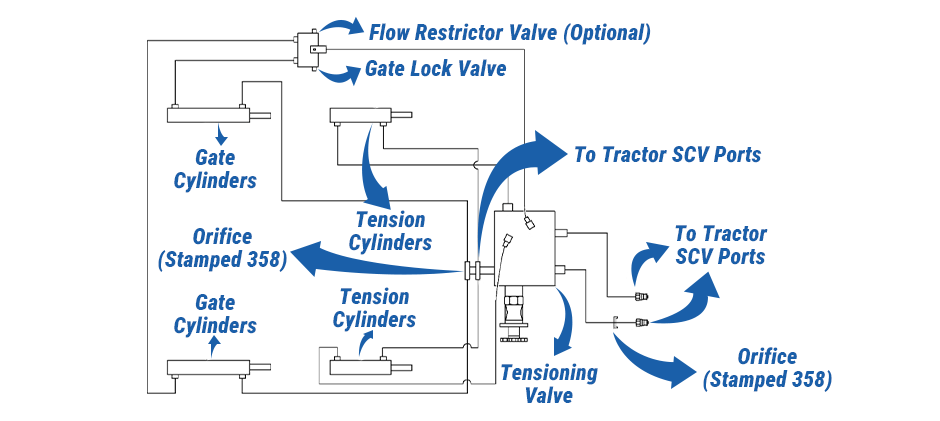
Let’s start by demystifying the diagram you provided. This schematic is a perfect example of a tractor-powered hydraulic system for an implement. Likely a round baler that performs two distinct functions: controlling bale tension and operating the rear gate. The entire system draws its power from the tractor’s own hydraulic pump via the Selective Control Valve (SCV) ports.
A hydraulic system diagram showing a tensioning valve connected to tension cylinders and gate cylinders, with connections for a tractor’s SCV ports. Here is a breakdown of each labeled component:
Tensioning Valve
This is the brain of the operation. It’s a control valve block that directs the flow of hydraulic oil from the tractor to the correct set of cylinders. It also contains internal check valves to hold pressure and a relief valve to prevent over-pressurization, protecting the system from damage.
Tension Cylinders
These are double-acting cylinders responsible for applying and maintaining pressure on the bale tension arms. Hydraulic fluid can push the cylinder rod out to apply tension and can also be used to retract it.
Gate Cylinders
These are also double-acting cylinders, but their job is to provide the heavy lifting force needed to open and close the implement’s rear gate.
Gate Lock Valve
This is a crucial safety component. It’s a two-position spool valve that, when engaged, completely blocks the flow of oil to and from the gate cylinders. This mechanically locks the gate in position, preventing it from accidentally closing.
To Tractor SCV Ports
These are the quick-connect couplers that plug into your tractor. They supply the pressurized hydraulic fluid that powers the entire system and provide a path for the fluid to return to the tractor’s reservoir.
Orifice
This is a small, precisely sized restrictor in the hydraulic line. Its purpose is to limit the maximum flow rate of the fluid, which helps control the speed of a hydraulic function, ensuring smoother and more predictable operation.
Flow Restrictor Valve (Optional)
This optional valve further refines the speed of a function. It’s often used if the implement has additional hydraulic features, like a net wrap system, that require a specific flow rate to operate correctly.
Valve Ports
The specific ports on the main tensioning valve. Tracing the lines shows their function: when you operate the corresponding SCV lever in your tractor’s cab, pressurized oil flows from the port, through the valve block, and is directed to either the tension cylinders or the gate cylinders, depending on which function you’ve selected.
The Role of Double-Acting Cylinders in John Deere Hydraulic Design
For tough John Deere farm implement jobs, single-acting cylinders just don’t provide enough control. A single-acting cylinder uses hydraulic pressure to extend, but only retracts with gravity or a spring, so control is really limited. Double-acting cylinders, though, deliver the power and precision modern farming needs.
- Two-way powered movement: Many heavy implement parts need force to move both ways—like planter folding wings or air seeder gates. They need active power to close and lock, not just gravity. Double-acting cylinders provide this force, ensuring safe, reliable operation in any machine position.
- Precise control: Modern farming needs precise adjustments—for tillage depth, loader bucket tilting, or steady tension pressure. Double-acting cylinders enable slow, accurate two-way movements, letting operators add, hold and release pressure exactly as needed (something gravity-return systems can’t do).
- Stable load holding: Holding heavy loads firmly in any position is critical for safety and performance. Double-acting cylinders trap fluid on both sides of the piston for a tight hydraulic lock—ideal for holding loaders up, stabilizing sprayer booms, or keeping tension arms in place. This keeps the equipment stable and prevents parts from shifting during use or transport.
Safety Features in John Deere Hydraulic Systems
The John Deere hydraulic system diagram shows a few built-in safety features that protect both the operator and the machine.
The most obvious one is the gate lock valve. It stops the gate from dropping suddenly. When you need to work on the back of the implement, lock this valve. The gate will be mechanically secured. It won’t drop if pressure leaks or someone operates it by accident. This is much safer than relying only on the hydraulic pressure in the cylinders.
The tension valve has a built-in pressure relief function. If the line gets clogged or you keep applying pressure after the cylinder is fully extended, system pressure rises fast. The valve automatically releases the excess pressure back to the tank, stopping hoses from bursting and protecting parts from damage.
Then there’s the orifice and restrictor valve. They slow down the parts, making movements smoother and easier to control. This helps prevent accidents from sudden jolts or abrupt stops.
Common Hydraulic Problems You Can Diagnose Using the Diagram
This diagram’s your go-to when something goes wrong. Just trace the hydraulic oil flow, and you can figure out where the problem is step by step.
- Gate won’t open, but tension arms work fine: Since the tension system’s working, the tractor’s sending power to the valve block like it should. The diagram shows the gate has its own separate hydraulic circuit, so the issue’s definitely with the gate cylinders, the hoses connected to them, or most likely—the gate lock valve is either locked up or broken on the inside.
- Tension arms feel weak and can’t hold pressure: Follow the tension circuit’s oil flow. Worn piston seals in the tension cylinders let oil leak past the piston. Or the check valve or seals inside the tension valve for this circuit fail, so they can’t trap pressure as they should.
- Gate drifts down slowly after being raised: This is a classic sign of an internal leak. The diagram points right to two main issues: either the piston seals in the gate cylinders are worn, letting oil slowly leak from one side to the other. More often, the gate lock valve has a small internal leak—it can’t hold oil perfectly, so the gate creeps down over time.
- All hydraulic functions are slow and weak: When every function’s affected, the problem’s almost always with the upstream parts (the main supply side). Start at the source: check the tractor’s hydraulic fluid level, and push the SCV couplers in all the way. A clogged main hydraulic filter on the tractor, or a failing tractor hydraulic pump, are also common reasons the whole system is weak and slow.
How This Hydraulic System Compares to Other John Deere Implements
This diagram is for a specific farm implement, but the basics apply to all kinds of John Deere equipment. Whether you’re looking at a diagram for a front loader, backhoe, or a complex planter, you’ll see these core ideas every time:
- Centralized control: There’s almost always one or more main valve blocks acting as the main hub—just like part A here.
- Tractor-powered: Most implements get their power from the tractor’s SCV ports, like the connection at E.
- Double-acting cylinders: Any function that needs precise movement both ways—like lifting a boom, curling a bucket, or folding a planter—uses double-acting cylinders.
- Safety features: Pressure relief valves, check valves, and often lock valves are all part of the system to keep things running safely and reliably.
More complex implements might have extra electric solenoid valves for automatic functions, or bigger valve blocks to control more cylinders. But the basic setup never changes: hydraulic fluid flows from the pump, through the valves, to the cylinders, and back to the tank.
Tips for Reading Any John Deere Hydraulic System Diagram
Learning to read these diagrams is a skill, and here are a few simple tips to start with:
- Start at the source: First, find where the power comes from – the tractor connections (SCV ports) or a pump on the machine.
- Trace the lines: Run your finger along the solid lines (pressure lines) from the power source to a valve, then from the valve to a cylinder.
- Find the “brains”: Find the main control valves; they direct the oil flow.
- Find the “muscles”: Spot the cylinders or hydraulic motors that do the actual work. Note if they’re single or double-acting.
- Look for safety/check parts: Identify check valves (only let oil flow one way), relief valves (prevent too much pressure) and lock valves. These are key to knowing how the system holds pressure and works safely.
Final Thoughts
John Deere hydraulic system diagrams are your go-to for maintenance and troubleshooting, helping you use your equipment better. When you diagnose a worn cylinder, leaky valve, or damaged hose, you need a reliable source for high-quality parts. FridayParts has compatible parts for many John Deere models, getting your machine back to work in no time.
