

No single number will pick your skid steer. The current John Deere lineup makes that clear, spanning 1,750 lb to 4,000 lb ROC across six models built for three very different kinds of work. Gates and barns point to one end of the range. Truck loading and high-flow attachments point to the other. It looks simple on paper. The catch is that two machines with nearly identical capacity can perform completely differently once the bucket comes off and attachments go on. The John Deere skid steer size chart below explains why.
John Deere Skid Steer Size Chart
Want a quick side-by-side of current machines? The table below has you covered. It’s the best starting point whether you’re after compact access, mid-size versatility, or large-frame loading power.
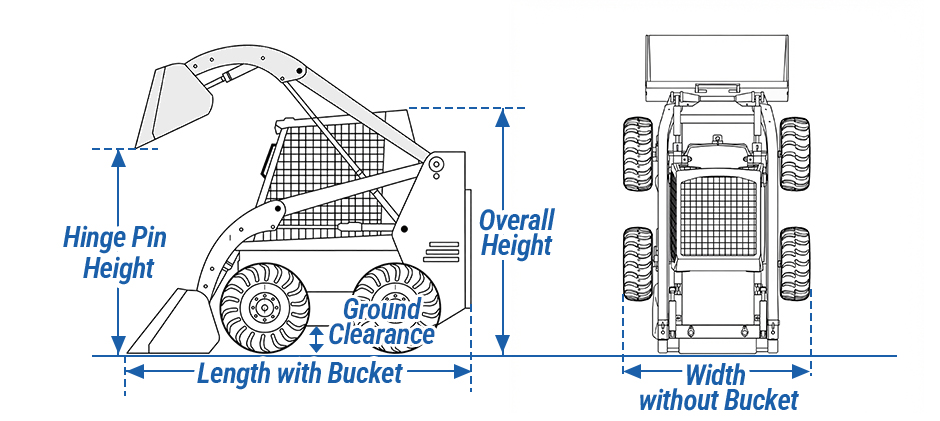
| Model | Frame | Lift Type | Gross HP | Net HP | ROC (lb) | Operating Weight (lb) | Width (in) | Hinge Pin Height (in) |
|---|---|---|---|---|---|---|---|---|
| 316 P-Tier | Small | Radial | 65 | 61 | 1,750 | 6,180 | 62.9 | 115.1 |
| 318 P-Tier | Small | Vertical | 65 | 61 | 1,945 | 6,542 | 62.9 | 120 |
| 320G | Mid | Vertical | 69 | 66 | 2,190 | 7,150 | 67.0 | 122.2 |
| 324G | Mid | Vertical | 74 | 70 | 2,690 | 7,700 | 67.0 | 126.0 |
| 330 P-Tier | Large | Vertical | 98 | 95 | 2,950 | 9,930 | 78.5 | 132.0 |
| 334 P-Tier | Large | Vertical | 118 | 114.7 | 4,000* | 10,264 | 78.5 | 132.0 |
*The 334 P-Tier reaches 4,000 lb ROC with one standard counterweight set.
This John Deere skid steer size chart already shows the main split in the lineup:
- 316 and 318 fit tighter work areas
- 320G and 324G cover the middle ground
- 330 P-Tier and 334 P-Tier are for heavier loading, grading, and attachment work
One more thing before you commit to a machine size: if uptime matters as much as raw specs, think ahead about wear items. Hydraulic parts, loader quick attach parts, and engine cooling parts all wear with hours—and they’re a lot easier to plan for than to chase down mid-job.
What Size Means in Real Work
A machine can look right on paper and still be wrong for the job. That usually happens when the focus stays on ROC alone.
Frame Size and Job Match
John Deere models fall into three useful groups:
| Frame Size | Models | Best Fit |
|---|---|---|
| Small Frame | 316 P-Tier, 318 P-Tier | gates, barns, backyard access, light material handling |
| Mid Frame | 320G, 324G | general construction, landscape supply yards, mixed farm use |
| Large Frame | 330 P-Tier, 334 P-Tier | truck loading, pallet handling, roadwork, high-flow attachments |
A small-frame unit is easier to trailer, stores easier, and won’t make you sweat in tight access. A large-frame machine brings more reach, more stability, and more hydraulic muscle—but it needs more room to turn and more room to haul.
Radial vs Vertical Lift
This is where many comparisons go sideways.
- 316 P-Tier uses radial lift
- 318 P-Tier, 320G, 324G, 330 P-Tier, and 334 P-Tier use vertical lift
Radial lift usually makes more sense for:
- digging
- grading
- pushing into piles
- lower lift work
Vertical lift usually makes more sense for:
- loading trucks
- placing pallets
- stacking material
- lifting to full height with better forward reach
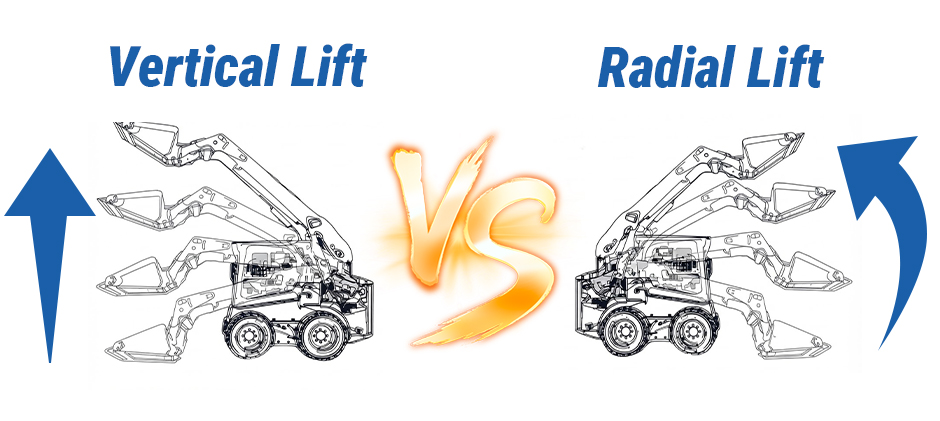
That is why two models with similar footprint can feel completely different on site. If you move bulk material low to the ground, radial lift can be the better fit. If you load high-sided trucks, vertical lift usually wins.
Dimensions That Actually Matter
A full John Deere skid steer size chart should not stop at ROC and horsepower. Physical dimensions decide whether the machine fits your site, trailer, and storage space.
| Model | Length w/ Bucket (in) | Width w/o Bucket (in) | Overall Height (in) | Wheelbase (in) | Ground Clearance (in) |
|---|---|---|---|---|---|
| 316 P-Tier | about 127 | 62.9 | 77.2 | 41.5 | 7.0 |
| 318 P-Tier | 127.6 | 62.9 | 77.2 | 41.5 | 7.0 |
| 320G | 136.3 | 67.0 | 81.1 | 44.2 | 9.3 |
| 324G | 136.3 | 67.0 | 81.1 | 44.2 | 9.3 |
| 330 P-Tier | 158.0 | 78.5 | 86.3 | 49.9 | 9.7 |
| 334 P-Tier | 150.7 | 78.5 | 87.0 | 49.9 | 9.7 |
A few takeaways stand out fast:
- 62.9-inch machines are much easier in tight gates and older buildings
- 67-inch machines are still manageable but more stable with heavier loads
- 78.5-inch machines need more space, but they give you a stronger platform
The 334 P-Tier is especially interesting. By capacity, it’s the largest John Deere skid steer you can buy right now. Funny thing, though: with bucket attached, it’s a touch shorter than the 330 P-Tier in the table above. Not a small machine by any means—just proof that you should read the full spec sheet instead of assuming more capacity means more length.
For long-term service planning, many fleets also keep an eye on skid steer tire options, hydraulic cylinder seal kits, and cab filter replacement parts because these affect downtime more than buyers expect. Keeping a reliable source for skid steer loader aftermarket parts helps reduce that downtime further.
The Biggest John Deere Skid Steer
If your goal is simply to find the largest machine, the 334 P-Tier sits at the top of the current lineup in this John Deere skid steer size chart.
334 P-Tier Key Numbers
- Gross power: 118 hp
- Net peak power: 114.7 hp
- ROC: 4,000 lb with one standard counterweight set
- Operating weight: 10,264 lb
- Tipping load: 8,000 lb
- Bucket breakout force: 13,800 lb
- Width: 78.5 in
- Height to hinge pin: 132 in
- Fuel tank: 35.5 gal
- Optional high-flow hydraulics: 44 gpm
Those numbers place it well above the 330 P-Tier in lift capacity. If you run demanding attachments, that gap matters even more.
Where the 334 P-Tier Makes Sense
The 334 P-Tier is a better fit when you need:
- More lifting capacity for palletized material
- More hydraulic output for cold planers or mulching heads
- More machine weight for stability
- More breakout force in packed material
Not every crew needs it. For work that’s mostly residential access, fencing, small trench support, or light grading, the added size can hurt more than it helps.
Power, Hydraulics, and Attachment Fit
Horsepower gets attention, but hydraulic output is what often decides whether a machine feels strong or slow with attachments installed.
| Model | Standard Flow (gpm) | High-Flow Option (gpm) | System Pressure (psi) | Fuel Tank (gal) |
|---|---|---|---|---|
| 316 P-Tier | 17 | — | 3,450 | 19.0 |
| 318 P-Tier | 17 | — | 3,450 | 19.0 |
| 320G | 17 | — | 3,450 | 21.0 |
| 324G | 17 | — | 3,450 | 21.0 |
| 330 P-Tier | 25 | about 37 | 3,450 | 25.5 |
| 334 P-Tier | 25 | 44 | up to 4,000 | 35.5 |
This is where lineup differences become more practical:
- 316 and 318 are fine for basic buckets, forks, and light-duty tools
- 320G and 324G add useful capacity without getting too large
- 330 P-Tier and 334 P-Tier are the better home for demanding hydraulic attachments
Planning to run mulchers, planers, or trenchers? Don’t gloss over hydraulic flow—it shapes the whole ownership experience. Line up support items early, too: auxiliary hydraulic couplers, attachment control parts, and replacement skid steer seats for long field days. For older John Deere models still in service, aftermarket John Deere 240 skid steer parts are also available.
How to Choose the Right Model
If you are still deciding, narrow the machine by the work first, not by brand loyalty or headline horsepower.
Choose 316 P-Tier or 318 P-Tier If You Need
- tighter width
- lighter transport weight
- easier access around buildings
- light material handling and cleanup
Pick the 316 if digging and grading matter more. Pick the 318 if lift height and pallet work matter more.
Choose 320G or 324G If You Need
- one machine for mixed use
- more ROC without jumping to large-frame size
- better reach and stability than entry models
- a practical middle option for crews and acreage work
The 324G is often the better step-up if your material loads are getting heavier, but you still want to avoid the bulk of a large-frame unit.
Choose 330 P-Tier or 334 P-Tier If You Need
- larger attachment capability
- more loading height
- more stability under heavy loads
- stronger performance on demanding jobs
Go with the 330 P-Tier if you want a large-frame machine that does a bit of everything. Step up to the 334 P-Tier when the standard large-frame class just isn’t cutting it anymore.
Final Words
A solid John Deere skid steer size chart does more than list weights and capacities. It matches machine dimensions, lift path, and hydraulic output to the work your crew actually handles. Once you’ve settled on a size, keeping that machine productive comes down to parts support. That’s where FridayParts fits in: quality aftermarket parts, John Deere skid steer parts, and more, at fair prices, deep inventory, and compatibility across a wide range of equipment brands.
