

Precision in fluid management is non-negotiable for maximizing the operational efficiency of your John Deere 4400-series combines and 440-class equipment. At FridayParts, we recognize that staying on top of fluid inventory prevents costly downtime. This guide provides technical specs pulled directly from the parts catalog, helping you maintain your off-road machinery to professional standards. Whether you are dealing with sump volumes or hydraulic system requirements, getting these numbers right is the first step in a successful preventative maintenance (PM) program.
What Are The Fluid Capacities For John Deere 4400 Series Combines?
The 4400-series exhibits significant variation in engine oil and hydraulic requirements, even though their core gearbox capacities remain largely standardized. The following table provides the specific capacities for these models:
| Model | Coolant | Crankcase | Reservoir | System | Transmission |
|---|---|---|---|---|---|
| Combine 4400 | 25 qt. | 6 qt. | 14 qt. | 17 qt. | 7 qt. |
| Combine 4420 | 28 qt. | 12 qt. | 14 qt. | 17 qt. | 7 qt. |
| Combine 4425 | 26.4 qt. | 12 qt. | 21 qt. | 26.4 qt. | 7 qt. |
| Combine 4435 | 26.4 qt. | 13 qt. | 21.2 qt. | 26 qt. | Gear: 7 qt. / Hydrostatic System: 26 qt. |
Owners of 4425 and 4435 models must account for a nearly 50% increase in reservoir capacity compared to the earlier 4400. While the base 4400 and 4420 units utilize a 14 qt. reservoir, the latter 4425 and 4435 models require 21 qt. and 21.2 qt. respectively. This higher volume supports the more intensive hydraulic demands found in these updated iterations.
Sump volume requirements for the engine crankcase effectively double when moving from the base 4400 to the 4420 and 4425 models. The initial 4400 series combination requires only 6 qt., whereas the 4420 and 4425 models jump to 12 qt. Technicians should always double-check these specs during PM intervals to avoid under-filling the engine.
How Do Capacities Vary In Other John Deere 440-Class Machinery?
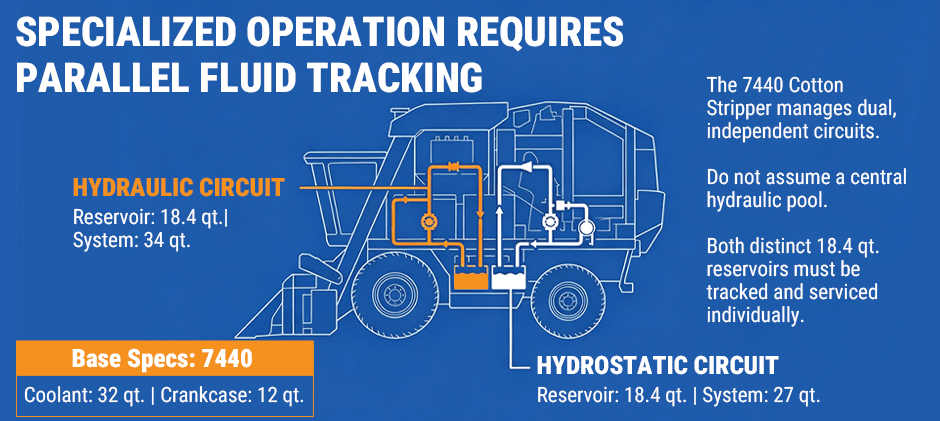
Specialized cotton harvesting requires the management of dual hydraulic and hydrostatic circuits that are distinct from standard grain combines. For a deeper understanding, you can review the John Deere Hydraulic System Diagram. The 7440 Cotton Stripper, for instance, requires high-precision fluid tracking for its parallel systems:
Cotton Stripper 7440
- Coolant: 32 qt.
- Crankcase: 12 qt.
- Hydraulic Reservoir: 18.4 qt.
- Hydraulic System: 34 qt.
- Hydrostatic Reservoir: 18.4 qt.
- Hydrostatic System: 27 qt.
Heavy-duty forage harvesting tasks demand significantly higher thermal load management and drivetrain-specific fluid volumes. The 5440 model requires a massive coolant volume and features variable hydrostatic capacities depending on the drivetrain configuration:
Self-propelled Forage Harvester 5440
- Coolant: 44 qt.
- Crankcase: 17 qt.
- Hydraulic: 12 qt. (15 qt. with hydraulic outlet)
- Hydrostatic without PRWD: 28 qt.
- Hydrostatic with PRWD: 44 qt.
- Transmission: 11 qt.
Note: While some manuals list 15 qt. as 19 L, this is a likely printing error as the correct conversion is 15 qt. ≈ 14.2 L. Technicians should prioritize the 15 qt. measurement for North American service fills.
4 Critical Tips For Managing Transmission And Hydrostatic Fluids
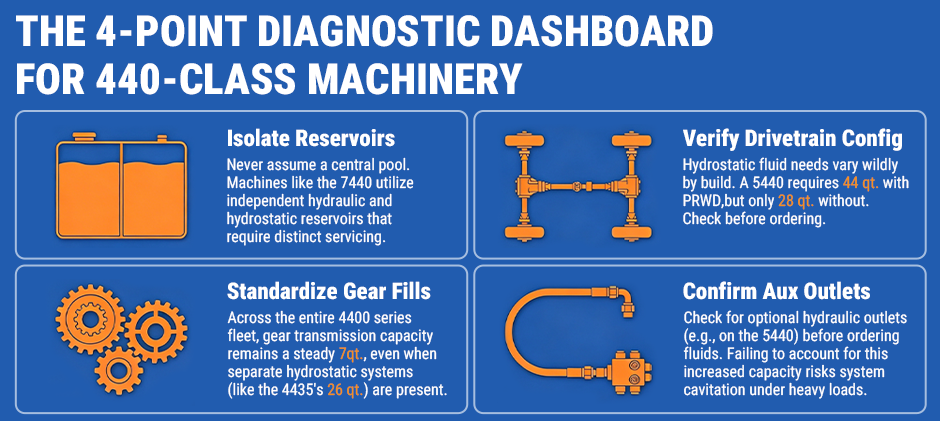
- Distinguish between independent hydraulic and hydrostatic reservoirs. For equipment like the 7440 Cotton Stripper, you cannot assume a central hydraulic pool, as it utilizes two separate 18.4 qt. reservoirs for its distinct hydraulic and hydrostatic systems. Mismanagement can lead to issues like discovering Water In Diesel Fuel. How to Remove It.
- Purchase hydrostatic fluid based on your specific drivetrain configuration. The 5440 Forage Harvester requires a substantial 44 qt. of hydrostatic fluid for units equipped with Power Rear Wheel Drive (PRWD), whereas standard two-wheel drive models (w/o PRWD) only require 28 qt.
- Standardize gear transmission maintenance at 7 quarts for the combine fleet. Across the 4400 series (4400 through 4435), the gear transmission capacity remains a steady 7 qt., though technicians must remember that models like the 4435 also feature a separate 26 qt. The hydrostatic system capacity must be serviced independently. Understanding if Is Transmission Fluid the Same as Engine Oil? is crucial here.
- Confirm the presence of auxiliary hydraulic outlets before ordering harvester fluids. On the 5440 Forage Harvester, the presence of an optional hydraulic outlet increases the required system capacity from 12 qt. to 15 qt., a necessary adjustment to prevent cavitation under heavy load.
When Should You Audit Your Equipment’s Cooling System?
The Self-propelled Forage Harvester 5440 requires the most coolant among the 440-class machines at 44 qt. Cooling demands scale directly with machine function; while a standard 4400 combine operates on 25 qt. of coolant, the more specialized Cotton Stripper 7440 requires 32 qt. This significant increase in volume for the forage harvester is due to the high thermal load generated during operation in high-debris environments. Unlike standard combines, forage harvesters like the 5440 require a much more robust cooling capacity to manage engine heat while processing dense material. Technicians should audit radiators and coolant levels frequently to ensure these systems can handle the intense field conditions without overheating.
Summary
Successfully managing the fluid specifications for the 4400-series and 440-class John Deere machines—from the 7 qt. gearboxes of standard combine to the 44 qt. cooling systems of forage harvesters—are the backbone of equipment longevity. Keeping these levels accurate is essential for preventing mechanical failure and maintaining the high performance expected of your fleet. For those looking to keep their equipment in peak condition, visit FridayParts for high-quality aftermarket John Deere parts and other essential off-road machinery parts.
