

Use a Kubota 3-point hitch parts diagram to verify your tractor’s components before placing an order. This covers lower links, top link, lift rods, stabilizers, pins, and brackets. It sounds basic, but this is where many hitch repairs go off track, especially after parts have been removed or mixed together. A careful check now can save a second order later, and the guide below shows what to look for.
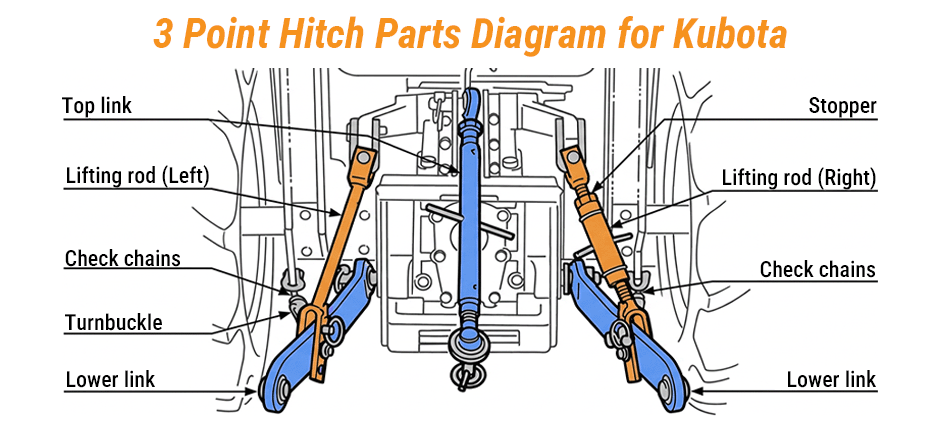
Main Parts In A Kubota 3 Point Hitch Parts Diagram
A Kubota 3-point hitch parts diagram is most useful when one part is missing, bent, loose, or difficult to identify. Before checking part numbers, look at the hitch as a full system. On many Kubota tractors, the core structure is similar, but the exact parts still vary by model.
Here are the main parts to identify first:
| Part name | Job on the tractor | What to look for in the diagram | Common issue |
|---|---|---|---|
| Top link | Sets implement angle | Upper center link point | Missing after hitch removal |
| Lower links or draft arms | Carry the implement load | Two main lower arms | Bent, missing, or side mismatch |
| Lift rods | Raise and level the lower links | Vertical or angled links from the rockshaft to the lower arms | Wrong length or hard to match |
| Stabilizers or sway control parts | Limit side movement | Turnbuckles, bars, telescoping rods, or chains | Missing hardware or wrong type |
| Hitch pins | Connect arms and link points | Small connection pieces throughout the diagram | Lost during service |
| Retaining clips or cotter pins | Keep pins in place | Clip symbols near pin locations | Often missing during reassembly |
| Brackets | Support links, rods, or stabilizers | Plates or mounting supports | Easy to overlook until installation |
Part names are not always presented the same way across diagrams and listings:
- The lower link and draft arm often refer to the same main arm
- The lift rod may also appear as a leveling rod
- A stabilizer may mean a turnbuckle, sway chain, or telescoping bar
- Pins and clips are usually separate parts, not one set
This is why a Kubota 3-point hitch parts diagram matters. It shows both the name of the part and where it fits in the assembly.
Quick Visual Order
If the hitch parts are laid out before installation, identify them in this order:
- Two lower links
- One top link
- Two lift rods
- Two stabilizers or sway control parts
- Mounting pins
- Retaining clips
- Brackets and bushings
That order makes it easier to see what is still missing.
How To Read The Diagram Before Ordering Parts?
A parts diagram only helps if it matches the tractor exactly. Many ordering mistakes happen when the tractor series is correct, but the hitch setup is different.
Start with these checks.

Check The Exact Model
BX, B, and L series tractors may all use a 3-point hitch, but the parts are not automatically the same. Even close models can use different lower links, lift rods, brackets, or stabilizer systems.
Check The Serial Range
Some parts listings split the same tractor model by serial number. A small serial break can indicate a change in rod length, pin size, or bracket style.
Check The Hitch Layout
Look at the full assembly, not just the part title. Focus on these points:
- Does the tractor use turnbuckle stabilizers or telescoping stabilizers
- Is the top link bracket shape the same
- Are the lower links straight or offset
- Does the setup include hardware used with a backhoe-ready frame
Check Left And Right Parts
Some Kubota lower links and Kubota lift rods are side-specific. Even if both sides look close in a small diagram image, the parts may not swap side to side.
Check What Is Not Included
This causes many delays during installation. A hitch kit or individual listing may include the main arms but leave out small hardware such as:
- Pins
- Clips
- Bushings
- Brackets
- Stabilizer hardware
That is why the full 3-point hitch parts list matters just as much as the diagram image.
Pre-Order Checklist
| Check item | Why it matters |
|---|---|
| Exact model | Similar Kubota tractors may use different hitch parts |
| Serial number | Early and late production parts may differ |
| Diagram section | Confirms the correct hitch assembly |
| Part orientation | Left and right parts may differ |
| Included hardware | Not every listing includes pins or clips |
| Backhoe setup | Removed hitch systems often use model-specific parts |
This becomes even more important if the tractor has a backhoe installed.
Common Missing Parts After Backhoe Removal Or Reassembly
Many owners need a Kubota 3-point hitch parts diagram after removing a backhoe or after finding that the tractor no longer has a complete hitch setup. In these cases, the major hitch parts may be gone, or the small hardware may be missing even when the main arms are still there.
The most common missing parts include:
- Lower links
- Top link
- Lift rods
- Stabilizer bars or sway chains
- Retaining pins and clips
- Center bracket pins
- Small hardware packed separately from the main hitch arms
On some BX tractors, one common issue is the center hole in the triangular bracket area. The missing piece may be a short retaining pin that keeps the bracket from sliding off the fixed rods. It is a small part, but it affects how securely the hitch stays in place.
What Missing Parts Look Like On The Tractor?
| Missing part | What you may notice | What to inspect next |
|---|---|---|
| Top link | The implement angle cannot be set correctly | Upper bracket and matching pin |
| One or both lower links | No lower attachment points for the implement | Outer hitch mounts and shaft connection |
| Lift rod | One side does not raise or level correctly | Left and right rod length |
| Stabilizer | Implement swings too far side to side | Axle-side and arm-side mount points |
| Pins and clips | Main parts are present but cannot be secured | Full hardware count |
| Bracket pin | Hitch assembly feels loose or shifts in place | Center support area |
A simple way to reduce mistakes is to split the inspection into two parts:
- Identify the missing major parts
- Identify the missing hardware
The first problem is easy to see. The second one often stops the job.
Installation Notes That Matter
Reassembly can take longer than expected when several hitch parts are removed and stored separately. These checks help keep the job simple:
- Lay out all parts before starting
- Compare both sides for symmetry
- Replace worn retaining clips
- Check stabilizer parts for bends or worn holes
- Test the full hitch movement before attaching an implement
This is also a good time to inspect Kubota top links, Kubota hitch pins, and Kubota stabilizer kits if the tractor has been used with several different implements.
Parts Sources And Replacement Planning
Once the missing parts are identified, the next step is deciding whether to replace the full hitch setup or only the damaged pieces. The best choice depends on how complete the current assembly is and how much time you want to spend matching separate parts.
When A Full Kit Makes Sense
A full hitch kit is often the practical choice when:
- Most removable hitch parts are missing
- The tractor came without the original 3-point setup
- The hitch was removed long ago, and the loose parts are gone
- Sourcing each piece one by one takes too much time
When Individual Parts Make More Sense
Separate parts are usually the better choice when:
- Only one rod, arm, or stabilizer is damaged
- The hitch is present, but the hardware is missing
- The tractor uses a bracket or pin style tied to a specific model
- Most of the assembly is still usable
This is where Kubota lower links, Kubota lift rods, and Kubota stabilizer parts should be checked as individual items instead of assuming one universal setup.
Simple Comparison Table
| Replacement option | Best for | Main advantage | Main concern |
|---|---|---|---|
| Full hitch kit | Multiple missing parts | A faster way to restore the system | Must confirm full fitment |
| Individual parts | One or two damaged items | Lower cost when most parts are usable | More time is spent matching each piece |
| Hardware only | Pins, clips, or bushings missing | Quick fix for reassembly | Easy to miss one small item |
That choice often becomes clearer after the hitch is laid out and compared with the Kubota 3-point hitch parts diagram. For owners looking beyond dealer-only options, aftermarket tractor 3-point hitch parts and aftermarket Kubota parts offer practical alternatives.
How To Make Sure The Replacement Parts Will Fit?
Fitment is where time and money are usually lost. A listing may say it fits Kubota tractors, but that does not confirm a match for your hitch assembly.
Use this process before ordering.
Match By Part Number First
If the diagram or parts list gives a part number, start there. The part number is more reliable than a broad model description.
Compare The Part Shape And Size
Check the replacement against the original part or diagram for:
- Length
- Offset shape
- Hole diameter
- Threaded adjustment section
- Pin type
- Bracket shape
Confirm The Tractor Family, Then Verify The Assembly
Some nearby Kubota models share related hitch parts within the same family. Even so, the final match should come from the diagram, the part number, and the assembly layout.
Inspect The Mounting Points On The Tractor
Before installing new parts, inspect the tractor itself:
- Measure pin diameters
- Check bracket wear
- Look for welded repairs
- Confirm mounting tabs are straight
- Inspect bushings for wear
Sometimes a new part looks incorrect when the real problem is wear on the tractor side.
Keep A Simple Parts Record
Once the hitch is sorted out, keep a short record for future service:
- Tractor model
- Serial number
- Hitch kit number
- Individual part numbers
- Pin sizes
- Stabilizer type
- Source used last time
That record saves time the next time a Kubota 3-point hitch parts diagram is needed.
Final Words
Once the hitch layout is clear, the repair usually moves much faster. A good Kubota 3-point hitch parts diagram helps reduce ordering errors and gives you a cleaner path to reassembly. If you need aftermarket replacement parts, FridayParts is a practical place to look, with affordable products, broad compatibility, and a large inventory for tractor and heavy equipment service.
