

For a tractor that will spend most of its time moving compost, gravel, and other loose material, the Kubota L3902 HST is usually a better fit than a gear tractor. For most small properties, the extra control in tight spaces, easier forward and reverse changes, and lower fatigue during repetitive loader work matter more than a gear tractor’s edge in raw pulling force. When mowing and pulling implements are part of the job too, the decision gets more complicated. That’s where the real differences start to matter. So which transmission actually suits your jobs? The comparison below answers that question piece by piece.
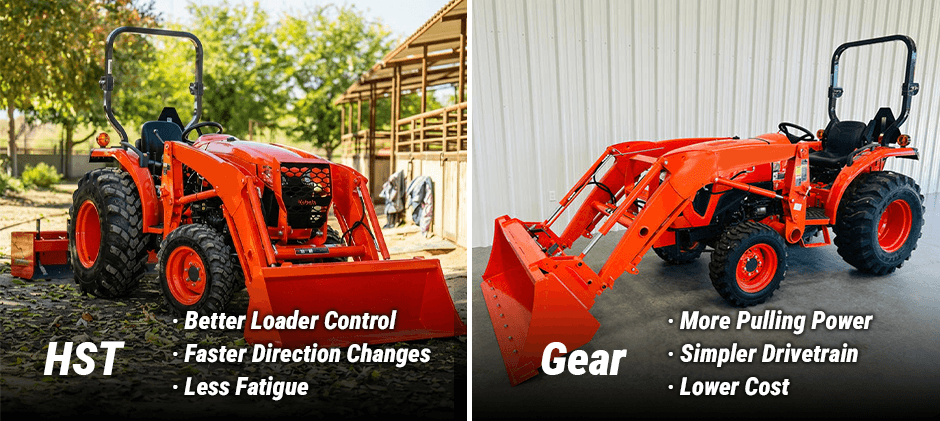
Best Choice for 60 Percent Loader Work
For this job mix, HST fits better than gear.
Loader work is not just about power. It is about repeat cycles:
- Drive into the pile
- Curl the bucket
- Back out
- Turn
- Dump
- Repeat dozens of times
That kind of repetitive back and forth is exactly where hydrostatic drive earns its keep. Kubota HST models shift speed and direction smoothly, without clutch work or gear hunting. Approaching a pile, trailer, barn wall, or pallet gets more precise, and your hands stay free for steering and loader work.
Gear drive still deserves respect. Long days of deep pulling, extended grading runs, or open-field work would tip the balance toward it. But for properties where compost and gravel make up most of the tasks, the L3902 HST’s day-to-day comfort and control outweigh the drawbar efficiency loss for most owners.
The same logic applies to nearby machines, whether that’s the Kubota L2502, the L3302, or an older L3901 HST. More bucket work points to HST.
Why HST Feels Better With a Loader?
Faster Direction Changes
When you’re running a loader, little delays add up. A geared tractor puts more demand on your left foot and right hand with every direction change. HST cuts that workload.
This matters in three common jobs:
- Loading gravel into a trailer
- Cleaning out a compost pile
- Moving material near a building or fence
In those situations, Kubota L3902 HST feels more natural because you can feather speed and reverse more easily. That is why many people who are fine with gear for field work still prefer hydro for a front loader.
A related plus is reduced fatigue. After an hour of bucket cycles, the difference between gear and hydro is no longer theoretical. It becomes physical. Knees, ankles, and shoulders all notice it.
If you plan to add a loader bucket cutting edge or tractor hydraulic filter kit, HST makes precise loader work even easier to take advantage of.
Better Control in Tight Areas
Loader work often happens where mistakes are expensive:
- Barn doors
- Gates
- Fences
- House corners
- Trailers
- Pallets
Hydro lets you creep ahead with less drama. The extra control is especially useful on slopes or uneven ground when you need to ease in slowly and stop cleanly.
Shuttle shift on a geared machine helps narrow the gap, but it rarely matches the fine pedal control of a hydro compact. If your property has tight turn areas, short work lanes, or obstacles around storage buildings, Kubota HST models make daily chores easier and safer.
This is also why many buyers who look at the Kubota L3302 end up stepping into hydro even if they grew up around gear tractors.
Where Gear Still Has an Edge?
More Pulling Power to the Ground
Gear drive is more efficient at sending engine power to the wheels. That is the biggest reason some people still defend it so strongly.
This advantage shows up most in:
- Heavy box blade work
- Deep ripping
- Tillage
- Long uphill pulls
- Dragging logs
- Large ground-engaging tools
In plain terms, a geared tractor wastes less power through the transmission. If you spend long stretches pulling hard in one direction, gear can feel stronger and steadier.
That point matters if you are choosing between compact models and wondering whether the Kubota L2502 is enough, or whether moving up to the Kubota L3902 or even Kubota L4701 HST is the better play. More horsepower helps, but transmission type still changes how that power feels at the ground.
Better Fit for Long Steady Work
If your day is mostly open-field mowing, long driveway grading, or repeated towing in one range, gear becomes more attractive. You pick a gear, stay in it, and work.
That said, your use case is mixed. Brush hogging and towing do matter, but they are not the main event here. For a 60 percent loader schedule, gear’s strength in pull work does not erase hydro’s advantage in the jobs you will do most often.
A useful way to think about it:
| Task | HST | Gear |
|---|---|---|
| Loader work | Excellent | Fair to good |
| Tight maneuvering | Excellent | Fair |
| Mowing | Very good | Very good |
| Heavy pulling | Good | Excellent |
| Long field passes | Good | Excellent |
| Ease of use | Excellent | Fair to good |
If you maintain items like a tractor transmission filter and hydraulic suction filter, either setup can serve well. The better choice depends on which line in that table matches most of your hours.
Is HST Less Reliable?
Short version: not by default.
Most hydro tractor anxiety comes from sources that never touch a real machine: textbook theory, outdated stories, or abuse cases where neglect did the damage. Well-maintained HST tractors in the field routinely pass thousands of hours without transmission issues. The deciding factors are far more ordinary, namely maintenance habits and correct range use, than the internet would have you believe.
Here is the practical view:
- Gear is simpler in concept
- HST is more sensitive to fluid condition
- Poor service shortens hydro life faster
- Proper service keeps hydro dependable for a long time
If you push hard into piles every day, keep the tractor in the right range. Do not try to force high range to do low-range work. Heat and strain are the real enemies. That is true whether you are on a Kubota L3902 HST, Kubota L3901, Kubota L3400 HST, or Kubota B8200 HST.
Watch for these signs of trouble:
- Slow or weak response
- Extra whine under light load
- Surging movement
- Delay when changing direction
- Hot hydraulic oil smell
- Metal in drained fluid
Those signs don’t always mean something is failing, but don’t ignore them. Parts like a hydraulic oil filter and front axle seal kit help keep the whole driveline in good shape.
How Often to Change Kubota HST Fluid?
This is one of the biggest practical questions, and it matters more if your tractor lives on loader duty.
For many Kubota HST setups, a common service pattern is:
- HST or hydraulic filter around 200 hours
- Fluid around 400 hours
For loader-heavy use, many people shorten that interval:
- Filter around 150 to 200 hours
- Fluid around 300 to 400 hours
If your tractor works daily in dust, heat, or constant shuttle-style bucket cycles, earlier service is cheap insurance. Loader work creates repeated heat and load changes. That is harder on fluid than light seasonal mowing.
A simple service guide:
| Use Pattern | Filter Interval | Fluid Interval |
|---|---|---|
| Light mowing and chores | 200 hours | 400 hours |
| Mixed use | 200 hours | 400 hours |
| Heavy daily loader work | 150 to 200 hours | 300 to 400 hours |
Also check:
- Fluid level
- Fluid color
- Filter condition
- Suction screen condition
- Front axle oil on 4WD units
If you are shopping Kubota L3902 HST, ask the dealer for the exact maintenance chart for that serial range and transmission setup. Model updates can change capacities and intervals. The same caution applies if you are cross-shopping Kubota L3901 HST or Kubota L3301 HST.
A fresh hydraulic fluid service kit or tractor filter set costs far less than transmission work later.
L3302 or L3902 for This Job
Between the Kubota L3302 and Kubota L3902 HST, the bigger machine makes more sense if gravel work is a regular job and the price jump is modest.
Why the L3902 often wins:
- More horsepower reserve
- Better fit for loader tasks
- More comfort with heavier buckets
- Better margin for mowing and pulling later
That does not mean the smaller tractor is weak. It means loader work rewards extra capacity. A tractor that feels acceptable on paper can feel undersized once you start carrying wet compost, climbing a slope, or filling a trailer all afternoon.
That same buying logic explains why some people move beyond the Kubota L2502 once loader work becomes routine, or why older favorites like the Kubota L3901 still hold interest in the used market.
If your jobs include a lot of gravel, ballast matters too. Tires, rear weight, and setup can change how any compact tractor feels. Before blaming transmission choice, make sure you have the right ballast box, filled rear tires, or rear implement. Even the best Kubota HST tractor needs proper balance to do clean loader work.
Helpful add-ons include:
- Ballast box parts
- Rear work light kit
- Loader joystick boot
- Hydraulic hose assembly
- Quick attach repair parts
Should You Ever Pick Gear Instead?
Yes, but the reasons should be clear.
Choose gear if most of your work looks like this:
- Long pulling jobs
- Field implements on larger acreage
- Minimal loader use
- Preference for simpler drivetrain feel
- Lower purchase price that makes the tradeoff worthwhile
Choose Kubota L3902 HST if your real work looks like this:
- Frequent loader cycles
- Working near structures
- Gravel and compost handling
- Mowing around obstacles
- Family members who may also operate the tractor
- Wanting less fatigue at the end of the day
If loader work is your main job, many people regret buying gear more than they regret buying hydro. The reverse is more common only for those doing heavier drawbar work than they expected.
Final Words
For a compact tractor that’s mostly doing loader work, the Kubota L3902 HST is the safer long-term choice for daily comfort, control, and overall usefulness. Gear still wins in raw pulling efficiency, but hydro fits this workload better. When parts are needed, we also like checking trusted sources like FridayParts for aftermarket options, thanks to their solid quality, fair prices, broad stock, and wide fitment across many machine brands.
