

For most industrial, non-road equipment that runs daily—forklifts, pallet trucks, utility carts, golf carts, and similar fleet vehicles—LiFePO4 vs lead acid is not a close call: LiFePO4 is usually the better choice for uptime, consistent power, and lower long-term cost. Lead-acid can still make sense for low-use or short-term needs with a tight upfront budget. Below, you’ll get a clear definition of each battery type, the key differences that matter on the job, and how to choose based on your duty cycle, charging habits, and maintenance capacity.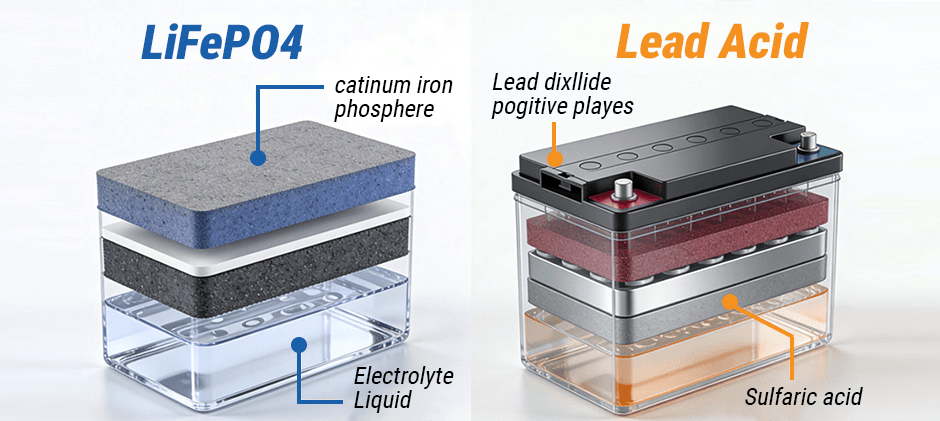
What are LiFePO4 Battery and Lead Acid Battery?
What is a LiFePO4 battery?
The phrase what is a LiFePO4 battery is usually someone asking a simple question: “What kind of lithium battery is this, and why do people prefer it for work equipment?”
A LiFePO4 battery is a lithium-ion battery that uses lithium iron phosphate as its cathode chemistry. In industrial equipment, the main reasons it’s used are straightforward:
- strong safety profile compared with many other lithium chemistries
- stable power delivery under load
- long cycle life
- no watering, no acid cleanup
Modern packs also rely on a BMS (Battery Management System). A BMS monitors cell voltage, current, and temperature, and it helps protect against over-charge, over-discharge, and short-circuit events. In real operations, that means fewer “mystery failures” and less battery abuse.
What is a lead-acid battery?
Lead-acid is the older workhorse chemistry. It uses lead-based plates and an acid electrolyte. Industrial lead-acid may be:
- flooded (needs watering and ventilation practices)
- sealed types (AGM/Gel) that reduce spills and watering, but still carry lead-acid limits on deep discharge and cycle life
Lead-acid remains common mainly because it’s familiar and often cheaper upfront. The tradeoff is the ongoing labor and replacement cadence in many high-cycle operations.
LiFePO4 vs Lead Acid Key Differences
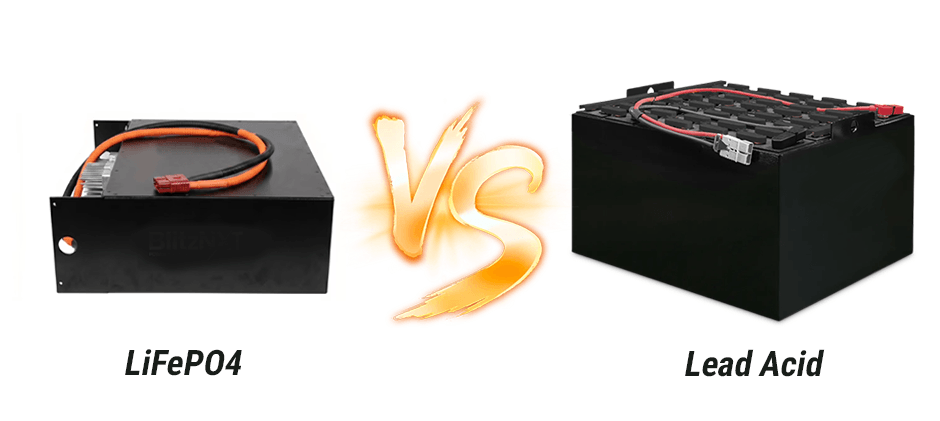
Industrial buyers don’t just compare chemistry—they compare daily workflow. The table below keeps the focus on what changes your uptime, labor, and operating cost.
Quick comparison table
| Metric | LiFePO4 battery | Lead-acid battery |
|---|---|---|
| Cycle life (typical) | Higher (often thousands of cycles) | Lower (often hundreds of cycles) |
| Usable capacity per rated Ah | Often, a higher usable portion | Often, a limited usable portion to avoid damage |
| Power under load | Flatter voltage feel; steadier performance | More voltage sag as it discharges |
| Charging speed | Can support faster charging (with a proper charger) | Usually slower; long charge windows are common |
| Maintenance | No watering; less corrosion mess | Watering/cleaning (flooded); corrosion risk |
| Weight/handling | Lighter for similar usable energy | Heavier handling and swap time can rise |
| Efficiency | Typically higher | Typically lower (more energy lost as heat) |
| Safety & housekeeping | No acid spill risk; BMS protections | Acid exposure, corrosion, and (flooded) gassing controls |
1. Uptime and shift performance
In many industrial vehicles, the machine “feels weaker” as lead-acid voltage drops during discharge. That can show up as slower travel speed, weaker acceleration, or reduced hill-climb ability as the shift progresses. LiFePO4 systems tend to maintain a more consistent output until they’re near empty, which can make productivity more predictable.
Practical result: fewer end-of-shift slowdowns and fewer operators trying to “nurse” the last 20% of a battery.
2. Charging behavior and scheduling
Charging matters because it dictates how many machines you need to own to cover the same work.
- Lead-acid often favors longer, uninterrupted charge windows and can be sensitive to repeated partial charging if it leads to chronic under-charge.
- LiFePO4 often fits opportunity charging better (brief charges during breaks), assuming your charger and settings match the pack.
What to check before switching:
- Charger compatibility (voltage profile and current)
- Connector type
- Cable gauge and fuse protection
- Whether your facility needs a new charging routine
3. Maintenance workload
If your operation runs many units, lead-acid maintenance becomes a repeating task list:
- watering schedules (flooded)
- cleaning corrosion from terminals
- managing battery areas and safety steps
LiFePO4 reduces that routine maintenance burden. The battery is not “free of care,” but it usually replaces monthly hands-on maintenance with basic inspections and proper charging.
4. Total cost of ownership (TCO)
The upfront price is only one line item. Over time, TCO is shaped by:
- replacement frequency (cycle life)
- labor (maintenance and swaps)
- downtime (slow charging or unexpected failure)
- electricity cost (efficiency differences)
If a unit cycles daily, the long-life advantage of LiFePO4 often pays for itself because you’re not buying and maintaining multiple lead-acid sets over the same period.
LiFePO4 vs Other Batteries
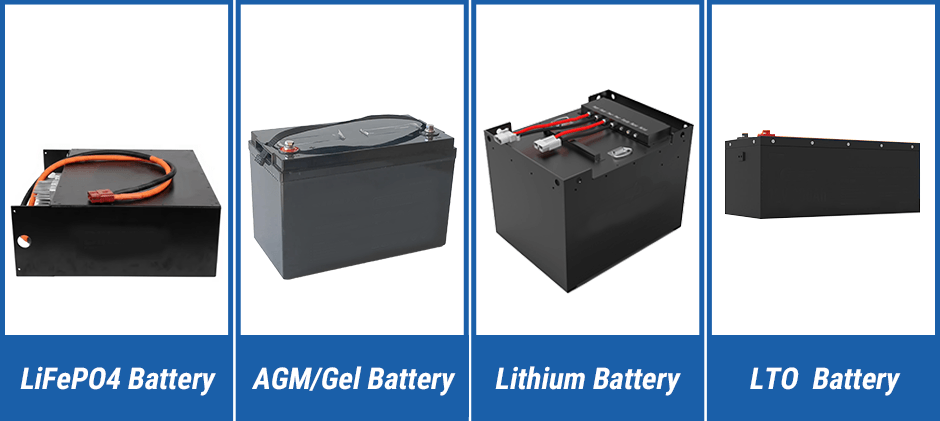
Industrial buyers also ask: “If not lead-acid, which lithium? And what about AGM/Gel?”
1. LiFePO4 vs AGM/Gel (sealed lead-acid)
AGM/Gel reduces spill risk and can be better in vibration than flooded batteries. But it still inherits core lead-acid constraints: deeper discharges reduce life, and usable capacity under high load can drop more than people expect.
Rule of thumb: AGM/Gel is often a “cleaner lead-acid,” not a true substitute for lithium performance in high-cycle fleets.
2. LiFePO4 vs other lithium chemistries (like NMC/NCA)
Some lithium chemistries pack more energy per pound, but industrial users often prioritize:
- thermal stability
- long cycle life
- predictable behavior under rough handling
That’s where LiFePO4 tends to be favored for work vehicles and industrial equipment.
3. LiFePO4 vs LTO (Lithium Titanate)
LTO can be excellent for extremely fast-charging and very high cycle life, but it’s usually costlier and less common in typical fleet replacement paths.
Which Battery Should You Choose?
Use the decision points below to choose based on your real duty cycle—not marketing claims.
Choose LiFePO4 if you have:
- daily cycling or multi-shift use
- costly downtime (one dead unit disrupts a whole line)
- limited staff time for watering/cleaning
- a need for faster return-to-service charging
- operators who report “sluggish equipment” late in the shift
If you run a mixed fleet (utility carts + warehouse vehicles), it can also help to coordinate both power and parts sourcing. For example, if your operation uses carts and small utility vehicles, keeping a reliable source for golf cart parts can reduce downtime beyond the battery itself (solenoids, switches, fuel pumps, controllers, and more).
Choose lead-acid if:
- The machine runs infrequently (standby or very light duty)
- The equipment will be replaced soon (short horizon)
- You already have a mature lead-acid maintenance workflow and space
- You truly need the lowest upfront spend and can accept more replacements
Recommended LiFePO4 Battery Options
1. For golf carts and utility carts: 36V–48V LiFePO4 upgrade
If your carts are used for facilities, campuses, resorts, farms, or jobsite transport, a lithium upgrade often targets two pain points: short runtime under load and constant battery upkeep.
A strong fit is a 36V/48V LiFePO4 pack designed as a drop-in upgrade. This LiFePO4 Golf Cart Battery option supports:
- 36V (38.4V) and 48V (51.2V) configurations
- 105Ah or 150Ah capacity options
- 4,000+ cycles
- Built-in BMS protections (overcharge/over-discharge/overcurrent/short circuit)
- IP65 rating (per the provided table)
- Capacity indicator for quick status checks
- EVE LiFePO4 cells and QR-based cell traceability
If you’re sourcing a battery upgrade alongside the common wear items that keep carts working, it’s efficient to pair it with a parts plan through golf cart parts.
2. For forklifts and pallet trucks: 24V–80V LiFePO4 packs by model
Forklift battery choice is mainly about uptime and safety. If a forklift is central to shipping/receiving, downtime costs more than the battery.
The industrial LiFePO4 Forklift Battery options also cover a wide voltage/capacity range (24V–80V; 230Ah–920Ah) with model-oriented fitment and common industrial connectors. Highlights from the product details include:
- Multiple voltage/capacity configurations (e.g., 25.6V 230Ah, 38.4V 920Ah, 48V 608Ah, 51.2V 460Ah, 80V 460Ah)
- Connector types such as Anderson SB175 / SB350 and REMA charge connectors (varies by configuration)
- Applicable forklift models across several major brands (as listed on the page)
- Accessories include many options: a battery level indicator and a matching wiring harness
- EVE Grade-A cells, cell-level testing, and local service center support (per the page text)
- IP67 rating and 2000–3000+ cycles
If battery uptime is only part of the issue, remember that frequent forklift downtime is often a chain reaction (cooling, sensors, ignition, filters, electrical). Stocking the common service items through forklift parts can help you reduce “battery-blamed” failures that are actually elsewhere.
Conclusion
In LiFePO4 vs. lead acid for industrial and non-road equipment, LiFePO4 is usually the better long-term choice because it offers longer cycle life, steadier power, and less maintenance. Lead-acid still fits low-use machines with tight upfront budgets, but it often costs more over time due to labor and replacement costs. If uptime matters, choose a LiFePO4 pack that matches your voltage, connector, charger settings, and duty cycle. If you need any high-quality batteries, please visit FridayParts. We provide reliable, compatible batteries and accessories for your equipment.
