

A 27 hp mini excavator doesn’t need a warehouse of spares — it needs the right mini excavator parts on the shelf before they fail. The core list is shorter than most owners expect: service filters, bucket and pin hardware, basic electrical spares, and a small hydraulic repair kit cover the vast majority of field breakdowns. Below is a practical stocking plan, with quantities, brand-specific notes for AGT, Kubota, Bobcat and Yanmar, and the mistakes that turn a “common part number” into a useless one.
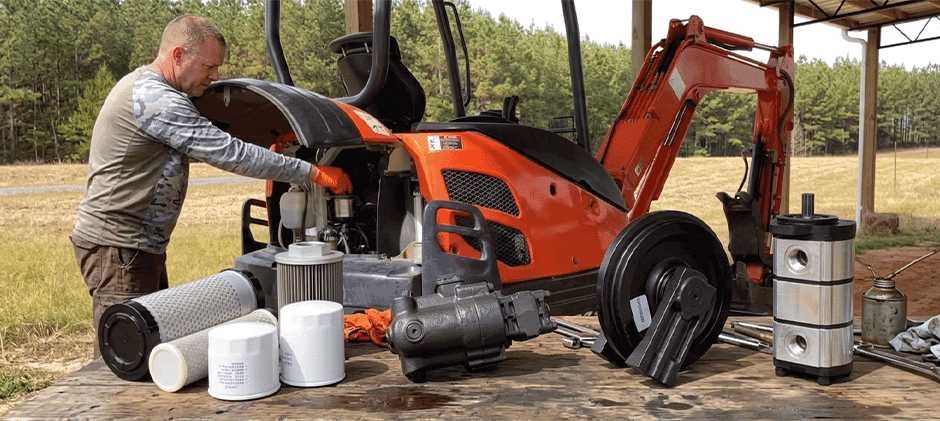
Start With the Parts Daily Service Depends On
Begin with the items tied to routine maintenance and the classic complaints — no-start, hard starting, low power. These earn their shelf space because they’re inexpensive, store easily, and tend to be needed with little warning.
For most 27 hp diesel machines, the core inventory looks like this:
- Engine oil filter
- Fuel filter
- Air filter
- Hydraulic oil filter
- Fan belt
- Coolant hose clamps
- Grease fittings
- Drain plug washers
- Engine oil
- Coolant
- Hydraulic oil
- Fuses and relays
Each of these has a direct line to a common failure mode. A fuel filter shedding debris causes hard starts, sluggish throttle response, and stalling that comes and goes. An air filter choked with dust turns the engine lazy in trenching and grading conditions. And the hydraulic oil filter matters just as much — contamination moving through that system takes out far pricier components downstream.
Machines working in remote areas deserve double coverage of everything on that list. Whether you stock AGT mini excavator parts, Kubota mini excavator parts, or Bobcat mini excavator parts, the rule holds.
How Much to Keep of Each Service Item
| Part | Sensible Stock Level | Why It Earns the Space |
|---|---|---|
| Engine oil filter | 2 to 4 | Consumed at every service interval |
| Fuel filter | 2 to 4 | First line against starting and fuel-flow problems |
| Air filter | 2 | Dusty conditions cut its life short |
| Hydraulic oil filter | 1 to 2 | Shields valves and pump from contamination |
| Fan belt | 1 to 2 | A cheap part that can still park the machine |
| Fuses and relays | Assorted box | Turns electrical faults into five-minute fixes |
Next, Stock the Wear Parts That End a Workday
With service items covered, attention shifts to wear components — the parts that degrade gradually, then suddenly cost you a day of digging.
Bucket and Pin Hardware
Keep these within easy reach:
- Bucket teeth
- Tooth pins
- Retainers
- Cutting edge bolts
- Attachment pins
- Pin clips
- Bushings
Few parts repay their cost faster. Nearly every digging job consumes them, and the damage compounds: worn teeth slow penetration and shift extra load onto the boom, arm, and bucket linkage, while a single lost pin can freeze an attachment swap mid-job.
If your attachments include a trenching bucket, ripper, auger, or thumb, stock spare hardware for each one. On many smaller imported machines, 25 mm pin hardware is the norm — but confirm the actual diameter, usable length, and clip style for your pins before ordering.
Undercarriage Components
Few breakdowns frustrate like an undercarriage failure. A full undercarriage assembly doesn’t belong on most shelves, but the pieces that wear or fail first absolutely do.
Recommended stock:
- Track tension assembly
- Track adjuster bolt
- Track idler wheel assembly
- Top roller, if your model uses one
- Bottom roller, if your model uses one
- A spare rubber track when the current set is already near its limit
- Drive sprocket, if replacement is approaching
The steady search volume around mini excavator undercarriage parts reflects daily reality: travel components grind through mud, stone, and demolition debris on every job. For machines working far from a dealer, one spare rubber track is cheap insurance against a tow.
Plan Ahead for Hydraulic Field Repairs
Hydraulic problems rank among the most frequent on compact excavators, simply because nearly every function rides on oil flow and pressure. You don’t need every major component in stock — but you do need the parts that resolve leaks, minor control faults, and attachment-circuit issues in the field.
A Practical Hydraulic Spares Kit
- Hydraulic hose fittings
- Quick connectors
- O-ring assortment
- Seal assortment
- Pressure regulator
- Pressure relief valve
- Flow control valve
- Cushion valve kit
- Spare hydraulic hoses for the thumb or auxiliary circuit
- Hydraulic thread adapters
The logic is simple: a blown fitting or a cut seal immobilizes a machine just as completely as a catastrophic pump failure. Having hydraulic hose fittings and seals on hand converts a potential tow into a thirty-minute repair.
A cushion valve kit also belongs on the shelf for certain compact models that use assembled swivel or swing valve kits — especially if the machine has a history of swing shock or jerky rotation.
Does a Spare Hydraulic Pump Make Sense?
Occasionally — typically when downtime costs real money and the pump is known to fit multiple machines in the fleet.
A spare pump is justified when:
- Replacement lead times run long
- The machine generates revenue every working day
- The exact pump model is confirmed
- You have the tools and the skill to swap it quickly
Outside those conditions, money is better spent on filters, seals, fittings, and valves. For most owners browsing aftermarket mini excavator parts, those lower-cost items deliver a far better return than capital sitting in an unused pump.
Don’t Overlook Electrical and Starting Components
Small electrical parts account for a disproportionate share of downtime. A large share of no-start complaints trace back to a faulty switch, a blown fuse, a corroded connector, or a tired cable.
Keep the following in a sealed box:
- Ignition switch
- Key set
- Battery disconnect
- Battery terminals
- Ground strap
- Blade fuses
- Relays
- Wire connectors
- Starter relay
- Work light bulbs or LED units
The ignition switch deserves particular attention on compact machines that live outdoors year-round — moisture and vibration are relentless against simple electrical components.
For diesel units, also consider:
- Glow plug set, where fitted
- Starter motor
- Alternator or charging lead
- Temperature sender
- Shutoff solenoid, if your model uses one
Every one of these is small against the hours a no-start machine burns.
Treat “Common Part Numbers” With Caution
Plenty of owners want a ready-made list of common part numbers for mini excavator parts. The idea works only up to a point. Certain sizes and replacement categories recur across brands, but exact fit still hinges on model, serial range, engine, hydraulic configuration, and attachment package.
Patterns you’ll see repeated on small excavators:
- 25 mm pin hardware
- M14 hydraulic fittings on some imported compact models
- Common thread sizes on cushion valve kits
- Standard bucket tooth sizes for narrow buckets
- Filters shared across machines in the same family
Yet one small difference — thread pitch, bypass setting, voltage, connector shape, hose length — can turn a “common” part into an expensive paperweight.
What to Document Instead
Build a file for each machine containing:
- Model number
- Serial number
- Engine model
- Filter part numbers
- Belt part number
- Track size
- Tooth and pin part numbers
- Hydraulic hose size and thread type
- Battery specification
- Fuse and relay ratings
This is where a mini excavator parts diagram earns its keep. With a clear diagram in hand, you can pinpoint the exact linkage pin, track adjuster component, switch, or valve before it gives out — rather than after. For fleets running Kubota, Yanmar, Takeuchi, Volvo, or John Deere machines, it’s worth filing those mini excavator parts diagrams with your service records.
Assemble a Field Kit That Solves the First Breakdown
A field kit exists to get the machine running again, not to rebuild it. Think of it as a survival pack for the failures that actually happen.
Field Kit Checklist
Stash these in the service truck or cab box:
- Fuel filter
- Engine oil filter
- Air filter
- Hydraulic oil filter
- Spare bucket teeth
- Tooth pins and clips
- Spare attachment pins
- Fuse and relay set
- Ignition switch
- Battery disconnect
- Hydraulic hose fittings
- O-ring kit
- Hose clamps
- Wire connectors
- Thread sealant
- Grease gun and cartridges
- Shop towels and gloves
Reserve the shop shelf for the bigger items:
- Rubber track
- Track idler wheel assembly
- Track tension assembly
- Starter motor
- Hydraulic pump
- Drive motor
- Pressure regulator
- Radiator fan
The split keeps things practical: fast-fix items travel with the machine, while the larger mini excavator parts that demand real diagnosis and install time wait at the shop.
Where Brand-Specific Stocking Pays Off
Most compact excavators obey the same logic, but certain fleets benefit from model-focused inventory. Examples:
- AGT mini excavator parts for imported 1-ton to 1.5-ton units
- Chinese mini excavator parts — pumps, switches, track hardware, thumb fittings
- Bobcat mini excavator parts for attachment wear items and undercarriage service
- Kubota mini excavator parts for filters, belts, and hydraulic service items
- Takeuchi mini excavator parts for track and bucket hardware
- Yanmar mini excavator parts for engine-side service components
Running more than one brand? Keep a universal shelf and machine-specific shelves separate. It prevents mix-ups and shaves time off every repair.
Final Words
A smart stocking plan starts with the failures that happen most often, not the parts that look most impressive. Keep the shelf filled with the mini excavator parts that keep a machine earning — filters, wear items, electrical components, and basic hydraulic repair parts. For reliable aftermarket support, FridayParts offers an extensive range — quality products, affordable pricing, broad compatibility, and a large inventory covering many machine brands.
