

A P0402 code on the screen points to one problem – too much exhaust gas is flowing back into the engine. Fresh air gets choked out. Power drops, black smoke appears, and limp mode may follow. This code shows up regularly on diesel equipment – excavators, dozers, loaders, tractors, and harvesters included. A new EGR valve is often the first part people throw at it. That’s usually a mistake. Cleaning the valve and sensor lines resolves most cases. This article explains what causes P0402, how to recognize it, and a step-by-step repair process.
4 Common Symptoms
A P0402 code doesn’t hide—the engine lets you know pretty quickly that something’s wrong. Here are the telltale signs.
- Power loss – you’ll feel it when the machine lags during digging, climbing, or any heavy hydraulic work. The engine just can’t seem to keep RPM up when it’s under load. The reason is simple: exhaust gas is crowding out the fresh air that should be going into the cylinders. Less oxygen in there means less punch from every power stroke.
- Black smoke from the exhaust – incomplete combustion caused by a lack of fresh oxygen. The smoke is usually thick and dark, especially during acceleration or under load. This is not just an emissions issue – it is wasted fuel and lost efficiency.
- Rough idle or stalling – the engine may shake at idle or die completely, particularly during cold starts when the engine needs clean air most. A stuck-open EGR valve lets too much exhaust into the cylinders at idle, where the effect on combustion is most noticeable.
- Limp mode activation – some systems reduce RPM and torque to protect the engine and aftertreatment components. This limits productivity until the issue is resolved. The machine may still run, but it cannot work at full capacity.
Any of these symptoms points back to the EGR system. The engine is not getting enough clean air, and the ECU knows it.
What Causes P0402?
Off-road machines work under conditions that accelerate EGR system failures in ways road vehicles rarely experience. Here are the three main causes.
Carbon buildup from low-load operation
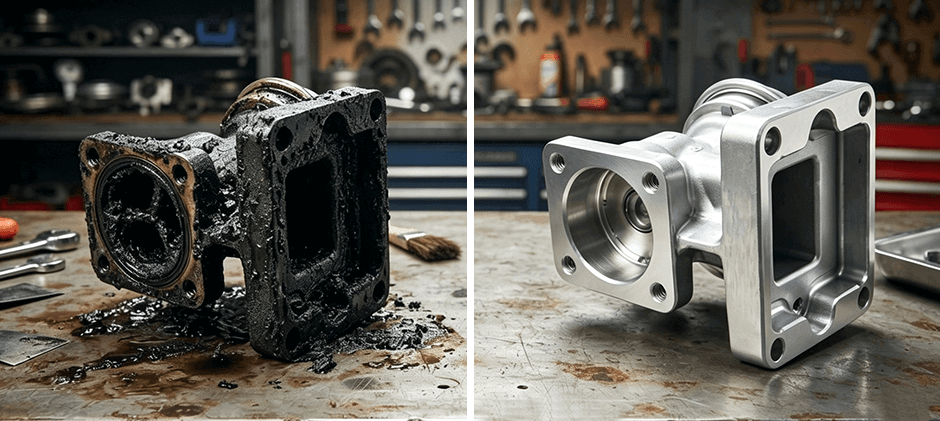
Equipment often spends hours at low idle – waiting for trucks, positioning loads, or moving between work areas. At low combustion temperatures, the exhaust produces wet soot that sticks to EGR valve stems. This carbon layer builds up over time. Eventually, it overcomes the return spring force and holds the valve partially open. That alone is enough to trigger P0402. The valve does not need to be fully stuck – even a small gap lets too much exhaust gas through and confuses the ECU. The carbon also accumulates on the valve seat, preventing full closure even when the actuator moves correctly.
Vibration damage to piping
Excavators, dozers, and loaders work on rough terrain. The constant shaking takes a toll on metal EGR tubes and rubber connectors. Hairline cracks develop at weld points over time. Clamps work loose from vibration. A small leak anywhere in the EGR circuit throws off the entire flow calculation. The ECU expects a certain pressure reading, and when it does not match, it logs the code. This cause is often overlooked because the leak may not be visible without close inspection. A crack that opens only under heat and pressure can be especially hard to find.
Contaminated sensor sampling lines
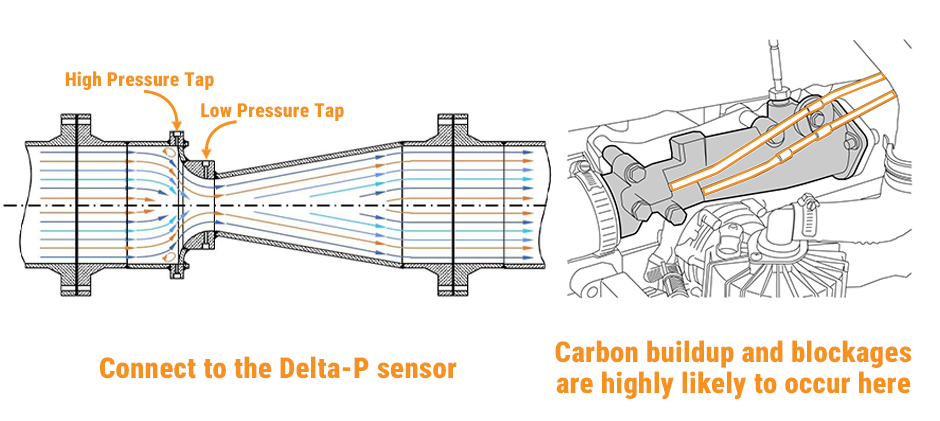
The Delta-P sensor measures the pressure difference across a venturi tube in the EGR circuit. The sampling lines that connect the sensor to the venturi are narrow – roughly the diameter of a pencil lead. Soot particles and moisture combine inside these lines to form sludge. Over time, the sludge hardens and blocks the lines completely. When that happens, the sensor reads high pressure even with the EGR valve closed. The ECU sees that high reading and assumes too much exhaust is flowing, triggering a false P0402. This is one of the most common and most misdiagnosed causes. Many technicians replace the sensor itself without checking the lines, only to find the new sensor reads the same way because the lines are still blocked.
Less common causes
While the three causes above account for most P0402 cases, a few other issues can trigger the code. A failed Delta-P sensor can send incorrect voltage signals even with clean lines. ECU software calibration issues may cause false triggers on some engine models. Exhaust backpressure from a restricted DPF can also affect EGR flow readings. These are less frequent, but they are worth keeping in mind if the common fixes do not work.
How to Fix P0402 – Step by Step
Skip the guesswork. Follow this sequence to find the real problem without replacing parts unnecessarily.
Step 1: Start with Live Data
Connect a heavy-duty scan tool to the diagnostic port. Monitor two things at idle:
- EGR valve commanded position versus actual position feedback
- Delta-P sensor voltage
If the command reads 0% but the actual position shows the valve open, the valve is mechanically stuck. If Delta-P voltage stays high with the valve commanded closed, the likely problem is blocked sampling lines or a failed sensor. Live data takes the guesswork out of the diagnosis and tells you where to look first. Write down the readings before clearing the code – this gives you a baseline for comparison after repairs.
Step 2: Check Piping and Connections
Before taking anything apart, do a visual inspection. Look for:
- Cracks or soot stains on EGR cooler tubes.
- Soft spots, swelling, or tears in rubber couplers.
- Loose clamps—a common issue on high-vibration machines.
This inspection takes five minutes and has solved many P0402 cases without further work. A loose clamp or cracked hose is a cheap fix compared to replacing an EGR valve. Pay special attention to the EGR cooler on the intake manifold pipe – this area sees high heat and vibration.
Step 3: Clean the Delta-P Sampling Ports
If the piping looks good, move to the sensor lines. Remove the metal tubes from the venturi ports. Spray carbon solvent into both ports. Use compressed air to blow through – but always direct the air away from the sensor diaphragm to avoid damage. Reinstall the lines and clear the code. Run the machine and see if the code returns. If it stays clear, the problem is solved. If the code reappears, continue to the next step. Some machines require a short test run under load to confirm the fix – idling may not be enough to trigger the fault again.
Step 4: Test and Clean the EGR Valve
Use the diagnostic tool to command the EGR valve to open and close. Listen for a sharp metallic click when the valve seats. If the valve responds slowly or does not seat fully, remove it for cleaning. Soak the valve body in carbon remover – but never submerge the electronic actuator or solenoid. Scrub the valve face and seat until they sit flush with no gaps. If the return spring has lost tension or the actuator is damaged, replacement with a new EGR valve assembly is the correct fix. Do not try to repair a damaged actuator – it will fail again. When reinstalling, use a new gasket and torque the bolts to specification.
Step 5: Check Wiring and Connectors
Off-road vibration takes a toll on electrical systems. Examine every connector in the EGR circuit. Look for pushed-out pins, corrosion on terminals, or chafed wires where insulation has worn through against metal edges. A broken wire or poor connection can cause intermittent EGR valve operation and trigger P0402. Repair any damaged wiring or replace connectors as needed. Electrical issues can be intermittent, so check the harness while flexing it gently – this can reveal breaks that are not visible when the harness is at rest.
Diagnostic Reference Table
| Diagnostic Step | What to Check | What It Tells You |
|---|---|---|
| 1. Live data | Commanded vs. actual EGR position, Delta-P voltage | Sticky valve or sensor signal issue |
| 2. Visual inspection | Piping, couplers, clamps | Leaks from vibration damage |
| 3. Clean sampling ports | Delta-P sensor lines | Blocked ports causing false readings |
| 4. Test the EGR valve | Valve response and seating | Carbon binding or actuator failure |
| 5. Check wiring | Connectors, pins, insulation | Electrical faults from vibration |
Prevention for the Long Run
Preventing P0402 from coming back is easier than fixing it repeatedly. Here are key practices that make a real difference.
- Limit unnecessary idling – keep it under 10 minutes when possible. Low-load operation produces the wet soot that causes most buildup problems. If the machine must idle for extended periods, consider raising the idle speed slightly to increase combustion temperature.
- Use low-sulfur fuel – high-sulfur fuel doubles the rate of sludge formation in the EGR system. Quality fuel pays for itself in fewer repairs. Test fuel from bulk storage tanks regularly to catch contamination early.
- Replace crankcase ventilation filters – oil mist from the crankcase mixes with soot to form a hard varnish that jams EGR valves and sensor lines. This is especially important on high-hour machines where blow-by is greater.
- Shorten EGR cleaning intervals in dusty conditions – dust and soot together create abrasive sludge that accelerates wear. In extreme environments, cleaning the EGR valve every 500 hours may be necessary.
- Keep the cooling system in good condition. EGR coolers can clog with soot or develop internal leaks. A plugged cooler reduces flow and changes pressure readings. A leaking cooler can send coolant into the intake, creating white smoke and damaging the engine.
Final Thoughts
P0402 is a common code on diesel equipment – excavators, loaders, dozers, tractors, and harvesters all see it. The usual causes are carbon buildup, vibration-damaged piping, and blocked sensor lines. A systematic check using live data and visual inspection solves most cases without expensive guesswork. When parts do wear out – whether it is an EGR valve assembly, a Delta-P sensor, or an engine wiring harness – FridayParts offers reliable aftermarket options that fit a wide range of machines at prices that make sense for working equipment.
