

If you’re dealing with rough shifts, delays when putting it in gear, or a transmission that won’t budge from one gear, the Transmission Control Module is a good place to start looking. The TCM is the brain behind shift timing, line pressure, and torque converter lockup, and when it starts acting up, it can easily pass for a mechanical failure. The good news is that the fix might be easier than tearing into the transmission—and often, a simple reset is all it takes. This guide covers TCM diagnosis, testing, and a reset procedure to restore proper function.
How to Diagnose the TCM?
Diagnosis is the most important step. Resetting a healthy Transmission Control Module will do nothing, and resetting a mechanically damaged transmission will waste time. Start with a structured approach.
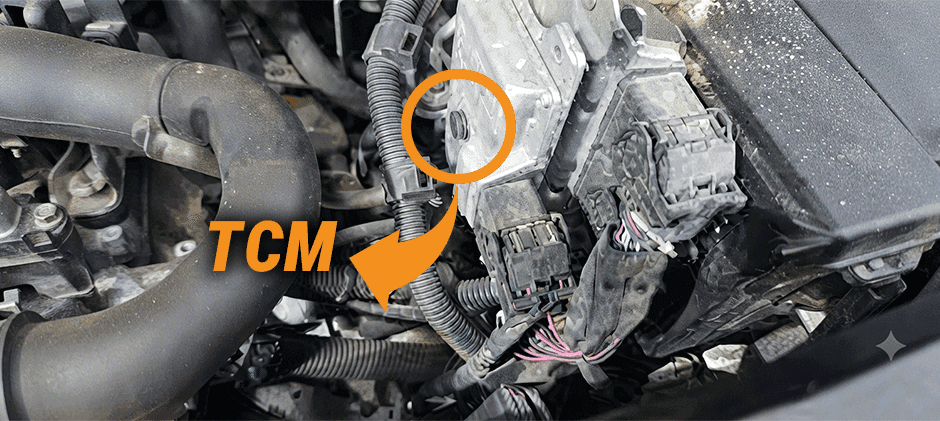
Locate the Module
The TCM can be in different places depending on the design. Some machines have it bolted to the transmission case. Others place it behind a cab panel or inside an electrical enclosure. On certain setups, the TCM is integrated with the engine control unit as a single powertrain module. Always check the service manual for the exact location before starting any work.
Read the Fault Codes
Connect a diagnostic tool that communicates with the transmission controller. Record all active and stored codes. Pay special attention to codes related to shift solenoids, speed sensors, or internal module faults. A general code like P0700 indicates a transmission control issue, but it does not tell you the root cause. Manufacturer-specific codes (often five characters starting with P, C, or U) provide more detail. For example, certain brands use codes like P16F8 to indicate an internal module failure, but the exact meaning varies by make and model. Codes tell you where the system sees a problem, not what caused it. Always look up the code definitions for your specific machine.
Check Power, Ground, and Wiring
A surprising number of Transmission Control Module issues come from bad connections. Perform these checks:
- Inspect the battery and chassis grounds for corrosion or looseness
- Test the power feed to the TCM with a multimeter (should match battery voltage)
- Check the fuse and relay for the transmission control circuit
- Examine the wiring harness for chafing, exposed copper, or burned insulation
If the wiring has rubbed through on a metal edge, repair the harness and secure it properly. Corroded terminals at the TCM connector can also cause intermittent issues. Clean them with electrical contact cleaner and apply dielectric grease.
Make the Decision
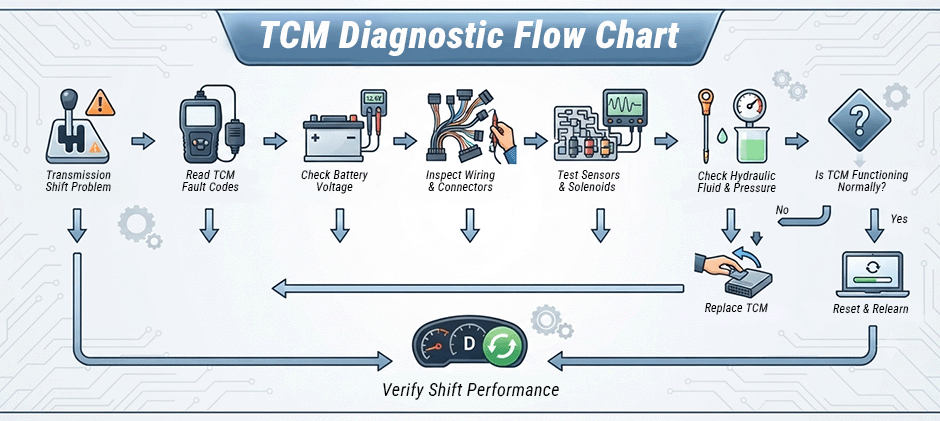
Once the physical checks are done, decide whether to reset, repair, or replace:
| Diagnosis Result | Action |
|---|---|
| Wiring fault, blown fuse, or bad sensor | Repair the faulty part. A reset is not needed. |
| No wiring issues, but poor shift quality remains | Proceed with a TCM reset and relearn. |
| Internal TCM hardware fault | Replace the TCM or the complete control valve body. |
Resetting is only effective when the hardware is sound and the adaptive memory is corrupted.
How to Reset the TCM?
There are two reset methods for the Transmission Control Module. The first is quick but limited. The second requires a diagnostic tool and is the proper way to clear adaptive values. The exact behavior of each method depends on the controller brand and generation.
Method 1: Power-Down Reset
This method removes power from the module to clear temporary memory.
- Turn the machine off and remove the key
- Disconnect the negative battery cable
- Wait 10 to 15 minutes for the capacitors inside the TCM
- Reconnect the battery and start the engine
The effect of this procedure varies by controller type. On some TCMs, it only clears fault flags and temporary glitches. On others, especially older units, it also erases the Keep Alive Memory (KAM) that stores learned adaptive values. You need to consult the service manual for your specific machine to know what this reset actually clears. Do not assume that a power-down reset has fully cleared the adaptive memory—it may not.
Method 2: Professional Adaptive Reset
This is the proper reset method for shift quality issues. It uses a diagnostic tool to clear the learned values that the TCM has stored over time.
- Connect the diagnostic tool to the data link connector
- Navigate to the transmission control module menu
- Select the function for resetting adaptive values (the exact name varies by tool brand)
- Follow the screen prompts to complete the reset
- Turn the ignition off for at least 10 seconds
Different controller brands use different terminology. Allison calls it “Reset T/A Values.” ZF uses “Adaptation Reset.” Caterpillar integrates the function within the ET software. Using the wrong tool or the wrong procedure can fail to clear the values or, in some cases, cause the controller to revert to a default state that requires a full calibration reload. Always use the tool and procedure recommended for your specific transmission.
Important warning: A reset cannot fix hardware problems. If the transmission solenoids are sticking or the clutch packs are worn, the reset will not help. The symptoms will return within a few operating hours. Replacing a faulty valve body gasket is a common step before resetting to ensure hydraulic pressure is stable. See the full guide on transmission solenoid symptoms, causes and fixes here.
After Reset: The Re-Learn Process
The reset is not the end. Once the adaptive values are cleared, the TCM has no memory of clutch fill times or shift characteristics. It must go through a relearn cycle to restore smooth operation. The exact steps vary by transmission model, but the principle is the same.
Why Is Relearning Required?
The Transmission Control Module learns how the transmission behaves over time. It adjusts solenoid currents to achieve the correct shift feel. When the memory is cleared, the module returns to generic default settings. These defaults do not match the wear state of your clutches. Driving with default settings can cause harsh shifts or slipping. The relearn cycle allows the TCM to re-measure the clutch behavior.
How to Perform the Relearn?
The machine must be operated under controlled conditions. Follow these general steps:
- Warm the transmission fluid to normal operating temperature (check the temperature value on the diagnostic tool)
- Drive the machine through a series of upshifts at light throttle (about 25-30% throttle opening)
- Hold the throttle steady during each shift
- Repeat the acceleration and deceleration cycle at least five times
- Stop the machine and shift through all ranges (Neutral to Drive, Neutral to Reverse), pausing 3 to 5 seconds in each gear
- Repeat the gear range cycling five times
During this process, the TCM measures how long each clutch takes to fill and adjusts the solenoid commands accordingly. It is important not to interrupt the process with aggressive throttle inputs or sudden stops.
Verify the Results
After completing the relearn, test the machine under normal working conditions. Smooth shifts should return. If the shifts remain harsh or delayed, the problem is not electronic. Consider these possibilities:
- Worn clutch packs
- Sticking shift solenoids
- Internal hydraulic leaks
- Incorrect fluid level or degraded transmission fluid
In these cases, a mechanical repair is required. A new torque converter may also be needed if the converter clutch is not holding properly. The TCM reset only reveals that the hardware is the real issue—it does not create a problem that was not already there.
Some operators attempt a reset at the first sign of trouble. This approach often leads to frustration because the symptoms return. A reset is not a cure-all—it is a targeted procedure for specific conditions. The table below summarizes when resetting makes sense:
| Condition | Column 2 |
|---|---|
| Harsh shifts with no fault codes | Often effective after relearning |
| Delayed engagement that worsens over time | May help if the adaptation is off; inspect solenoids first |
| Internal module fault code | Not effective; replace the TCM |
| Stuck in limp mode after sensor failure | Reset after repairing the sensor |
| Random shift flare with no pattern | Check and replace the valve body gasket before resetting |
A reset can resolve purely memory-related issues. But it cannot restore a worn-out transmission. If the relearn process fails to improve behavior, prepare for internal repairs. For replacement components like transmission solenoids, valve body parts, or torque converters, verify the correct part number and specifications before ordering.
Final Thoughts
A structured diagnosis saves time and avoids wasted effort. Checking wiring, reading codes, and verifying power takes less than an hour with the right tools. That hour can prevent unnecessary parts replacement and keep the machine productive. A reset is only effective when the hardware is sound and the adaptive memory is corrupted. When replacement parts are needed, FridayParts offers a range of aftermarket options that fit various drivetrain configurations. Keeping the TCM and hydraulic system in good condition ensures longer service life and lower operating costs.
