

Do you really understand your planetary gears in your heavy equipment? When your excavator loses pulling power, your bulldozer drifts to one side and your tractor struggles to deliver power to the rear wheels, the culprit is often your planetary gear system. Understanding how they work, what they do, and how to spot trouble early can save you from unexpected downtime and costly repairs.
What Is A Planetary Gear?
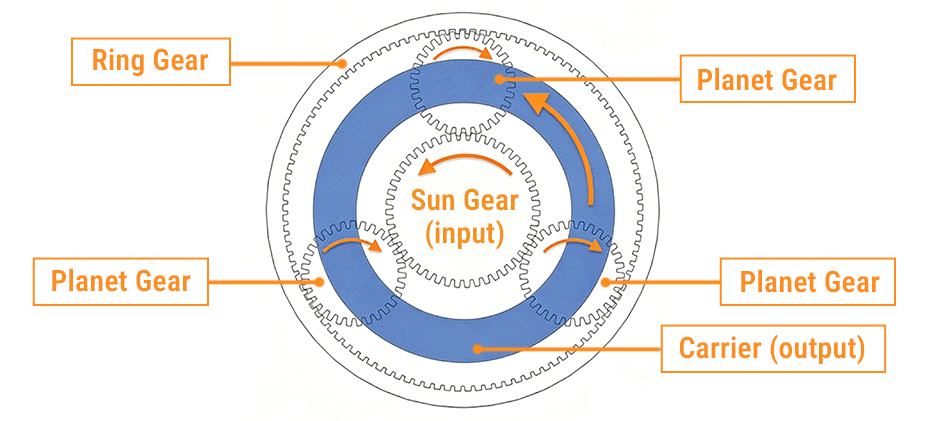
A planetary gear set is a central component in modern transmissions. It usually has a central sun gear and one or more fixed surrounding planet gears. These gears are held in place by a rotating carrier and mesh with an outer ring gear, or annulus. The gear is compact and enables smooth shifting and efficient power delivery from the engine to the wheels, making it ideal for automatic transmissions.
How Do Planetary Gears Work?
A planetary gear consists of a sun gear, planet gears, a ring gear and a carrier. All these components work together as a planetary carrier within a highly efficient planetary gear train. The sun gear is the central gear to receive power directly from the motor or input shaft; the fixed planet gears rotate around the sun gear and distribute the load evenly; the planet carrier holds the planet gears and transfers the combined rotational force; the ring gear encases the planet gears, facilitating torque distribution to the output shaft. These interconnected gear systems enable precise load distribution and consistent torque transfer across all contact points. These features have made it widely applied in agricultural machinery and construction equipment.
What Role Do Planetary Gears Play in Heavy Equipment?
In heavy equipment, the planetary gear system acts as the critical link between a hydraulic motor’s output and the real-world forces needed to move machines, rotate structures, and lift loads. Without it, the raw power generated by the engine and hydraulic system would never translate into the controlled, usable force to get work done.
Here’s where you’ll find it doing critical work:
- Final Drive: The planetary gear inside the final drive assembly takes the output from the travel motor and reduces speed while multiplying torque. And it transfers that force directly to the drive sprocket to propel the machine across the ground.
- Swing Drive: In excavators, the swing drive contains a planetary gear reduction system, enabling the smooth, powerful 360-degree rotation of the upper structure. Without it, the hydraulic swing motor alone could never generate the torque needed to rotate a fully loaded machine.
- Travel Motor: The internal planetary stage within the travel motor regulates walking speed and tractive effort, giving operators control over machine movement across varying terrain conditions.
- Winch and Hoist Systems: In cranes and lifting equipment, planetary gear reductions are essential for achieving the controlled, precise pulling and lifting forces required for safe load handling.
Signs Your Planetary Gears Are Failing
Planetary gear sets are robust by design. But they can wear out over time, especially under heavy loads and extreme environments. Catching the early warning signs is essential to save you from a full drivetrain rebuild. Common signs of a bad planetary gear include:
- Grinding, whining or clicking noises from the final drive or swing drive
- Oil leaks around the drive housing due to a sealing failure
- Reduced travel speed or pulling to one side
- Sluggish, jerky, or noisy swing movement
- Metal particles in the gear oil
- Increased fuel or hydraulic oil consumption
If you notice these signs of a bad planetary gear, it is worth checking and replacing yours with high-quality planetary gears.
What to Do When Your Planetary Gear Fails?
Once a planetary gear failure is confirmed or strongly suspected, you can follow the steps to avoid more damage and costs.
- Stop your equipment immediately: If you continue to run a machine with a compromised planetary gear set, it can cause worse problems. A broken gear tooth can circulate through the oil, leading to more severe damage to other components.
- Inspect your planetary gear system carefully: Open the final drive or swing drive housing and inspect all planetary components.
- Replace the entire gear set: If one planet gear is worn, the others have almost certainly experienced similar stress and will fail soon after. Replacing the entire planetary gear set at the same time is always more cost-effective than performing multiple partial repairs.
- Select quality planetary gears: While OEM parts are one option, high-quality aftermarket planetary gears offer a reliable and more cost-effective alternative. Get your Planetary Gears here.
- Refill with the correct gear oil: After reassembly, always refill with the oil grade and quantity specified in your owner’s manual. Using the wrong lubricant is one of the most common causes of premature planetary gear failure.
How to Extend the Life of Your Planetary Gears?
Prevention is always less expensive than repair. A few maintenance habits can help extend the service life of your assemblies.
- Change the final drive oil every 1,000 hours or at least once per year
- Check for damaged or degraded oil seals regularly to prevent contaminants
- Avoid prolonged high-slip track operation
- Check oil levels before each shift to avoid oil starvation-related failures
- Address abnormal noises immediately
Conclusion
Planetary gears have a direct impact on your machine’s productivity, fuel efficiency, and overall reliability. Whether you operate a single excavator or manage a large fleet, understanding how planetary gear systems work and catching the early signs is crucial to the life of your machines. When replacement is necessary, choosing the right gears from a trusted supplier makes all the difference. Our vast range of aftermarket transmission & undercarriage parts is fully compatible with your equipment, so you can get your equipment back to work faster and stay there longer.
