

When your truck AC is not cooling, the problem is usually caused by restricted condenser airflow, low refrigerant, compressor issues, or poor airflow inside the HVAC system. Most AC not cooling problems can be traced to one of these common faults. Some problems are minor and easy to fix, while others require closer inspection or parts replacement. Understanding the most common causes can help you find the right fix faster and avoid unnecessary repairs.
Condenser Airflow
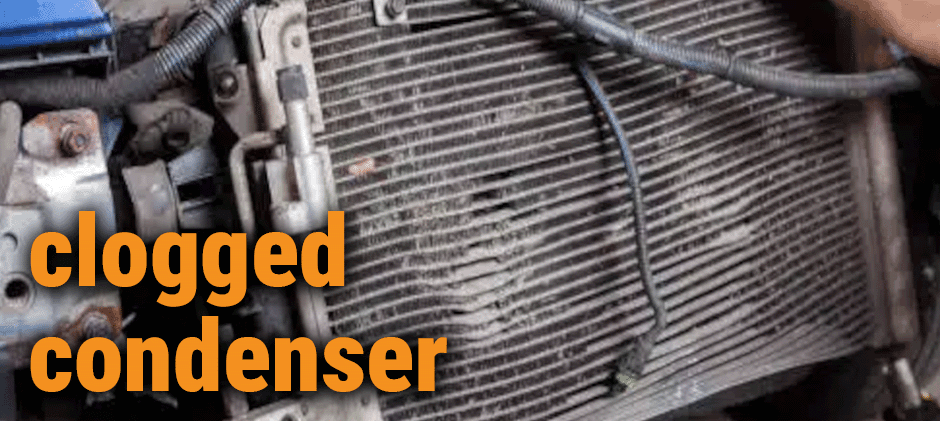
When a truck AC isn’t cooling well, checking the condenser airflow is usually the best place to start. Over time, dirt, bugs, mud, and road debris build up on the fins and block heat transfer. The system may still run, but cooling drops because the refrigerant can’t shed heat fast enough.
This issue becomes more noticeable when the truck:
- Idles for long periods
- Drives in slow traffic
- Runs in high ambient heat
- Has a dirty condenser
- Works in dusty or dirty conditions
A blocked condenser can make the AC feel weak — even if the compressor still kicks in. That’s why you should inspect the condenser early, not late.
Cleaned it, but still have poor airflow? Next steps could be replacing the condenser, checking the cooling fan, or figuring out whether the fan clutch needs replacement.
Cooling at Idle
If your AC cools fine on the highway but goes warm at idle or in stop-and-go traffic, that usually points back to condenser airflow. At low speeds, there’s less natural air moving through the condenser. So the system relies more on the fan and clean cooling surfaces.
Common complaints include:
- The AC is colder while driving than while stopped
- Cooling is better in the morning than later in the day
- The air gets warmer in slow traffic
- Cooling improves when engine speed increases
This does not automatically mean the compressor is failing. In many cases, the system cannot reject heat well enough at idle. Restricted condenser airflow, weak fan performance, or heat buildup around the engine compartment are more likely starting points.
For that reason, cooling loss at idle should be treated as a diagnostic clue, not just a symptom.
Low Refrigerant
Low refrigerant is still a very common reason a truck’s AC doesn’t cool well. Over time, vibration, worn hoses, aging seals, and fatigued fittings cause slow leaks. The system may cool okay for a while, but performance gradually drops as the charge goes down.
Signs that support a low-charge condition include:
- Cooling fades during operation
- Vent temperature rises in hot weather
- Compressor cycling becomes irregular
- Oil residue appears near hoses or fittings
Adding refrigerant without checking for leaks is usually only a short-term fix. It is better to inspect the system first and identify where the charge is being lost.
If leakage is confirmed, the repair may involve AC hose replacement, seal service, receiver-related parts, or a compressor replacement if testing also shows compressor wear.
Compressor Problems
Compressor faults do happen, especially on older trucks or systems that have been running with poor charge or high heat load. That said, the compressor is also one of the most commonly misdiagnosed AC parts.
A blocked condenser, low refrigerant, or poor airflow through the HVAC system can all act like compressor failure. The cab stays warm. Cooling feels spotty. And the compressor gets blamed — even when the real problem is somewhere else. This is why a complaint of AC not cooling often leads to a compressor swap that doesn’t fix anything.
This is where false compressor failure becomes important. Before replacing the compressor, it is better to rule out three common causes of misdiagnosis:
- Condenser airflow is restricted
- Refrigerant charge is low
- Vent airflow or HVAC airflow is restricted
Possible compressor-related signs include:
- The clutch does not engage
- Pressure does not build normally
- Cooling stays weak after airflow and charge are corrected
- Noise appears when the AC is turned on
If these signs remain after the basic checks, pressure testing and electrical checks should come next. Once the fault is confirmed, AC compressor replacement becomes the correct repair.
Vent Airflow
Not every cooling complaint starts in the refrigerant circuit. Sometimes the air may be cool, but too little of it reaches the cab. Weak vent airflow often comes from a dirty filter, a restricted evaporator, a weak blower motor, or an HVAC door problem.
Typical causes include:
- Dirty cabin air filter
- Restricted evaporator surface
- Weak blower output
- Stuck or damaged HVAC doors
- Debris in the air path
This type of problem can feel similar to poor cooling, but the repair path is different. If air volume is low from the start, it makes more sense to inspect the cabin-side airflow components before assuming the AC system has failed.
In dusty operating conditions, filter restriction is one of the easiest problems to find and correct.
Heat Load
Heat load has a direct effect on truck AC performance. A system that seems acceptable in mild weather may struggle in summer, during long idle periods, or in heavy traffic. In many cases, the problem is not total system failure. It is a loss of cooling reserve caused by limited heat rejection capacity.
At that point, the system can approach saturation under idle conditions. Condenser efficiency drops as airflow decreases, heat rejection slows down, and vent temperature begins to rise, even though major components may still be working.
Cooling performance tends to fall faster when:
- The truck is in direct sunlight
- The outside temperature is very high
- The engine idles for long periods
- The condenser is partly restricted
- Refrigerant charge is already marginal
When heat rejection capacity is limited, the system can still run but lose the ability to hold low vent temperature under real operating load.
This is why poor performance in hot weather often shows up first at idle or in stop-and-go traffic.
How to Diagnose Truck AC Not Cooling?
A short and logical inspection order usually gives the clearest answer.
| Check Item | What To Look For | Likely Meaning |
|---|---|---|
| Vent airflow | Strong or weak air from vents | Weak airflow points to the filter, blower, evaporator, or HVAC path |
| Condenser face | Dirt, bugs, mud, fin damage | Restricted heat rejection |
| Idle vs highway speed | Better cooling at speed | Airflow or fan-side issue |
| Hoses and fittings | Oil traces or leak signs | Low refrigerant or leak condition |
| Compressor operation | Clutch action, noise, pressure response | Compressor or control fault |
| Cabin air filter | Heavy dust or blockage | Restricted airflow into the cab |
A practical order is:
- Check the airflow from the vents.
- Inspect the condenser and the surrounding area.
- Compare cooling at idle and at highway speed.
- Look for leak signs around hoses and fittings.
- Confirm compressor and clutch operation.
- Inspect the cabin air filter and HVAC airflow path.
Common Fixes for Truck AC Not Cooling
Once the symptom pattern is clear, the repair direction becomes much easier.
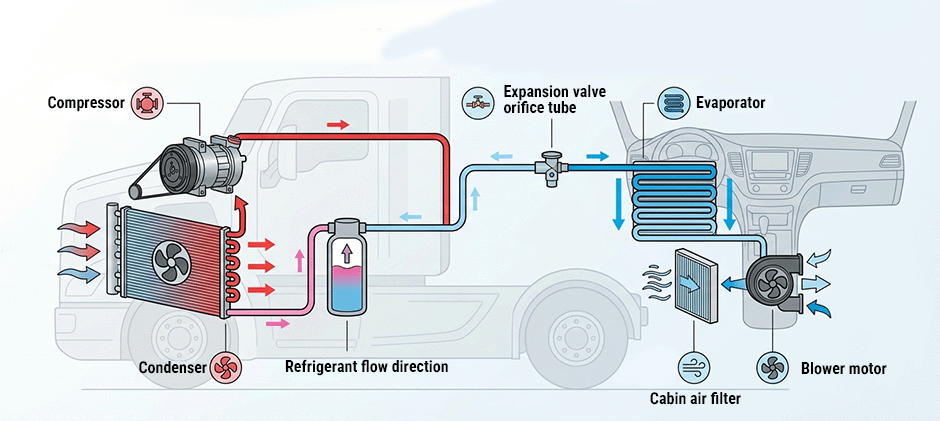
When vent airflow is strong but cooling is weak, start by checking the condenser condition, refrigerant charge, and compressor performance. Trucks that cool better at speed than at idle usually need closer inspection of condenser airflow, fan function, and heat buildup around the front of the system.
Any visible leak signs should be repaired before the system is recharged. Weak airflow through the vents usually points to the cabin air filter, blower components, or HVAC doors. Fan clutch replacement or cooling fan service may be needed when testing shows reduced fan-side airflow. A condenser that is physically damaged or badly restricted may need to be replaced. When system testing confirms internal compressor failure, AC compressor replacement becomes the proper repair.
The key is to match the repair to the symptom pattern instead of jumping straight to the most expensive part.
Prevention
Many repeated truck AC problems can be reduced with basic preventive service. Airflow surfaces and AC components work harder in hot, dirty, and low-speed conditions, so regular inspection matters.
Good preventive steps include:
- Clean the condenser regularly
- Replace restricted cabin air filters on schedule
- Inspect hoses and fittings during service
- Watch for early cooling loss at idle
- Correct minor leaks before cooling drops badly
These checks are simple, but they can help prevent a small cooling problem from turning into a larger repair.
FAQ
Why is my truck’s AC not cooling at idle?
If cooling is weak at idle but improves at higher speeds, the most common cause is limited airflow across the condenser. At idle, the system depends more on fan performance and clean cooling surfaces. A dirty condenser, weak fan support, or heat buildup can all reduce cooling.
Why does it cool fine on the highway but not in a drive-through?
Because at highway speed, air is blasting through the condenser. When you stop, that airflow basically goes to zero. The system still runs, but without airflow, heat has nowhere to go. Your vents end up blowing lukewarm air, not cold.
Why is my truck’s AC not cold in hot weather?
Hot weather pushes the AC system hard. If condenser airflow is limited or refrigerant charge is slightly low, the system may still operate but lose enough efficiency that the cab no longer feels cold.
How do I know if the condenser is plugged up?
Here’s what you’ll notice: weak cooling at idle, better cooling once you hit highway speeds, poor performance on hot afternoons, and cooling that slowly gets worse as the day goes on. One thing to watch – the compressor might still kick in like normal. That’s why a plugged condenser gets mistaken for a bad compressor all the time.
Can low refrigerant look like a bad compressor?
Absolutely. Happens more than you’d think. Low refrigerant will kill your cooling, change how the compressor cycles on and off, and send you chasing the wrong problem. Always check the charge first. Don’t just throw a compressor at it.
Conclusion
Most truck AC cooling problems come from condenser airflow restriction, low refrigerant, compressor weakness, or poor vent airflow. When you’re facing an AC not cooling complaint, the best approach is to separate airflow faults from cooling-system faults first, then inspect in a logical order. If you end up needing parts, FridayParts carries solid aftermarket options that won’t break the bank, with good coverage for many heavy-duty trucks.
