

Buying a box blade isn’t about getting the biggest one your tractor will hold. Go too wide or too heavy, and you’ll run into problems—tire tracks you can’t cover, or a tractor that’s working too hard. The right size is the one that fits your horsepower, covers the rear tires, and actually suits what you’re doing. This guide will help you figure out the right size, sort through the features, and know when a box blade is the tool you need.
What Size Box Blade Do You Need for Your Tractor?
Size is the most important decision. The right width depends on your tractor’s horsepower and the width of your rear tires.
| Tractor Type | Horsepower Range | Recommended Box Blade Width |
|---|---|---|
| Sub-compact | 15–25 HP | 4 feet (48 inches) |
| Compact | 25–40 HP | 5 feet (60 inches) |
| Utility | 45–70 HP | 6–7 feet (72–84 inches) |
| Large Utility | 70+ HP | 7–8 feet (84–96 inches) |
Matching Width to Horsepower
The numbers in the table above are starting points. A 4-foot blade is the max for a sub-compact. A 5-foot blade suits most compact tractors. Utility tractors can handle 6 to 7 feet. Large utility tractors with 70+ HP can pull 7 to 8 feet. Going wider than recommended puts too much strain on the tractor. The blade won’t dig in properly, and you risk stalling or damaging the drivetrain. Going narrower means more passes to cover the same area.
Covering Your Tire Tracks
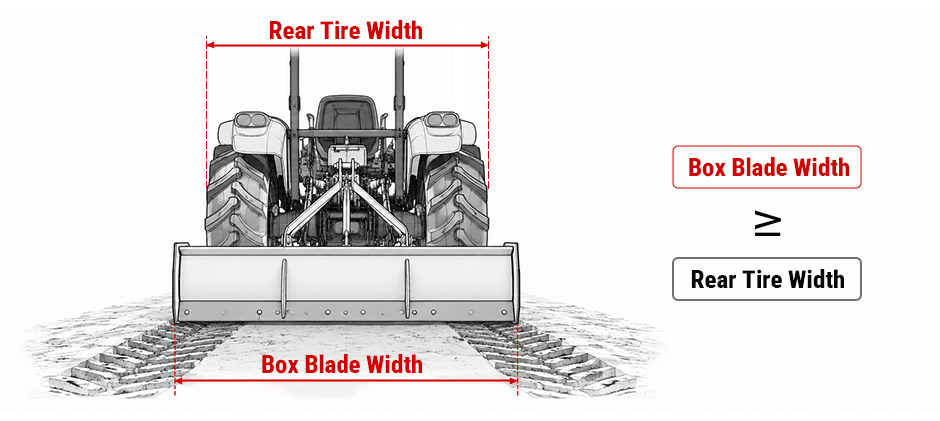
The tractor box blade needs to be at least as wide as your rear tires. If it’s narrower, you will leave tire tracks that you cannot smooth out. Measure your tractor’s rear tire width from outside edge to outside edge. That number is your minimum blade width. The blade should be at least as wide as your rear tires to cover your tracks.
When to Choose a Box Blade for a Tractor?
A tractor box blade is the right choice when your main jobs involve rough grading, moving material, cutting down high spots, and filling low areas. It pulls dirt from mounds and carries it forward, dropping it where you need it. This makes it ideal for:
- Driveway repair and maintenance
- Site preparation and leveling
- Fixing ruts in lanes or pastures
- Breaking up compacted ground
Skip the tractor box blade if your main job is spreading loose material over a large area—a landscape rake works better. If you mostly push snow, a rear blade does that more effectively. A tractor box blade also isn’t the best choice for finish grading; that’s where a land plane takes over.
Key Features to Compare Before You Choose
Once you know the size and have confirmed a box blade fits your needs, compare these features across models.
Scarifier Shanks
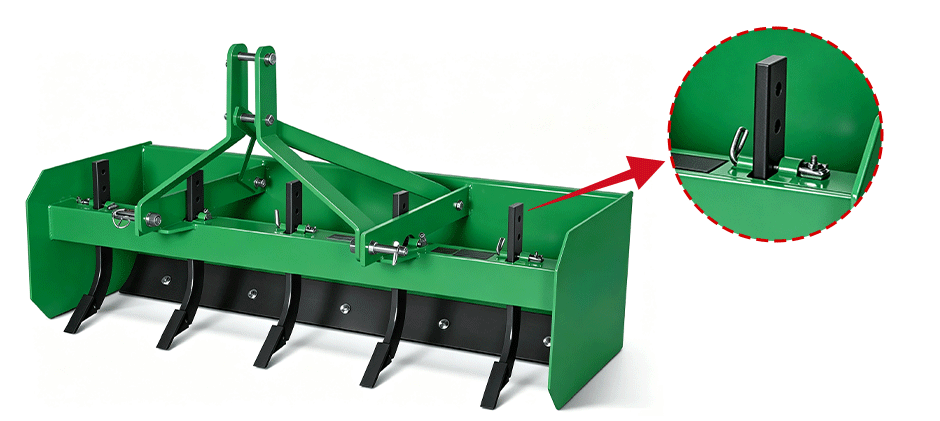
Scarifier shanks (also called ripper shanks) are the teeth at the front that break up hard ground. Look for at least four shanks on a 4- to 5-foot blade, and more on wider models. Adjustable depth settings matter—a shank with multiple pin holes lets you control how deeply it penetrates.
Over time, these scarifier shanks wear down and need to be replaced. A worn shank won’t penetrate hard ground effectively, making the whole job slower. Many tractor box blades use universal-style shanks with replaceable teeth, so you only need to swap the tip when it wears out instead of buying a whole new shank.
Cutting Edges
Good tractor box blades have replaceable and reversible cutting edges on both the front and back. When one side wears out, you flip it around and keep going. When both sides are worn, you replace the edge instead of the whole blade. A cutting edge is a wear item that eventually needs replacement. Getting one with reversible edges saves money over time.
Quick Hitch Compatibility
Some boxes are designed to work with a quick hitch system, which makes swapping between implements faster. If you have a quick hitch, look for a compatible blade.
Electrical & Hydraulic Care
Electrical maintenance matters too. If your box blade uses hydraulic scarifier lift, it depends on a cable harness and controller to operate properly. The system also includes a hydraulic cylinder that raises and lowers the scarifier beam. Over time, cylinders can leak or fail. Replacing a faulty harness, controller, or hydraulic cylinder is often faster than troubleshooting the entire system.
Why Weight Matters for a Tractor Box Blade?
Weight is often overlooked, but it directly affects how well the blade performs. A heavy blade stays on the ground. A light blade bounces, skips, and makes leveling frustrating.
| Box Blade Width | Typical Weight Range |
|---|---|
| 4 feet (48″) | 380–450 lb |
| 5 feet (60″) | 430–500 lb |
| 6 feet (72″) | 500–750 lb |
| 7 feet (84″) | 750–1,000+ lb |
What Happens If It’s Too Light?
The blade bounces over hard or rocky ground instead of cutting in. You end up making multiple passes with poor results. Some operators add weight by placing concrete blocks or steel plates on top of the box. Others fill the box with material during use, which adds weight while working.
But you can’t just add any weight. Your tractor’s 3-point hitch has a lift capacity limit. Before buying, check your tractor’s specs—the blade weight plus any added material must stay within what the hitch can safely lift.
Steel thickness also matters. Blades made with 1/4-inch steel are more durable than those with 3/16-inch steel, especially when working in rocky ground. Heavier construction means the blade holds up longer and stays straight under stress.
Box Blade vs Land Plane vs Rear Blade: Which One Fits Your Job?
These three implements overlap in some ways, but each serves a different purpose.
Box Blade: The All-Rounder
A tractor box blade is the most versatile of the three. It can move a lot of material and is the right choice if you’re reshaping land, fixing driveways, or filling potholes. Best for rough grading, moving dirt, cutting and filling, and breaking up hard ground. Takes practice to finish work.
Land Plane: For a Smooth Finish
A land plane is easier to use and produces a finer finish than a box blade. It’s ideal for maintaining existing gravel roads or smoothing out a surface that’s already close to level. Best for finish grading, driveway maintenance, and smooth surfaces. Can’t move large amounts of material.
Rear Blade: For Ditching and Snow
A rear blade can tilt and angle, which makes it good for cutting ditches or moving snow. It’s less effective for moving material across a job site and harder for beginners to master. Best for ditching, snow removal, shaping slopes, and pushing material. Harder for beginners and moves less material.
Quick Comparison Table
| Implement | Best For | Limitations |
|---|---|---|
| Tractor Box Blade | Rough grading, moving dirt, cutting and filling, breaking up hard ground | Takes practice to finish work |
| Land Plane | Finish grading, driveway maintenance, smooth surfaces | Can’t move large amounts of material |
| Rear Blade | Ditching, snow removal, shaping slopes, pushing material | Harder for beginners, less material movement |
If you can only buy one, a tractor box blade is the smarter choice. It covers more jobs than a land plane or rear blade, even if it takes a bit more practice to get perfect results.
Final Words
Choosing the right tractor box blade means knowing the model, its features, and why weight matters. When scarifier shanks or cutting edges wear out, replacing them is simple—and it keeps the blade performing at its best. FridayParts offers a selection of replacement shanks, teeth, and cutting edges to fit most tractor box blade models.
Related Reading:
