

Nobody wants to go through downtime, especially when it’s so expensive. On this occasion, neglecting the fault code is no other than graveling your own. This guide aims to explain what code P0108 means, what its symptoms are, how to diagnose it, and eventually fix it. Focus on your sensor and learn now.
What Does Code P0108 Mean
Definition: Manifold Absolute Pressure (MAP) / Barometric Pressure Circuit High Input.
The Technical Explanation:
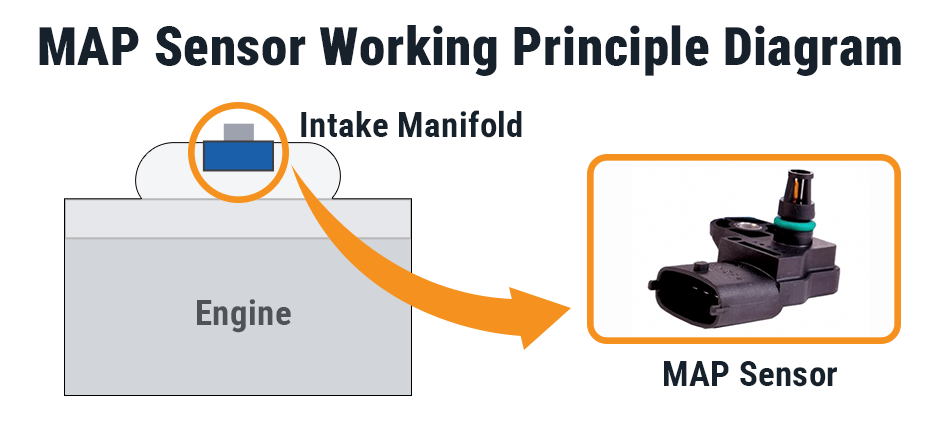
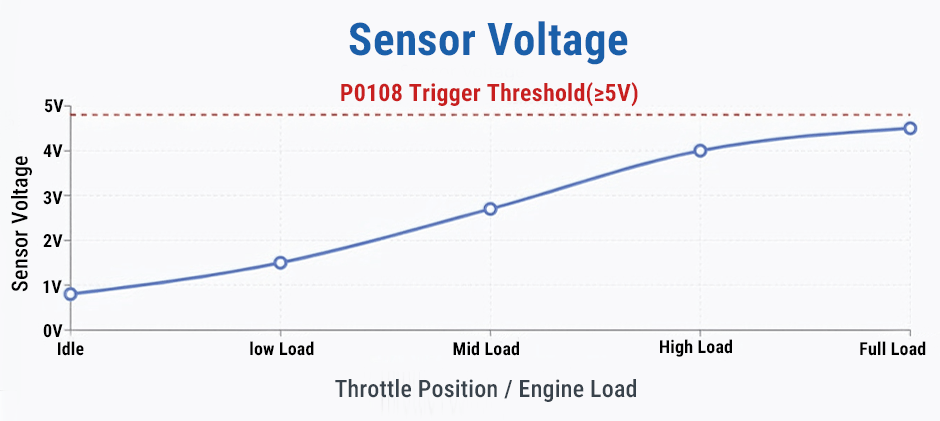
Your engine’s ECU (Electronic Control Unit) relies on the MAP sensor to monitor the air pressure inside the intake manifold. This sensor typically operates on a 5-volt reference scale.
- Low Voltage (approx. 0.5V): Idle or deceleration (High Vacuum/Low Boost).
- High Voltage (approx. 4.5V): Full throttle (High Load/High Boost).
Code P0108 triggers when the ECU detects a voltage signal that is higher than the expected limit (usually above 4.8V or 5V) for a set period. This is similar to other “Circuit High” errors, like the one you might see for a Fuel Level Sensor “A” Circuit High. Essentially, the computer thinks the sensor is “pegged” at maximum pressure, or there is a short circuit sending full voltage into the signal wire.
Common Symptoms in Heavy Equipment
If your loader or excavator throws a P0108, you will likely notice:
- Rough Idle: The ECU thinks the engine is under full load, so it dumps extra fuel, causing the engine to stumble or idle roughly. This can sometimes be mistaken for symptoms of a bad fuel injector.
- Black Smoke: Due to the overly rich fuel mixture. This can also be one of the common symptoms of a clogged DPF.
- Limp Mode / Derate: To protect the engine, the ECU may limit RPMs or power output.
- Hard Starting: The engine struggles to calculate the correct fuel-to-air ratio for ignition.
- Fuel Knock: You may hear a “rattle” due to incorrect injection timing.
3 Common Causes of P0108
Based on standard diagnostics and community discussions (specifically regarding Cummins heavy-duty applications), here are the three main culprits:
1. The “Standard” Failures
- Faulty MAP Sensor: The internal circuitry of the sensor has failed, permanently sending a “High” signal. Many different sensors can fail, such as a Throttle Position Sensor.
- Wiring Short to Power: The signal wire is rubbing against a power wire, feeding 12V or 5V directly into the signal circuit.
- Bad Ground: If the sensor loses its ground connection, the voltage reading can float to the maximum.
2. The “High Performance” Factor
- The Issue: As noted by forum users ThorneRock and AK Bob, this code frequently appears on modified engines (e.g., upgraded turbos or injectors).
- Why: Standard MAP sensors have a physical limit (often around 36 PSI for stock sensors). If your machine is running a high-performance tune or a larger turbo that pushes boost past the sensor’s rating, the sensor voltage hits the 5V ceiling. The ECU sees this “maxed out” voltage as a circuit error (P0108) rather than a valid boost reading.
- The Fix: If your machine is modified, a standard replacement won’t fix it. You may need a 3-Bar or 4-Bar MAP sensor and a revised ECU tune to scale for the higher pressure.
3. The “Electrical Gremlin”
- The Issue: User Muzzy pointed out a critical, often overlooked cause: Batteries and Alternators.
- Why: Heavy machinery vibrates intensely. If your batteries are weak or the alternator has a bad diode (allowing AC ripple), the electrical “noise” can confuse the ECU. A voltage spike in the system can momentarily push the MAP sensor circuit voltage too high, triggering the code.
- The Fix: Always check your battery terminals and alternator output before replacing sensors.
How to Diagnose P0108
Tools Needed: Multimeter, OBDII/Heavy Duty Scanner.
Step 1: The “Unplug” Test
This is the quickest way to rule out wiring issues.
- With the key ON (engine off), view the Live Data on your scanner. It should show high pressure/voltage.
- Unplug the MAP sensor.
- Check the scanner.
- If the reading drops to 0V (or code changes to P0107 Low Input): Your wiring is likely good. The sensor itself is shorted internally. Solution: Replace the MAP Sensor.
- If the reading stays High: You have a short to power in the wiring harness (the wire is touching a voltage source somewhere between the plug and the ECU).
Step 2: Check the Reference Voltage
Use your multimeter on the harness connector (sensor unplugged, Key ON). A guide on how to test an alternator with a multimeter can provide general usage tips.
- Find the 5-Volt Reference pin. It should read roughly 5.0V.
- Find the Ground pin. It should read 0V (good continuity to ground).
If you have 5V and a good ground, but the sensor (when plugged in) outputs 5V constantly, even at idle, the sensor is defective.
Step 3: Inspect for Corrosion
As mentioned in many field reports, check the connector pins. Green crust (copper corrosion) or mud intrusion can bridge the 5V reference wire to the Signal wire, causing a permanent P0108.
Use electrical contact cleaner and apply dielectric grease.
Step 4: The “Battery” Check (Crucial for Heavy Equipment)
If the sensor and wiring test fine, but the code keeps popping up intermittently:
- Load test your batteries.
- Check alternator output.
- Ensure the ground strap from the engine block to the chassis is tight and corrosion-free.
The Solution
If your diagnosis points to a failed sensor, do not settle for cheap, unbranded electronics. Heavy machinery operates in high-heat, high-vibration environments.
FridayParts Recommendations:
- Stock Machines: Replace with a high-quality MAP Sensor from FridayParts. Our sensors are tested to withstand the rigorous vibration of off-road environments.
- Modified Machines: If you are running high boost (over 35-40 PSI), consult with your tuner. You likely need to upgrade to a higher-rated sensor (e.g., 3-Bar) and adjust your ECU parameters to prevent the “Voltage High” error.
Need a replacement Sensor? Visit FridayParts.com to find the exact match for your machinery. We keep you running.
