

Seeing code P2459 on your dashboard is a warning about your emissions system. It means your Diesel Particulate Filter (DPF) is trying to clean itself (regenerate) too often. Most of the time, this happens because the engine is making extra soot or because a sensor is giving the wrong reading—not because the DPF “suddenly failed.”
This guide explains what P2459 means, what usually causes it, and a simple way to diagnose and fix it without wasting money on parts you don’t need.
What Does Code P2459 Mean?
Code P2459 – Diesel Particulate Filter Regeneration Frequency
Your DPF catches soot in the exhaust. When soot builds up, the machine runs a regeneration cycle. Regeneration uses high heat to burn soot into a small amount of ash.
The Engine Control Module (ECM/ECU) sets P2459 when it sees regen cycles happening more often than expected. In plain words, the machine thinks the DPF is filling up too fast.
Clear Statement: P2459 usually does not mean the regen process “doesn’t work.” It means the machine needs regeneration too frequently, so something else may be causing fast soot buildup or false readings.
How Serious is Code P2459?
How serious it is depends on the other symptoms.
- If only the Check Engine Light is on: You likely have time to plan a diagnosis soon. The machine is telling you it is not running efficiently.
- If you also have power loss, derate/limp mode, or constant active regens: Treat it as urgent. A restricted DPF can raise exhaust backpressure, which can hurt the turbo and engine if you keep working it hard.
If the machine starts running worse quickly, don’t “work through it.” Diagnose first.
4 Common Symptoms of P2459
Different machines show different signs, but these are common:
- Check Engine Light is on (or an emissions/DPF warning lamp).
- Regeneration happens too often (more frequent regen lights, higher idle, hotter exhaust, different engine sound).
- Reduced engine power (derate/limp mode to protect the engine).
- Higher fuel consumption (active regen often uses extra fuel to make heat).
Other symptoms you may also see (especially when the problem is engine-related):
- Black or heavy exhaust smoke
- Hard starting or rough running
- Dashboard messages about DPF/regeneration
What Are the Main Causes of P2459?
Before you blame the DPF, check the common root causes below. Many problems start upstream (before the DPF).
1. Faulty Sensors (very common): The system uses a DPF differential pressure sensor (and small hoses) to estimate how full the filter is.
- Cracked hoses, plugged hoses (soot), melted hoses, damaged wiring, or a bad sensor can make the ECU think the DPF is loading faster than it really is.
2. Engine Performance Issues (very common): If the engine makes extra soot, the DPF will fill too fast. Common causes include:
- Leaking/poor injectors
- EGR valve problems
- Boost leaks (split charge-air hose, loose clamp, leaking intercooler)
- Turbo problems (not building boost, worn, or sticking)
Keeping the engine healthy with quality Perkins parts helps protect the DPF system.
3. Problems with the injection system: Bad injection timing or poor spray can raise soot and can also affect exhaust temperature, making regen less effective.
4. Leaks in the exhaust system: Exhaust leaks can change pressure/temperature readings and can confuse the system, causing regen timing problems and codes.
5. Incorrect Operating Conditions: Short run times, long idle time, or very light work may not get hot enough to complete regen. Incomplete regens can lead to faster soot buildup and more regen attempts.
6. Obsolete ECU software (sometimes overlooked): Some machines need an ECU/ECM software update to improve how regeneration is managed.
7. A clogged DPF: Over time, ash builds up in the DPF. Ash does not burn off during regen. Too much ash reduces the space inside the filter, so it fills with soot faster and triggers P2459.
How to Diagnose and Fix Code P2459
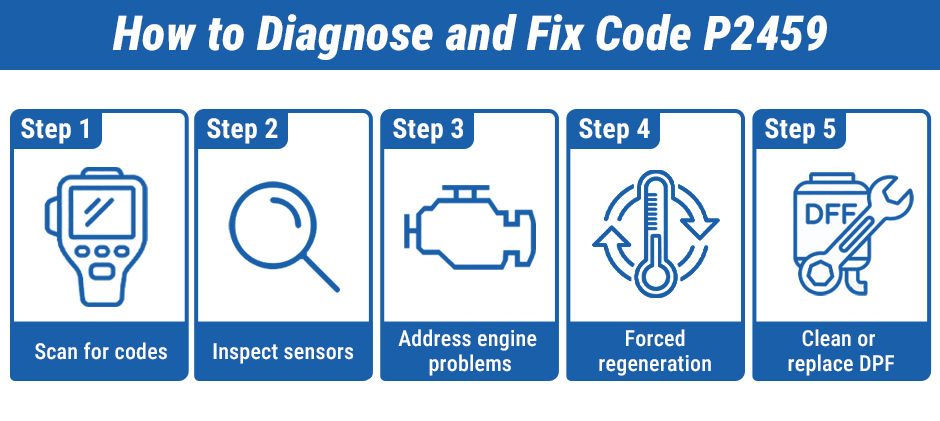
Don’t guess. Use a simple step-by-step plan.
Step 1: Scan for All Diagnostic Codes
Use a scan tool and write down all codes, not just P2459. P2459 is often a “secondary” code caused by something else.
Also look for related DPF codes that can give clues, such as:
- P2002 (DPF efficiency)
- P2458 (DPF differential pressure sensor)
- P2463 (DPF soot accumulation/regeneration intensity)
Then clear nothing yet—save the data first (freeze frame, soot load %, regen history if available).
Step 2: Inspect DPF Sensors and Hoses
Do a careful visual check:
- Differential pressure sensor hoses: cracks, holes, melting, kinks, loose fittings
- Hose ports: soot plugging
- Wiring/connectors: rubbed-through wires, corrosion, loose pins
If you have a service manual, compare sensor readings at idle and under load to the expected range. A sensor or hose issue is often one of the cheapest fixes.
Step 3: Address Upstream Engine Problems
If the engine is making extra soot, the DPF will keep requesting regens.
Check the basics:
- Intake/boost system: look for leaks between turbo → charge air cooler → intake manifold
- Injectors/fueling: watch for rough running, smoke, fuel smell, high fuel trims (if available), or injector balance issues (if your tool supports it)
- EGR system: sticking valves or cooler problems can increase soot
- Turbo health: low boost = poor combustion = more soot
Fix these first. Otherwise, the DPF will clog again even after a regen.
Step 4: Perform a Forced Regeneration
If the machine allows it and the DPF is not dangerously restricted, a technician can run a forced/stationary regeneration with a scan tool.
This can help if the DPF is moderately loaded. But remember:
- Forced regen is not a cure if you still have a boost leak, injector issue, sensor fault, or bad operating pattern.
- If the code returns quickly after a forced regen, that’s a strong sign the root cause is still there.
Step 5: Clean or Replace the DPF
If sensors and engine issues are fixed/ruled out and the DPF is still restricted, the DPF may be full of ash or physically damaged.
- Professional DPF cleaning is often the best next step.
- Replacement is needed if cleaning can’t restore flow or the substrate is cracked/melted.
Do this last—after you stop the soot problem or false sensor readings.
Final Thoughts
P2459 means “regen is happening too often.” It’s a helpful warning because it can point you to issues like a bad differential pressure sensor, exhaust leaks, injector/EGR/turbo problems, or an operating pattern that prevents complete regens. If you diagnose in order, you can often fix the real cause and avoid replacing the DPF too early.
Once your diagnosis is complete, getting the right components is key to a lasting repair. Whether your inspection points to a faulty DPF pressure sensor, a leaking intake hose, or the diesel particulate filter (DPF) itself, FridayParts offers the high-quality, direct-fit components needed to restore your equipment’s efficiency and get you back on the job.
Important note: Code meanings and test steps can vary by brand and model. If you’re not sure, use the machine’s service manual or work with a qualified shop—especially before forced regeneration.
